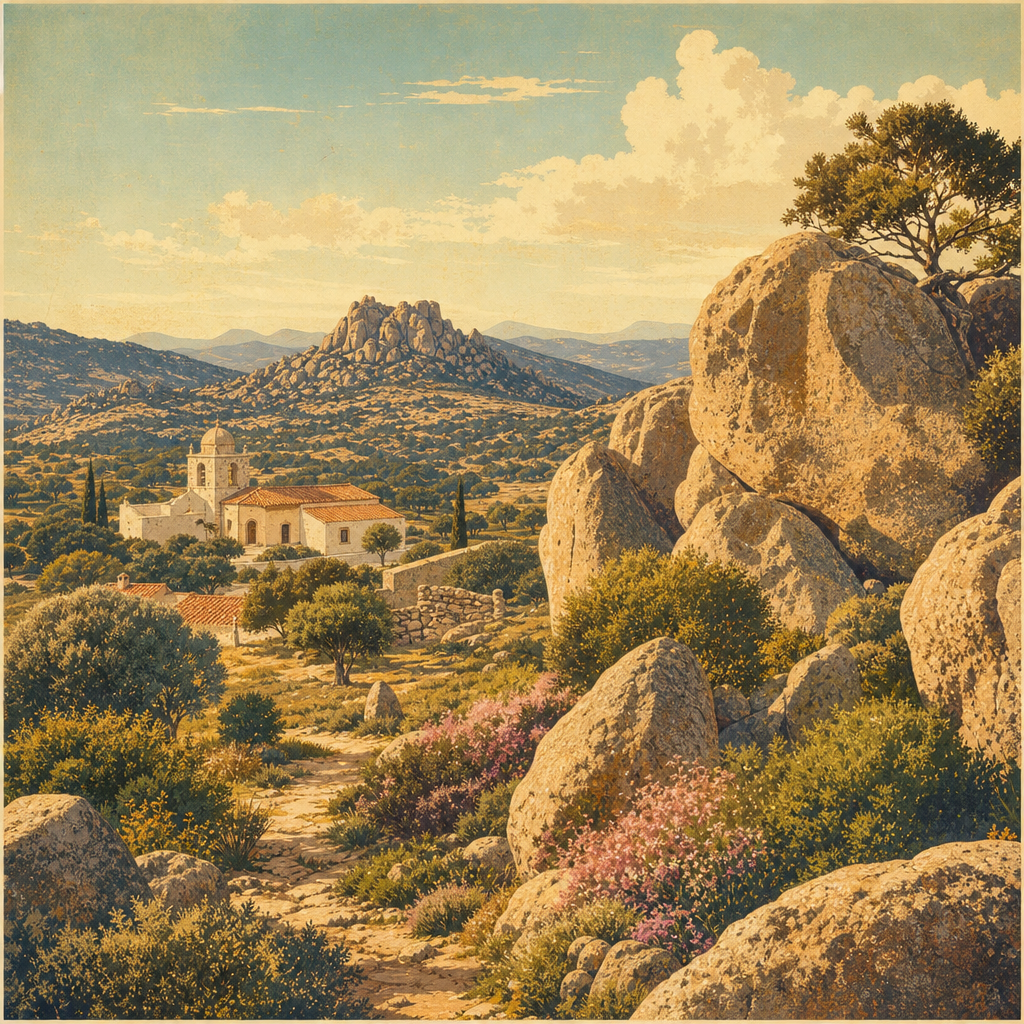
The Gallurese landscape finds one of its most recognizable expressions in Arzachena. Amid granite rocks, landforms shaped by time, rugged coastlines, wind, and Mediterranean scrub, the territory tells a story that goes beyond the image of the Costa Smeralda. Understanding these elements helps visitors read the landscape with greater awareness and grasp its deeper identity.
- Gallura landscape: Arzachena in the historical and cultural context of Gallura
- The Gallura landscape as territorial identity
- Gallura Landscape: Archaeology, Memory, and Historical Continuity
- Traditions, stazzi, and the culture of local communities
- The transformation of the area and the birth of the Costa Smeralda
- Arzachena beyond the coast’s best-known images
Gallura landscape: Arzachena in the historical and cultural context of Gallura
Arzachena occupies a central position in northeastern Gallura. The area brings together inland areas and coastline. It also preserves clear traces of its rural history and more recent transformations.
To explore the relationship between local identity and the territory in greater depth, it may be useful to read Arzachena and Costa Smeralda: history and identity of the territory. For institutional information, a key reference source remains the Municipality of Arzachena.
The Gallurese landscape as a territorial identity
The landscape of Gallura is defined above all by granite. The rocky formations emerge from the vegetation and create instantly recognizable profiles. In addition, the intense light and the wind help shape the perception of the territory.
Alongside the rocks, Mediterranean scrubland grows. Junipers, mastic trees, strawberry trees, and myrtles accompany visitors across much of the area. As a result, the landscape maintains a strong visual continuity between the inland areas and the coast.
Although attention often focuses on the beaches, the inland area reveals a more complex history. Indeed, rural communities, historic routes, and agricultural areas have contributed to shaping the local identity.
- Granite formations shaped by natural forces.
- Rugged coastlines and natural coves.
- Mediterranean scrub and coastal habitats.
- Ancient rural paths and stazzi.
- Wetlands and areas of environmental interest.
Gallura landscape: Archaeology, memory, and historical continuity
Arzachena preserves some of the most important archaeological evidence in northern Sardinia. Among these, the Giants’ Tomb of Coddu Vecchiu and the nuragic complex of La Prisgiona stand out.
These sites show a very ancient human presence. They also help to understand the connection between communities and the landscape over the centuries. For this reason, they represent an essential component of local identity.
Traditions, stazzi, and the culture of local communities
To understand Gallura, it is essential to know the stazzi. These rural settlements were the center of family and productive life. Over time, they helped shape the territory and social relationships.
Gallurese culture also includes language, religious traditions, agricultural practices, and oral memory. However, these elements do not belong only to the past. Even today, they influence the way the area is experienced and described.
The transformation of the territory and the birth of the Costa Smeralda
In the 1960s, the area underwent a decisive transformation. The Costa Smeralda project increased the area’s international profile and changed its infrastructure, connections, and economic activities.
However, the history of Arzachena is not limited to that of the coast alone. On the contrary, this new phase became part of an area already rich in traditions, archaeological sites, and historic landscapes.
Arzachena beyond the coast’s best-known images
The most famous images of the Costa Smeralda tell only part of the story of the area. Behind the bays and marinas stretches a landscape of granite, hills, wind, and historical memory.
The rocks that define the landscape were there long before tourism development. In the same way, the ancient rural routes continue to connect places that preserve a strong cultural identity.
For this reason, Arzachena stands apart from the rest of Sardinia. Here, nature, history, and human presence are in constant dialogue. As a result, visitors can read the territory not as a simple seaside destination, but as a complex system of landscapes and meanings.