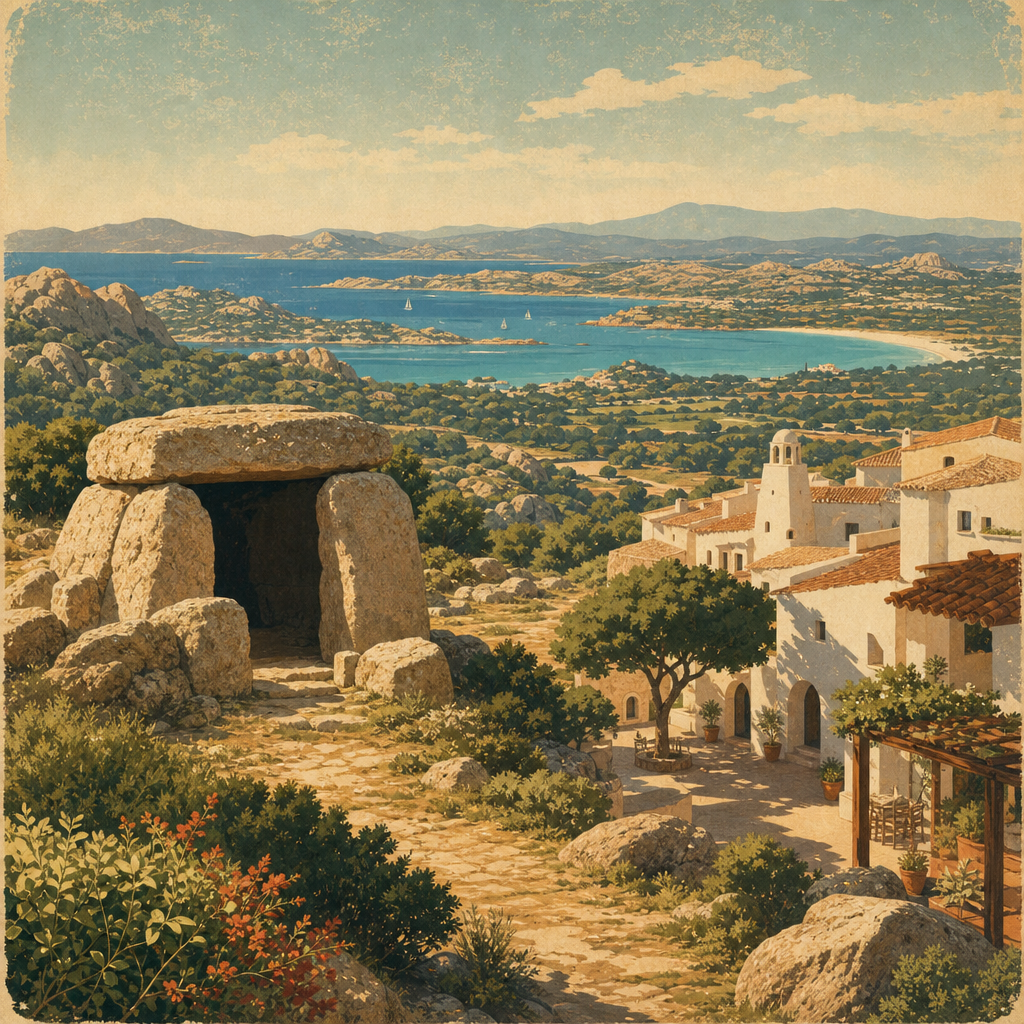
The history of Arzachena tells of a journey spanning millennia. Among wind-sculpted granite, Mediterranean scrub, and the inlets of Gallura, this area brings together archaeology, landscape, and contemporary development. Long before the Costa Smeralda gained international fame, in fact, the area was already inhabited and deeply connected to its natural resources. Understanding Arzachena therefore means reading nature, memory, and historical transformations together.
- Arzachena in the historical and geographical context of Gallura
- The origins from prehistory to the Nuragic civilization
- Arzachena: Landscape, Environment, and Territorial Identity
- Traditions, culture and memory of local communities
- The birth of the Costa Smeralda and the transformation of the region
- The role of the Municipality of Arzachena in safeguarding heritage
- Between Continuity and Change: The Cultural Significance of Arzachena Today
Arzachena in the Historical and Geographic Context of Gallura
Arzachena is located in the northeastern part of Sardinia, in the historic region of Gallura. Here, granite, the landscape, and traditions have helped shape a distinctive identity. In addition, the municipal territory is among the largest on the island.
Inland countryside, granite outcrops, rugged coastlines, and wetlands form a highly varied mosaic. As a result, a range of activities have developed over time, from livestock farming to fishing and tourism.
Local history is documented by numerous archaeological records. To explore the historical context of the area in greater depth, it is also useful to read Arzachena and Costa Smeralda: history and identity of the territory. In addition, the Municipality of Arzachena provides information dedicated to cultural heritage.
Looking at Gallura, one constant element emerges: the relationship between humans and the landscape. Over the centuries, communities have adapted their settlements to the environmental features and available resources.
The origins from prehistory to the Nuragic civilization
Arzachena’s roots go back to prehistory. Thanks to favorable environmental conditions, the first communities settled in the area in very ancient times.
Among the best-known monuments are the Giants’ Tombs. In particular, the Coddu Vecchiu Giants’ Tomb is one of the best-preserved examples in Sardinia.
Another key site is the Nuragic complex of La Prisgiona. Here, it is possible to understand aspects of the daily life and social organization of Nuragic communities.
Furthermore, numerous archaeological remains attest to a continuous human presence in the area. Consequently, Gallura emerges as a strategic area in the connections of the ancient Mediterranean.
- Giants’ Tombs of Coddu Vecchiu and Li Lolghi.
- Nuragic complex of La Prisgiona.
- Necropolises and prehistoric funerary monuments.
- Settlements between the inland and the coast.
- Traces of occupation after the Nuragic age.
Today, these places are not merely archaeological attractions. On the contrary, they stand as tangible proof of the bond between human communities and the environment.
Arzachena: Landscape, Environment, and Territorial Identity
The landscape of Arzachena is the result of natural and cultural processes. The large granite outcrops characterize all of Gallura and have influenced settlements and economic activities.
At the same time, the Mediterranean scrub helps define the identity of the area. Strawberry trees, myrtles, and junipers are part of an environment rich in biodiversity.
A distinctive feature is the dialogue between the hinterland and the sea. On one side are the historic stazzi and the Gallura countryside. On the other, bays, promontories, and internationally renowned beaches emerge.
However, reducing Arzachena to only a seaside destination would be limiting. Its value lies precisely in the convergence of nature, history, and culture.
Traditions, Culture, and Memory of Local Communities
The history of Arzachena is tied to the people who have inhabited the area. Over time, the Gallurese communities developed distinctive traditions, linguistic practices, and forms of social organization.
Of particular importance is the culture of the stazzi. These rural settlements were homes, but also centers of economic and family life.
Moreover, the Gallurese language represents a significant element of identity. It reflects a complex history and numerous contacts with other areas of the Mediterranean.
Religious festivals, cuisine, and folk traditions keep the cultural heritage alive. In this way, the past continues to engage in dialogue with the present.
The Birth of the Costa Smeralda and the Transformation of the Territory
A decisive turning point came in the 1960s with the birth of the Costa Smeralda. From then on, the area gained growing international renown.
The name of Karim Aga Khan IV is closely associated with this phase. Through the Costa Smeralda Consortium, in fact, a project took shape that influenced the economy, landscape, and image of the territory.
Porto Cervo became the symbol of this transformation. However, local history had begun much earlier and already retained a strong cultural identity.
Over time, new economic opportunities emerged. At the same time, a debate developed around the relationship between growth, environmental protection, and the preservation of local identity.
The Role of the Municipality of Arzachena in Protecting Heritage
The promotion of historical heritage is an essential component of the area’s cultural life. For this reason, the preservation of archaeological sites and the dissemination of historical knowledge play a central role.
It is not only a matter of protecting monuments. It is equally important to explain the meaning of these places to residents and visitors.
In particular, the prehistoric and Nuragic sites are one of Arzachena’s main cultural treasures. Protecting them helps keep the connection with the area’s origins alive.
Between Continuity and Change: The Cultural Significance of Arzachena Today
Today, Arzachena holds a distinctive place in the history of Sardinia. Within just a few kilometers, you can move from prehistoric monuments to rural landscapes and internationally renowned tourist destinations.
This coexistence of different eras represents one of the area’s most interesting aspects. It also shows how each historical phase has left visible traces.
In conclusion, Arzachena is not just a tourist destination. It is a place where archaeology, the environment, and contemporary development coexist. It is precisely this balance that explains the cultural value of its long history.