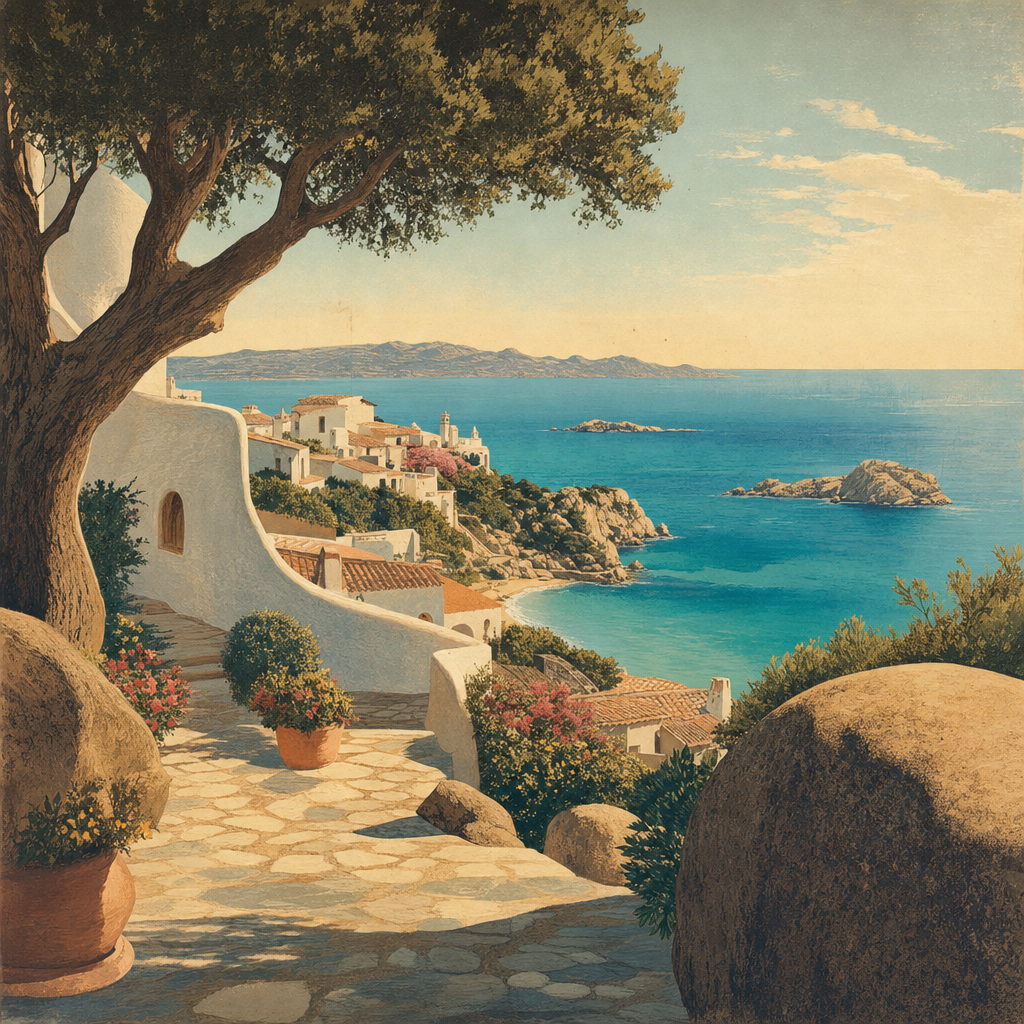
Photographing the Costa Smeralda means coming into contact with a landscape that brings together nature, architecture, and historical memory. This balance is rare in the Mediterranean. Among bays with crystal-clear waters, wind-shaped granite rocks, and urban centers designed to engage with the environment, every image tells a story.
Moreover, this stretch of Gallura represents one of the most interesting examples of integration between landscape and design. For this reason, it offers photographers numerous narrative possibilities.
- The origins of the Costa Smeralda and the birth of a new visual identity
- Porto Cervo, the photographic heart of the Costa Smeralda
- The light of Gallura, colors, seasons, and times of day
- Beaches, promontories, and landscape perspectives
- Architecture, small squares, and details to observe through the lens
- The marina and the relationship between the sea, urban space, and the horizon
- Photography and cultural identity: understanding the territory beyond the image
The Origins of the Costa Smeralda and the Birth of a New Visual Identity
To understand what makes the Costa Smeralda so recognizable, it is useful to look at its origins. Before the 1960s, much of this area retained a predominantly rural character. The territory was marked by Gallura’s traditional stazzi, Mediterranean scrub, and a largely undeveloped coastline.
Later, with the launch of the project that would give rise to the modern Costa Smeralda, the area began a profound transformation. Although the figure of Karim Aga Khan IV is closely associated with this evolution, the final result was born from the joint work of architects, urban planners, and local communities.
The most interesting aspect for photographers lies in the design approach. In fact, the goal was not to impose monumental buildings on the landscape. On the contrary, the structures were integrated in harmony with the natural forms of the coast. As a result, a strong visual identity developed, based on the relationship between buildings, vegetation, and the sea.
To learn more about the area’s history and heritage, you can consult the official website of the Municipality of Arzachena, which provides information on the local cultural and territorial context.
Porto Cervo, the photographic heart of the Costa Smeralda
Porto Cervo is the best-known symbol of the Costa Smeralda. It is also one of the most photographed places in Sardinia. Its strength does not lie in its size. Rather, it comes from the quality of its spaces and the care given to its urban perspectives.
Strolling through small squares and narrow streets, you come across arches, panoramic terraces, and stairways. In addition, the routes continually offer new points of view. The soft shapes of the buildings, the light colors of the plasterwork, and the constant presence of the sea all help create balanced and recognizable images.
- The Piazzetta of Porto Cervo.
- The terraces overlooking the bay.
- The routes between the historic center and the port.
- Views where architecture and landscape meet.
- Panoramic views of the hills and the sea.
In this way, every corner tells the story of a place designed to integrate with the land rather than dominate it.
Gallura’s light, colors, seasons, and times of day
Light is one of the most fascinating elements of photography on the Costa Smeralda. Atmospheric conditions are often clear. In addition, the presence of the sea and the light-colored rocks creates a particularly evocative quality of light.
At dawn, the granite takes on pinkish hues and the sea reflects delicate tones. For this reason, it is the ideal time to capture architectural details and coastal landscapes in soft, diffused light.
In the late afternoon and at sunset, however, the side light emphasizes volumes and textures. As a result, the shadows lengthen and the surfaces gain depth. Consequently, the landscape takes on a more dramatic character.
- In spring, the vegetation displays intense, vibrant colors.
- In summer, the sea reaches its brightest shades.
- With the arrival of autumn, fewer tourists make for more contemplative photographs.
- In the winter months, the light can appear particularly crisp and high-contrast.
The main chromatic components of the area include the turquoise of the waters, the green of the Mediterranean scrub, and the pinkish gray of the granite. In addition, there are the warm tones of the evening light.
Beaches, headlands, and landscape perspectives
The beaches of the Costa Smeralda are famous throughout the world. However, their photographic value goes far beyond the classic beach image. Places such as Liscia Ruja, Capriccioli, Romazzino, La Celvia, and Grande Pevero offer landscapes that differ greatly from one another.
Rocks sculpted by the elements often become key components of the photographic composition. In addition, Mediterranean vegetation helps create particularly effective color contrasts.
To capture more complete images of the area, it is useful to look for elevated vantage points. From these positions, the relationships between bays, headlands, seabeds, and hills become clearly visible. In this way, it is possible to tell the story of the landscape as a whole.
- Granite formations shaped by the wind.
- The sinuous lines of the inlets.
- The contrasts between sea and vegetation.
- Natural scenic viewpoints.
- The integration of architecture and the coastal environment.
These elements therefore help convey a more authentic and complete view of the Costa Smeralda.
Architecture, small piazzas, and details to observe through the lens
One of the most distinctive aspects of the Costa Smeralda is the architectural language developed from the 1960s onward. The buildings draw inspiration from Mediterranean traditions. However, they are reinterpreted with an original and contemporary style.
The plastered walls, softly contoured roofs, and openings oriented toward the sea help create continuity with the landscape. In addition, the use of local materials strengthens this connection.
Among the most representative buildings, the Church of Stella Maris stands out, considered one of the symbols of Porto Cervo. Moreover, its panoramic location and sinuous forms make it a particularly interesting photographic subject.
- Arches and porticoes.
- Stairways that follow the contours of the land.
- Inner courtyards.
- Local stone and plastered surfaces.
- Windows overlooking the sea.
- Plant elements integrated into architectural spaces.
Indeed, it is often precisely these understated details that best convey the identity of the place.
The marina and the relationship between the sea, urban space, and the horizon
The Porto Cervo marina represents another fundamental element in the photographic narrative of the Costa Smeralda. Here, the sea does not simply serve as a backdrop. On the contrary, it becomes an integral part of the urban experience.
The quays, promenades, and open views over the gulf create constantly changing scenes. In the morning, reflections on the water offer ideal conditions for luminous images. At sunset, by contrast, the combination of artificial lighting and natural light creates particularly evocative atmospheres.
From the harbor, it is also possible to grasp the international dimension that has characterized the history of the Costa Smeralda. Moreover, this place continues to be a meeting point for Mediterranean cultures and traditions.
When sea, architecture, and horizon coexist harmoniously within the frame, the essence of the region emerges clearly.
Photography and cultural identity: understanding the territory beyond the image
Every photograph of the Costa Smeralda captures much more than a spectacular landscape. Behind the iconic images lie decades of territorial transformations, urban planning choices, and cultural interpretations.
The destination’s international fame has often focused attention on tourism and exclusivity. However, the area also tells a story of integration between the natural environment and architectural design. In fact, many views now considered symbolic stem from deliberate decisions aimed at preserving the readability of the landscape.
For the photographer, this means observing not only what appears within the frame. It also means understanding the relationships that created that landscape. As a result, sea, rocks, vegetation, buildings, and public spaces become elements of a broader narrative.
The Costa Smeralda continues to represent a unique case in the contemporary Mediterranean. Its image is born from the encounter between nature and human intervention, between local memory and international vision.
Photographing it therefore means documenting this ongoing dialogue. In this way, it is possible to capture not only the beauty of the places, but also the history and identity that have made them famous throughout the world.