The international destination of Costa Smeralda is the result of a process developed over several decades. Today, this stretch of Gallura is known throughout the world for its landscape, hospitality, yachting, and distinctive image. However, its renown does not stem from natural beauty alone. On the contrary, it arises from the convergence of environment, planning, and international relations.
- The origins of territorial transformation
- Porto Cervo and the birth of a symbolic center
- Architecture, Landscape, and Visual Identity
- Hospitality and the Role of Historic Hotels
- Yachting as a driver of international relations
- The Image of the Costa Smeralda Around the World
- Recognition Built Over Time
- Memory, territory, and contemporary significance
The origins of territorial transformation
Until the mid-twentieth century, the area was characterized by limited human presence and agro-pastoral activities. Later, the intuition of Prince Karim Aga Khan IV helped launch a new phase of development. Around this vision, a project took shape that aimed to enhance the territory without separating it from its identity.
In addition, the establishment of the Costa Smeralda Consortium introduced urban planning and architectural rules aimed at protecting the landscape. To explore the historical context in greater depth, it is useful to read the analysis dedicated to Aga Khan’s vision in Sardinia.
- Quality of the natural landscape.
- Environmentally conscious planning.
- Development of hospitality and yachting.
- Building a recognizable identity.
- Openness to international networks.
Porto Cervo and the Birth of a Symbolic Center
Porto Cervo occupies a central place in the history of the destination. From the very beginning, it was designed to integrate with the natural inlet that hosts it. As a result, the village became an international landmark.
The squares, pedestrian paths, and marina help create a recognizable environment. Moreover, the constant relationship between the built environment and the landscape has strengthened the symbolic value of the locality.
Architecture, Landscape, and Visual Identity
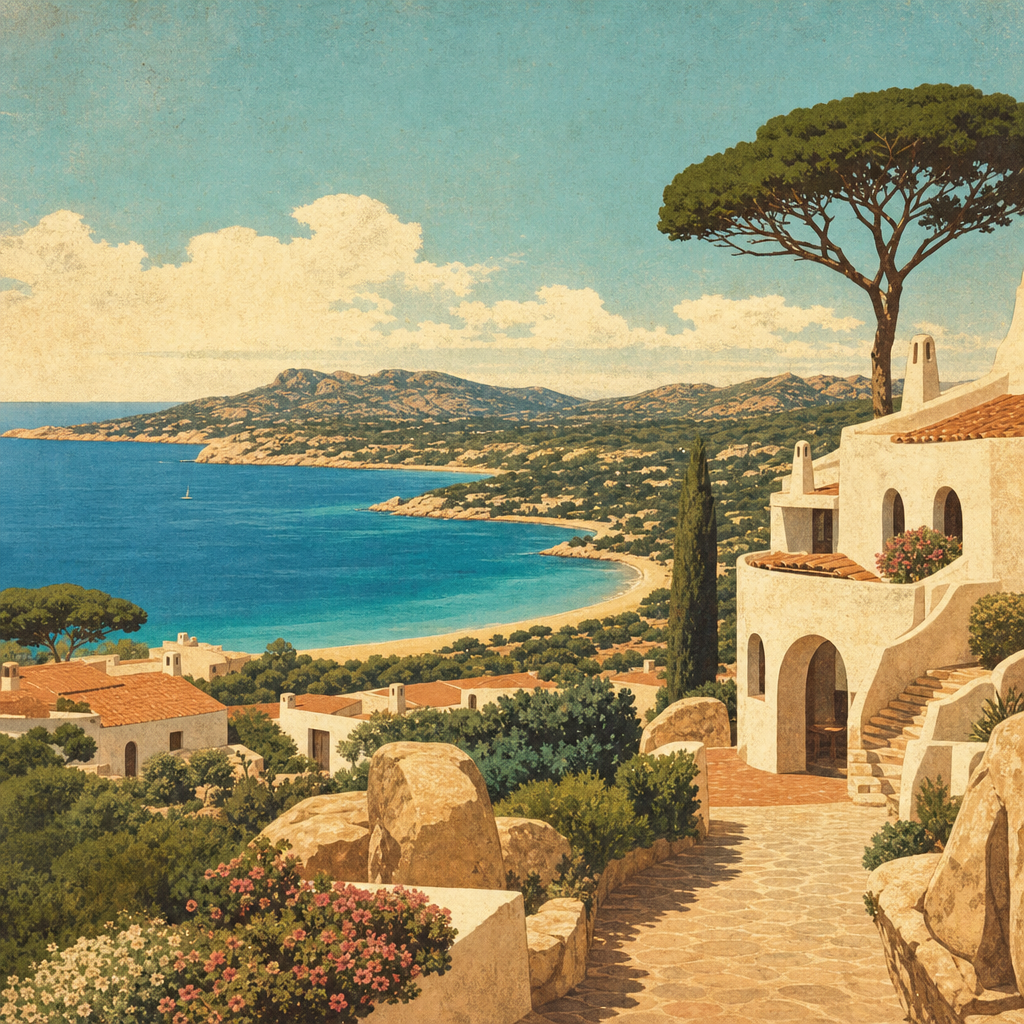
One of the most important factors is the dialogue between architecture and the environment. From the earliest developments, the buildings were designed to fit into the natural setting. For this reason, the Costa Smeralda has developed a coherent and easily recognizable image.
Architects such as Luigi Vietti, Michele Busiri Vici, and Jacques Couëlle helped define a style characterized by soft forms, natural materials, and restrained volumes. In addition, the use of local granite and attention to panoramic views have reinforced a strong visual identity.
Hospitality and the Role of Historic Hotels
At the same time, the destination’s growth was supported by a hospitality system integrated with the landscape. Properties such as Cala di Volpe, Cervo Hotel, Romazzino, and Pitrizza became international landmarks.
The hotels were not conceived as large, isolated complexes. On the contrary, they sought to evoke the scale of small Mediterranean settlements. As a result, the visitors’ experience remained closely tied to the territory.
Yachting as a driver of international relations
If the landscape forms the foundation of the local reputation, yachting has expanded its global reach. Thanks to its strategic location in the western Mediterranean, Porto Cervo has become an important meeting point for sailors and yacht owners.
In particular, the Yacht Club Costa Smeralda has contributed to its international visibility through regattas and sailing events. In addition, the presence of high-level marina infrastructure has fostered relationships that go beyond seasonal tourism.
The Image of the Costa Smeralda Around the World
Over time, photographs, reports, and travel stories have spread an immediately recognizable image of the destination. The bays, granite rocks, and architecture nestled in the Mediterranean scrub have become symbols of the area.
At the same time, international connections, foreign investment, and major events have expanded the area’s visibility. According to the information available on the official UNESCO portal, the cultural landscape often represents the result of the interaction between human activities and the environment, a central theme in the debate surrounding the Costa Smeralda as well.
Recognition built over time
Moreover, the area’s international reputation was not built in just a few years. On the contrary, it grew through a combination of landscape quality, high-level services, and relationships developed within the Mediterranean and global context. For this reason, the destination continues to attract visitors, investors, and boating enthusiasts from numerous countries.
Likewise, the continuity of the territorial image has fostered immediate recognition of the place. As a result, the name Costa Smeralda has become associated with a distinctive model of tourism development and landscape enhancement.
Memory, Territory, and Contemporary Significance
Today, the Costa Smeralda is much more than a tourist destination. Indeed, it represents a significant case of territorial transformation in the contemporary Mediterranean. Nature, architecture, hospitality, and international relations have all contributed to its global prominence.
Finally, its history shows how a region can gain worldwide fame while maintaining a strong connection to the landscape and the cultural context of Gallura.