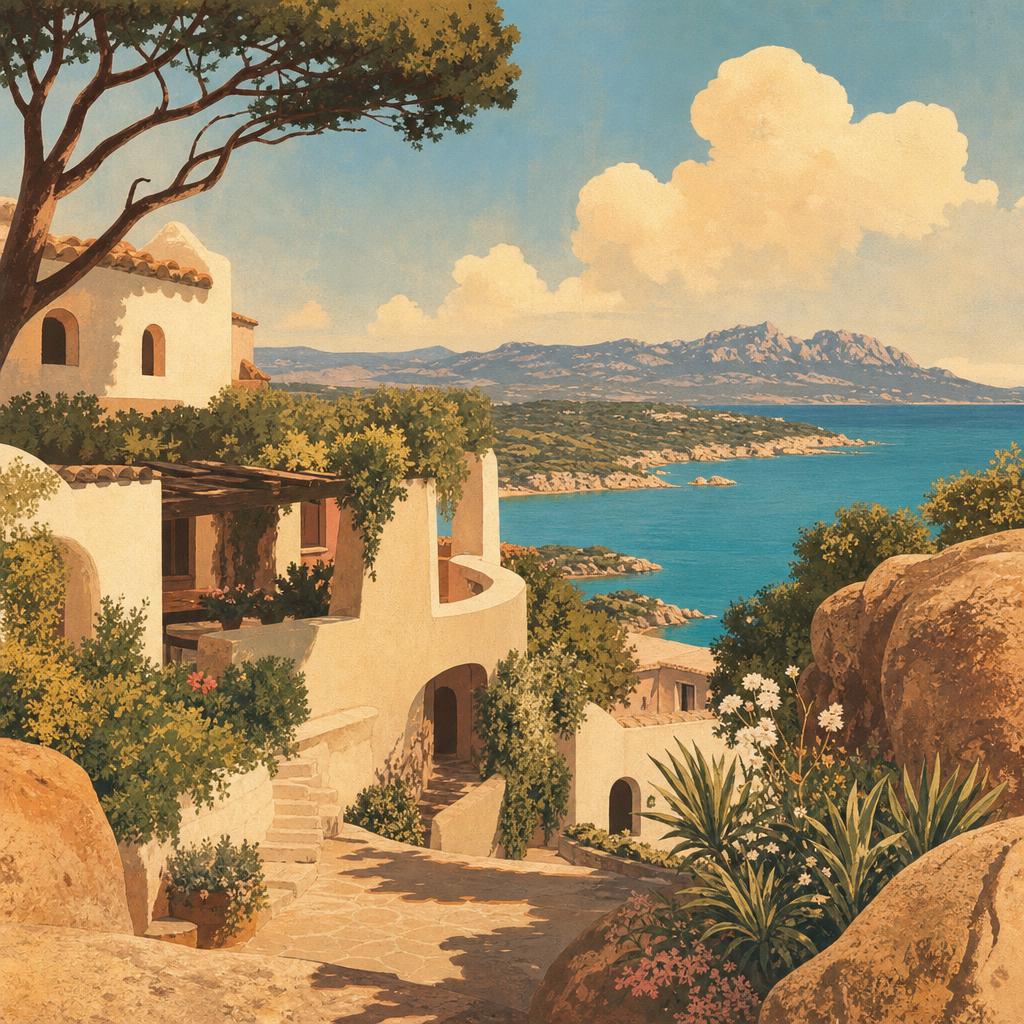
Costa Smeralda and high-quality tourism represent a significant example of how a destination can build its international reputation through a project that connects landscape, architecture, and cultural identity. Among the granite rocks of Gallura, the turquoise bays, and the Mediterranean vegetation, this stretch of Sardinia has become one of the most recognizable symbols of tourism in the Mediterranean. Moreover, its history tells of the birth of a territorial vision that sought to enhance the natural setting without transforming it indiscriminately.
- The origins of the Costa Smeralda and the birth of a territorial vision
- Porto Cervo: the heart of a Mediterranean destination
- Architecture, landscape, and visual identity
- What quality tourism means in Costa Smeralda
- Marina, small squares, historic hotels, and symbolic places
- Transformations, debates, and land conservation
- The Costa Smeralda as part of the Mediterranean’s cultural heritage
The origins of the Costa Smeralda and the birth of a territorial vision
Until the 1960s, the northeastern coast of Gallura was characterized by a limited human presence and an almost unspoiled landscape. The main activities were farming and pastoralism, while international tourism was still far removed from these areas.
The turning point came thanks to the initiative of Prince Karim Aga Khan IV and a group of investors who recognized the area’s unique potential. The goal was not simply to build hotels or tourist villages. On the contrary, they wanted to create a destination capable of standing out for its landscape quality and architectural harmony.
The founding of the Costa Smeralda Consortium in 1962 marked a decisive turning point. Through urban planning regulations and design guidelines, controlled growth was encouraged. As a result, efforts were made to preserve the character of the area. This approach helped define a different model from that of many other coastal destinations developed during the same period.
To explore the project’s historical and cultural context in greater depth, it is also useful to consult Karim Aga Khan IV’s vision for the Costa Smeralda.
Porto Cervo: the heart of a Mediterranean destination
Porto Cervo is the symbolic center of the Costa Smeralda. Designed as a meeting place between architecture and landscape, it was not conceived as a traditional town. Rather, it presents itself as a collection of squares, pedestrian paths, terraces, and glimpses of the sea.
The natural shape of the inlet favored the creation of a sheltered harbor that over time became a point of reference for international yachting. Later, an urban fabric developed around the harbor, characterized by intimate public spaces and a strong visual connection with the surrounding environment.
The celebrated small squares of Porto Cervo remain one of the features most appreciated by visitors. Here, the urban experience is shaped through a succession of perspectives, stairways, porticoes, and panoramic viewpoints that evoke the atmosphere of Mediterranean villages.
Architecture, Landscape, and Visual Identity
One of the most distinctive aspects of the Costa Smeralda concerns the relationship between the built environment and nature. From the earliest stages of development, the architects involved in the project worked to integrate the buildings into the landscape rather than impose them visually on the territory.
Among the most influential designers were Michele Busiri Vici and Jacques Couëlle. They helped define an architectural style characterized by soft forms, irregular volumes, and lines inspired by nature. Moreover, the buildings were designed to engage with the terrain, vegetation, and granite rocks typical of Gallura.
Some elements that have contributed to the visual identity of Costa Smeralda are:
- Use of local stone and natural materials.
- Colors in harmony with the surrounding landscape.
- Architecture with organic forms.
- Constant presence of Mediterranean vegetation.
- Public spaces designed for pedestrian use.
- Visual continuity between the natural environment and buildings.
This attention to landscape integration has helped create a unique image that is immediately recognizable internationally.
What Quality Tourism Means in Costa Smeralda
When discussing quality tourism in Costa Smeralda, the concept goes far beyond the mere standard of the services offered. Indeed, quality is linked to a combination of factors that include landscape protection, urban planning, sustainability, and the visitor’s overall experience.
In this model, the territory is not a passive backdrop. On the contrary, it is a fundamental component of the tourist experience. Well-preserved beaches, architecture integrated into the environment, well-maintained public spaces, and attention to the perception of the landscape all contribute to building the destination’s value.
Among the elements that define quality tourism are:
- Respect for the natural characteristics of the territory.
- Control of urban development.
- High-quality public spaces.
- Integration of hospitality and the environment.
- Enhancement of local identity.
- Seeking a balance between development and conservation.
In today’s context, quality is increasingly associated with sustainability and the ability to preserve resources for future generations. In this regard, the topic is also explored by the World Tourism Organization (UN Tourism).
Marina, Piazzette, Historic Hotels, and Iconic Landmarks
The Costa Smeralda is made up of a series of places that, over time, have taken on strong symbolic value. Among them, the Marina di Porto Cervo stands out as one of the main connection points with the Mediterranean’s nautical circuits.
Historic hotels have also played an important role in shaping the destination’s image. Properties such as the Cala di Volpe, the Cervo Hotel, and the Romazzino are considered significant examples of hotel architecture integrated into the landscape.
The beaches are another essential element of the area’s identity. Places such as Liscia Ruja, Capriccioli, La Celvia, Romazzino, and Pevero are famous for their combination of pale sand, crystal-clear sea, and granite formations.
- Porto Cervo.
- The Porto Cervo Marina.
- The Piazzetta and the historic center.
- The Church of Stella Maris.
- The coast’s historic hotels.
- The most iconic bays and beaches.
- The panoramic promontories of Gallura.
Transformations, Debates, and Protection of the Territory
Like any successful destination, the Costa Smeralda has also had to reckon with the consequences of its own growth. Economic development and international renown have brought significant benefits. However, they have also opened up a debate on the relationship between tourism and landscape conservation.
Over the years, the area has often been at the center of discussions on the management of coastal zones, the control of development, and the need to maintain environmental balance. Today, these issues are even more relevant because of climate change and the growing pressure on natural resources.
The main challenge is to continue enhancing the area without compromising the elements that have determined its success. For this reason, the Costa Smeralda remains an interesting laboratory for understanding how tourism development and protection can coexist.
The Costa Smeralda as a Cultural Heritage of the Mediterranean
Today, the Costa Smeralda can be considered much more than just a beach destination. It is the result of more than sixty years of transformations involving architecture, landscape, economy, and culture.
Its bays, public spaces, architecture integrated into nature, and the role played by Porto Cervo tell a story that belongs not only to Sardinia, but to the entire Mediterranean. In this sense, the area represents an example of how a design vision can help build a strong and lasting identity.
Its experience continues to inspire reflection on the meaning of quality tourism and on the ability to preserve the value of places over time. In this way, hospitality, landscape, and culture emerge as inseparable elements of a recognizable and coherent destination.