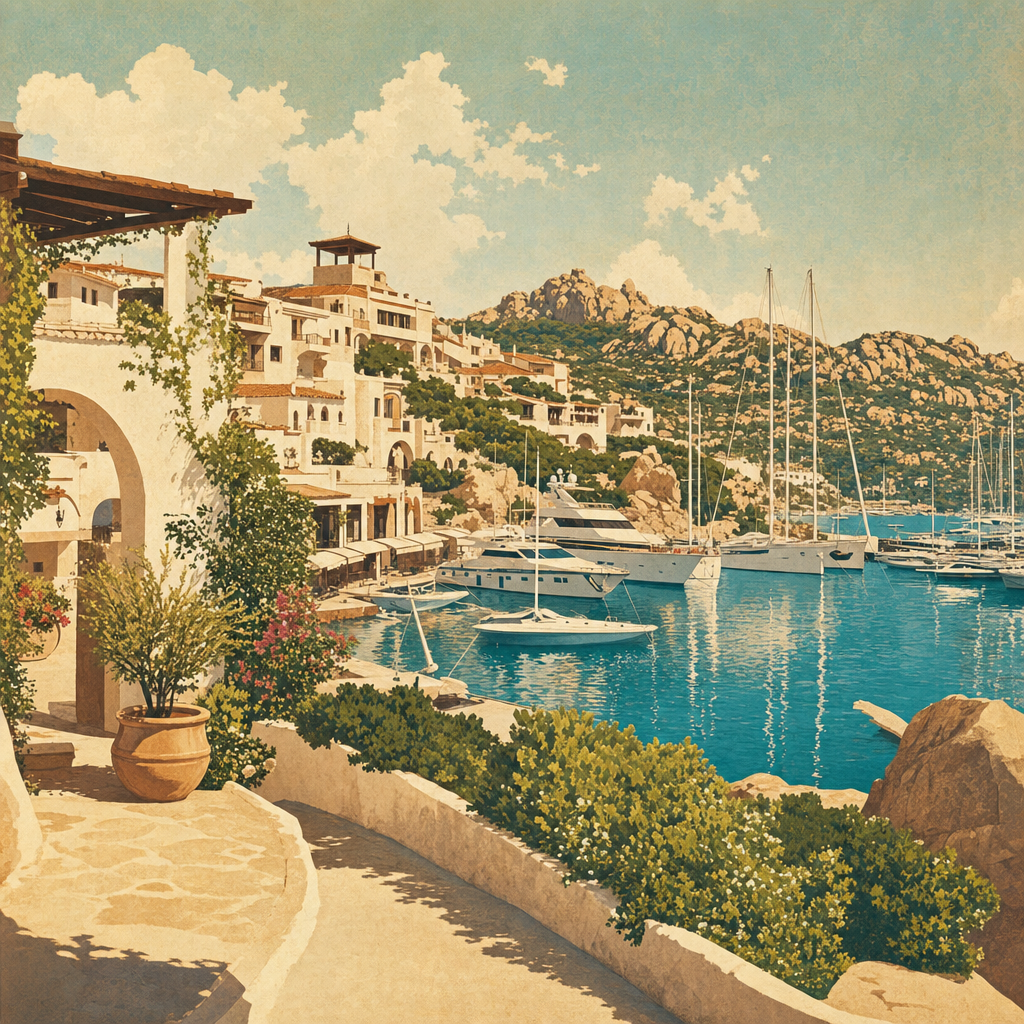
When the mistral wind ripples the turquoise waters off Porto Cervo, the marina appears as a place where the sea engages in dialogue with architecture and nature. At the same time, it conveys a precise idea of the future. It is not merely a tourist harbor, but a cultural and territorial space. It was born from a vision that profoundly shaped the identity of the Costa Smeralda and Gallura. To understand this place, then, is to read a story that began in the 1960s, inextricably linked to the figure of Prince Karim Aga Khan IV.
- The origins of a Mediterranean vision
- Prince Karim Aga Khan IV and the Costa Smeralda
- The birth of the Marina di Porto Cervo
- Landscape, architecture, and Gallurese identity
- Porto Cervo, Arzachena, and the territorial dimension
- Public memory and cultural significance
The Origins of a Mediterranean Vision
Before the name Costa Smeralda became internationally known, northeastern Sardinia was defined by an agro-pastoral economy. Coastal settlements were few, and the relationship with the sea was primarily practical. Arzachena and its hamlets, in fact, lived within a world tied to inland Gallura, to seasonal rhythms, and to a landscape shaped over centuries.
In the aftermath of World War II, Italy and the Mediterranean were considering tourism as a tool for development. In this context, Sardinia’s northeastern coast still appeared unspoiled, yet fragile. For this reason, any intervention would have lasting consequences. The birth of the Costa Smeralda was therefore not improvised, but rather the result of careful planning. The goal was to combine international appeal with respect for the land.
The Marina di Porto Cervo fits into this scenario as a key element. On one hand, it was a nautical infrastructure. On the other, it became a cultural and symbolic point of reference for the new relationship between humankind and the sea. From the very beginning, the harbor was conceived as an open urban space integrated into the landscape.
It was precisely at this stage that a figure emerged who was able to look at Gallura with an international outlook. At the same time, he remained attentive to local specificities. This Mediterranean vision was not limited to aesthetics, but took shape as a cultural proposal destined to leave its mark on the territory.
Prince Karim Aga Khan IV and the Costa Smeralda
Prince Karim Aga Khan IV, born in 1936, is known worldwide for his institutional and cultural commitment. His interest in Sardinia took shape in the early 1960s. During that period, he identified the Gallura coast as the ideal place to experiment with an alternative model of tourism development. An early phase of this story is also explored in the article dedicated to the young Karim Aga Khan and the vision of the Costa Smeralda.
In 1962, the Consorzio Costa Smeralda was founded. This organization brought together properties and design intentions under a shared vision. According to historical sources, the goal was to avoid disorderly growth. Instead, it promoted coherent urban planning inspired by traditional architecture and the landscape. An institutional reference framework can also be consulted through the Consorzio Costa Smeralda.
Aga Khan IV’s role was not that of a mere investor. On the contrary, his presence took shape as a form of cultural direction. He involved architects, urban planners, artisans, and local institutions. As a result, the Costa Smeralda became a laboratory for dialogue between modernity and Mediterranean tradition.
Time has brought inevitable changes, and the passing of Prince Karim Aga Khan IV in 2025 prompted a broader reflection on his legacy in Sardinia. It is important to distinguish between documented facts and the narrative that followed. Nevertheless, one clear historical fact remains. His intervention had a structural impact on the configuration of the territory and on the collective imagination of Porto Cervo and Arzachena.
The Birth of the Porto Cervo Marina
The Marina di Porto Cervo represents one of the most emblematic outcomes of this vision. Planned beginning in the second half of the 1960s, it was conceived as the nautical heart of the Costa Smeralda. It also connected with the Mediterranean’s main routes, attracting an international community of sailors.
From a functional standpoint, the port met the needs of a growing nautical tourism sector. However, its construction went beyond the technical aspect. Attention to the scale of the buildings and to local materials helped create a distinctive space. The sea was not dominated, but welcomed.
Over time, the marina became a meeting place for different cultures. In this sense, Porto Cervo was not merely a destination. Instead, it took on the role of a symbolic node in an international nautical network.
Over the years, the harbor has evolved alongside changes in tourism and boating. At the same time, it has maintained a constant connection to its original concept. This balance explains its cultural relevance, as well as its economic importance.
Landscape, architecture, and Gallurese identity
One of the most recognizable aspects is its relationship with architecture. The buildings surrounding the harbor do not strive for grandeur. On the contrary, they blend into the landscape with irregular volumes and light colors. The references to Gallura’s traditional constructions are evident.
This choice was not accidental. According to historical reconstructions, Aga Khan IV promoted an architectural language capable of reinterpreting local tradition. It was not a folkloric replica. The result is an environment that appears natural, despite being the product of coordinated planning.
The coastal landscape, with its granite rocks and Mediterranean vegetation, becomes part of the harbor experience. As a result, the marina does not interrupt the visual continuity of the coastline. On the contrary, it enhances it through views that tell the story of the relationship between humans and the sea.
Is it possible to build an international port without losing the soul of a territory?
The answer suggested by the Marina di Porto Cervo lies in its capacity for mediation. It is a balance between different needs that has helped define the contemporary identity of the Costa Smeralda.
Porto Cervo, Arzachena, and the Territorial Dimension
Although Porto Cervo is often perceived as a place apart, its history is tied to Arzachena and the Gallura context. In particular, the marina has served as a catalyst for transformation. These changes have involved infrastructure, services, and employment.
Over the years, the dialogue between the Costa Smeralda project and local institutions has redefined the relationship between the coast and the inland areas. Arzachena, with its archaeological and cultural heritage, has thus found new opportunities for integration and visibility.
Naturally, this process was not without debate. As with any significant transformation, critical reflections emerged on the balance between development and preservation. Nevertheless, the marina remains an example of infrastructure capable of generating dialogue and collective growth.
For the attentive visitor, understanding this dimension means going beyond the iconic image of the harbor. It means recognizing the fabric of relationships that connects it to Gallura and its history.
Public Memory and Cultural Significance
Today, Prince Karim Aga Khan IV has become part of the Costa Smeralda’s public memory. His name is associated with symbolic places in Porto Cervo and with commemorative initiatives. These acknowledge his historic role in the development of the area.
This memory should not be understood as a mere personal celebration. Rather, it represents the recognition of a lasting project. Indeed, the Marina di Porto Cervo continues to serve as a point of reference for understanding the dialogue between an international vision and the local context.
Over time, Aga Khan IV’s cultural legacy has become intertwined with the stories of those who live and work here. Artisans, maritime workers, and visitors renew the meaning of this place every day. In this way, the bond between past and present remains alive.
Reflecting on this legacy means recognizing that the Costa Smeralda is not just an image. It is a historical process in constant evolution. Within this framework, the Marina di Porto Cervo remains a privileged lens through which to read it. It helps us understand how landscape, architecture, and collective memory can converge in an identity capable of speaking to the world without losing its roots.