Arzachena granite is one of Gallura’s most recognizable features. Amid wind-sculpted coastlines, hills covered in Mediterranean scrub, and ancient settlements, this stone tells the natural and cultural story of the area. For visitors, it offers a valuable interpretive key, helping them understand the connection between landscape, architecture, and local identity.
- Granite Gallura: Origin of an Identity-Defining Landscape
- Arzachena: history, archaeology, and the memory of the land
- The great granite landscapes of Arzachena
- Granite, community, and Gallurese traditions
- Before and after the Costa Smeralda
- Arzachena and the stone that tells the story of the land
Granite Gallura: the origin of an identity-defining landscape
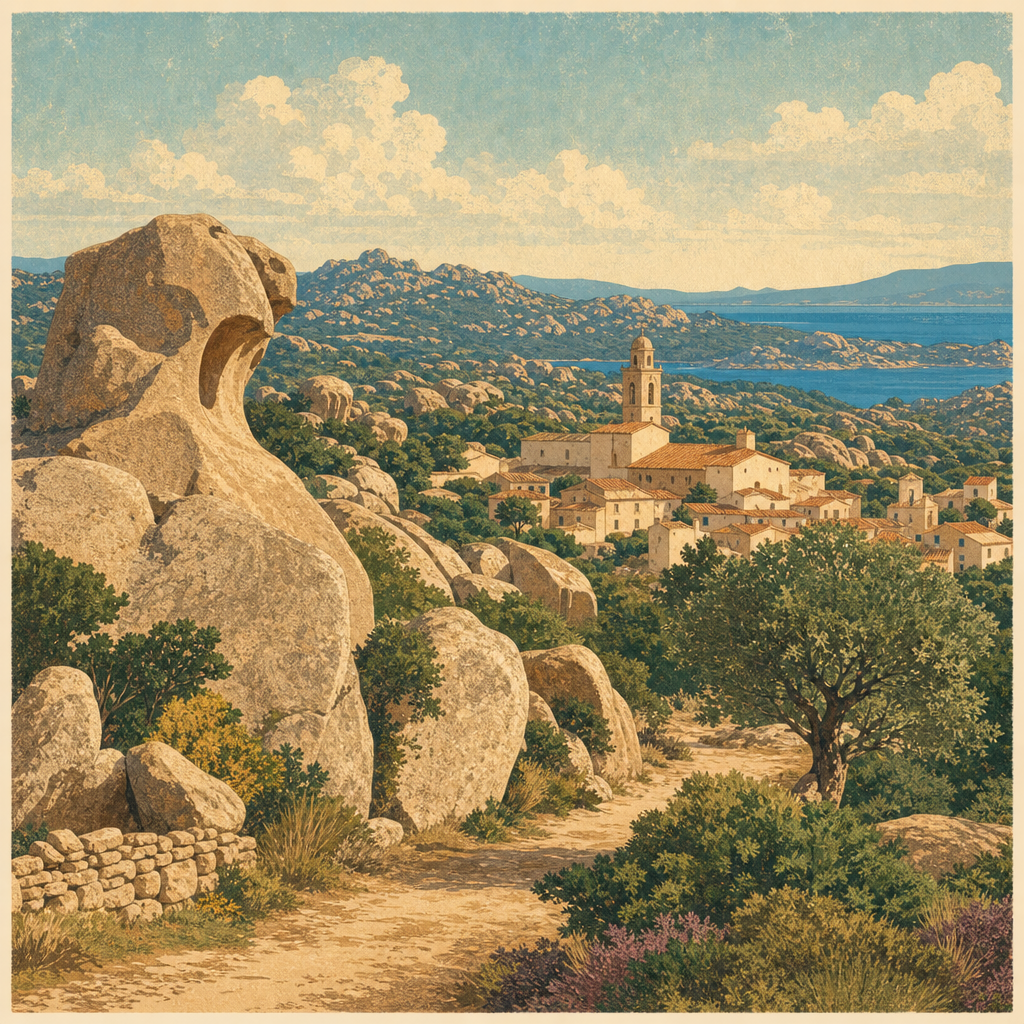
Gallura is strongly characterized by the presence of granite. As a result, rounded hills, tafoni, and large rocky outcrops define a landscape unique in the Mediterranean. For centuries, these geological forms have influenced the way people inhabit and interpret the land.
In the Arzachena area, rock is a constant presence. It also accompanies trails, hills, scenic viewpoints, and archaeological sites. The shapes that attract tourists today are the result of extremely long erosion processes caused by wind, water, and climatic variations.
This geological identity has also influenced human history. Local communities, in fact, have used granite as a building material and as a territorial landmark. For this reason, understanding Gallura means observing the relationship between people and the environment.
To learn more about the area’s geographical and natural context, it is also useful to read The Arzachena Area: landscapes between sea and granite. In addition, for institutional information on the local heritage, you can consult the Municipality of Arzachena.
Arzachena between history, archaeology, and the memory of the land
Arzachena preserves evidence of a very ancient human presence. In fact, dolmens, nuraghi, necropolises, and Giants’ Tombs document a continuity of settlement spanning millennia.
Among the best-known sites are the Li Muri Necropolis and the Giants’ Tomb of Coddu Vecchiu. In many cases, local granite was used directly in the construction of the monuments.
Alongside the major archaeological sites, the area preserves the memory of the stazzi and rural life. At the same time, traditions, the Gallurese language, and agricultural activities help define the community’s identity.
The great granite landscapes of Arzachena
Observing Arzachena means passing through very different environments. On one side, granite dominates the inland areas; on the other, it reaches the sea through spectacular promontories and inlets.
Many rock formations take on surprising shapes. Erosion has, in fact, created cavities, natural arches, and profiles that resemble human or animal figures. For this reason, these features have become recognizable symbols of Gallura.
- Hills shaped by thousands of years of erosion.
- Rocky outcrops immersed in the Mediterranean scrub.
- Tafoni and natural cavities typical of the region.
- Coastal promontories sculpted by sea and wind.
- Landscapes that visually connect the coast and inland areas.
- Archaeological sites integrated into the natural environment.
In short, these settings tell the story of geology, history, and culture all at once.
Granite, Community, and Gallurese Traditions
The presence of granite has influenced rural architecture and the organization of settlements. For example, the stazzi reflect the use of locally available materials.
Over the generations, communities developed knowledge closely tied to the land. In addition, many places were identified by distinctive, easily recognizable rock formations.
Language, folk festivals, and food and farming traditions complete this cultural picture. As a result, the landscape is not merely a natural backdrop, but an integral part of local identity.
Before and After the Costa Smeralda
Before the 1960s, the area was mainly tied to a rural and pastoral economy. Later, the development of the Costa Smeralda brought new infrastructure, greater international visibility, and significant economic changes.
However, Arzachena cannot be reduced to the history of the Costa Smeralda alone. Its archaeological heritage, traditions, and inland landscapes continue, in fact, to represent central elements of the area’s identity.
Arzachena and the stone that tells the story of the land
Granite is found along the coasts, in the hills, in historic buildings, and in archaeological monuments. For this reason, it serves as one of the most effective common threads for interpreting Gallura. Moreover, those who visit Arzachena discover an area where nature, culture, and history are in constant dialogue through the stone that has shaped its face.