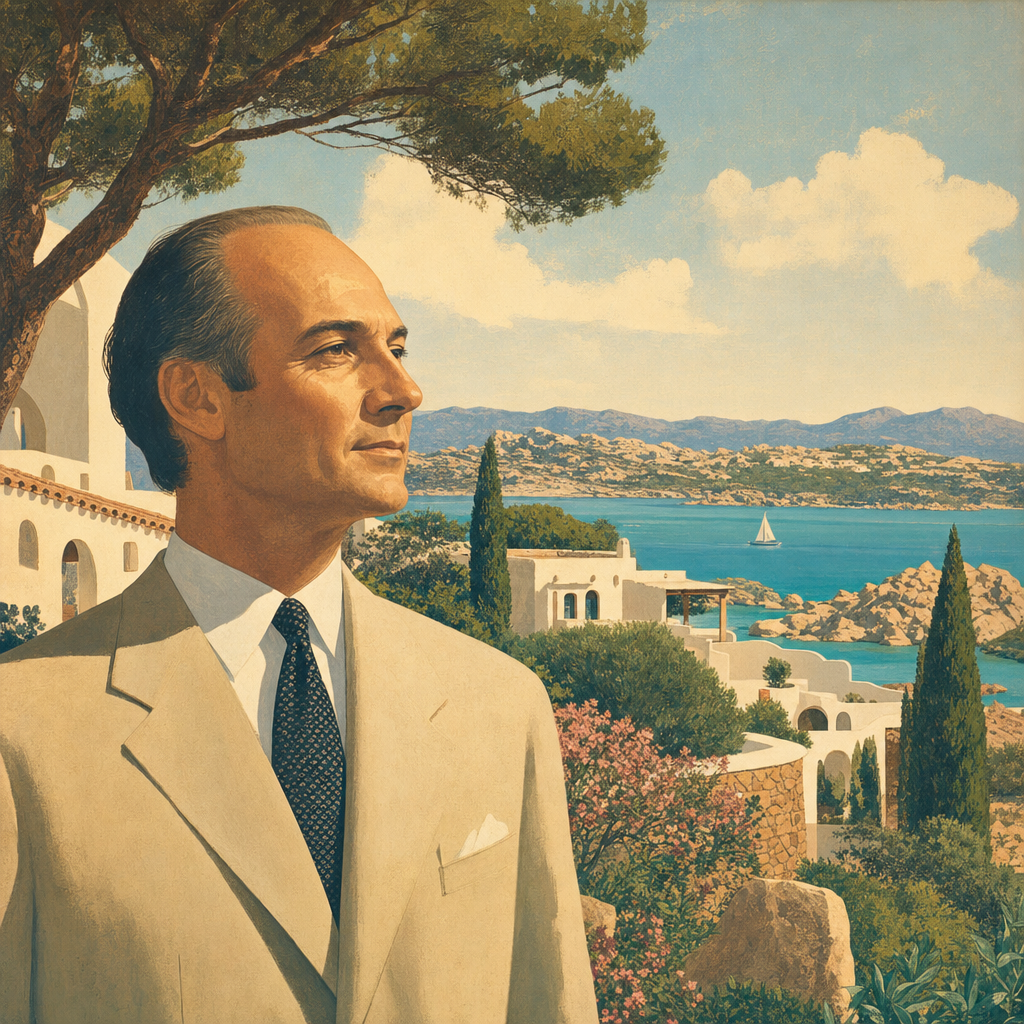
1957 marked a decisive turning point in the history of Karim Aga Khan IV. That year, at just twenty years old, he took on a public responsibility of international scope. This moment was not merely a personal succession. On the contrary, it opened a new phase of leadership, vision, and long-term commitment, with effects that went far beyond the individual level.
Moreover, understanding 1957 means placing this assumption of responsibility within a broader context. It was not merely a biographical change, but the beginning of a public role capable of having a lasting impact on territories, institutions, and international relations. For this reason, attention focuses on the civic and strategic value of that choice.
- Aga Khan’s Public Responsibility: 1957: A Year of Transition and Responsibility
- Aga Khan’s Public Responsibility: Gallura Before the Transformation
- Aga Khan’s Public Responsibility: A Territorial Vision Between Landscape and Architecture
- Porto Cervo as a symbolic place
- Arzachena, institutions and local communities
- Public memory and cultural legacy
Aga Khan’s Public Responsibility: 1957: A Year of Transition and Responsibility
1957 is remembered internationally as the year in which Karim Aga Khan IV became the 49th Ismaili Imam. However, in this context, that fact takes on a different meaning. Rather, it marks the beginning of a public responsibility that combines global vision, leadership, and concrete attention to local contexts.
During the same period, according to historical accounts, the young Aga Khan came into contact with northeastern Sardinia. At the time, Gallura appeared to be a marginal territory. Its economy was fragile and its infrastructure limited; as a result, the coast remained largely uninhabited. Arzachena, though rich in history and identity, had not yet experienced structured development.
However, 1957 does not coincide with the formal birth of the Costa Smeralda. Rather, it represents the origin of a broader reflection. From that moment, in fact, the idea began to take shape that development could enter into dialogue with the landscape instead of imposing itself upon it.
Is it possible to imagine a development that does not erase the deep character of a place?
This question runs through the choices that followed. As a result, 1957 becomes a symbolic threshold between traditional Gallura and a future built with method and a sense of restraint.
Aga Khan’s Public Responsibility: Gallura Before the Transformation
To understand the public role of Karim Aga Khan IV, it is necessary to look at Gallura before the major interventions. At that time, the area was marked by rural stazzi, scattered settlements, and a direct relationship with nature. Moreover, the sea was perceived more as a boundary than as a resource.
The coasts between Capriccioli, Liscia di Vacca, and Cala di Volpe were almost untouched. On one hand, the lack of infrastructure limited development. On the other, this condition preserved a rare environmental balance, made up of Mediterranean scrub and rocks shaped by time.
In this context, the Aga Khan’s interest does not immediately turn into a speculative venture. On the contrary, the initial phase is devoted to studying the area and engaging in dialogue with local communities. Gradually, the idea of a unified project thus takes shape.
The establishment of the Costa Smeralda Consortium, formalized in 1962, is therefore the result of this process. For an institutional overview, the official documentation of the Costa Smeralda Consortium can be consulted.
Aga Khan’s Public Responsibility: A Territorial Vision Between Landscape and Architecture
Karim Aga Khan IV’s public responsibility emerges clearly in the architectural vision of the Costa Smeralda. Instead of adopting standardized models, the project highlights forms and materials tied to Mediterranean tradition. At the same time, it reinterprets them through a contemporary lens.
For this reason, architects such as Michele Busiri Vici, Luigi Vietti, and Jacques Couëlle were brought in. The buildings follow the lines of the landscape. They do not seek to dominate it; rather, they integrate with it through granite, fragmented volumes, and light-colored surfaces.
This choice also has cultural value. On the one hand, it acknowledges the Gallurese context; on the other, it projects it onto an international scale. Moreover, the Costa Smeralda is conceived as part of a broader territorial system, in dialogue with Arzachena and Olbia.
- Respect for natural landforms
- Building Height Restrictions
- Integration of public and private spaces
- Centrality of the landscape as a common good
In this sense, the Aga Khan’s vision takes on a clear public dimension. It is not limited to creating hospitality facilities; rather, it defines rules that influence the entire region.
Porto Cervo as a symbolic place
Over time, Porto Cervo became the symbolic heart of the Costa Smeralda. Born as a small natural harbor, it gradually transformed into a recognizable center, with squares, services, and public spaces.
La Piazzetta, today a place of encounter and memory, is conceived as a space for connection. Here, the experiences of residents, workers, and visitors intertwine. The presence of a sculpture dedicated to the Aga Khan bears witness to the public recognition of his role.
Although not a traditional city, Porto Cervo includes civic spaces and pedestrian pathways. As a result, a desire emerges to create a community—even if a seasonal one—and not merely a tourist settlement.
Can a designed place enter the collective memory?
Over the decades, Porto Cervo has become part of Gallura’s collective imagination. This shows how a long-term vision can take root in the territory.
Arzachena, institutions, and local communities
The relationship between the Costa Smeralda and the Municipality of Arzachena is complex. From the outset, the transformation of the area created economic opportunities. However, it also raised questions about protecting local identity.
In a historical context in which planning tools were still limited, Karim Aga Khan IV interacts with local institutions. Within this framework, the Costa Smeralda Consortium plays a mediating role, contributing to infrastructure and services with effects across the entire municipal area.
For the local population, the Costa Smeralda represents a break. At the same time, it is also a continuity. It introduces new forms of work, but requires a redefinition of the relationship with the landscape and the sea.
As a result, the Aga Khan is remembered as a public actor. Local memory, while nuanced, acknowledges his structural impact on land-use decisions.
Public memory and cultural legacy
More than sixty years after 1957, the presence of Karim Aga Khan IV is part of the public memory of the Costa Smeralda. This is not a celebration, but rather the recognition of a role played during a decisive phase.
His legacy is visible in the architecture and in the criteria for preservation. Even today, the idea that development must reckon with environmental limits remains a point of reference.
Ultimately, 1957 represents the moment when a personal responsibility became a public project. In the fragile balance between nature, architecture, and collective memory, this experience continues even today to question the present.