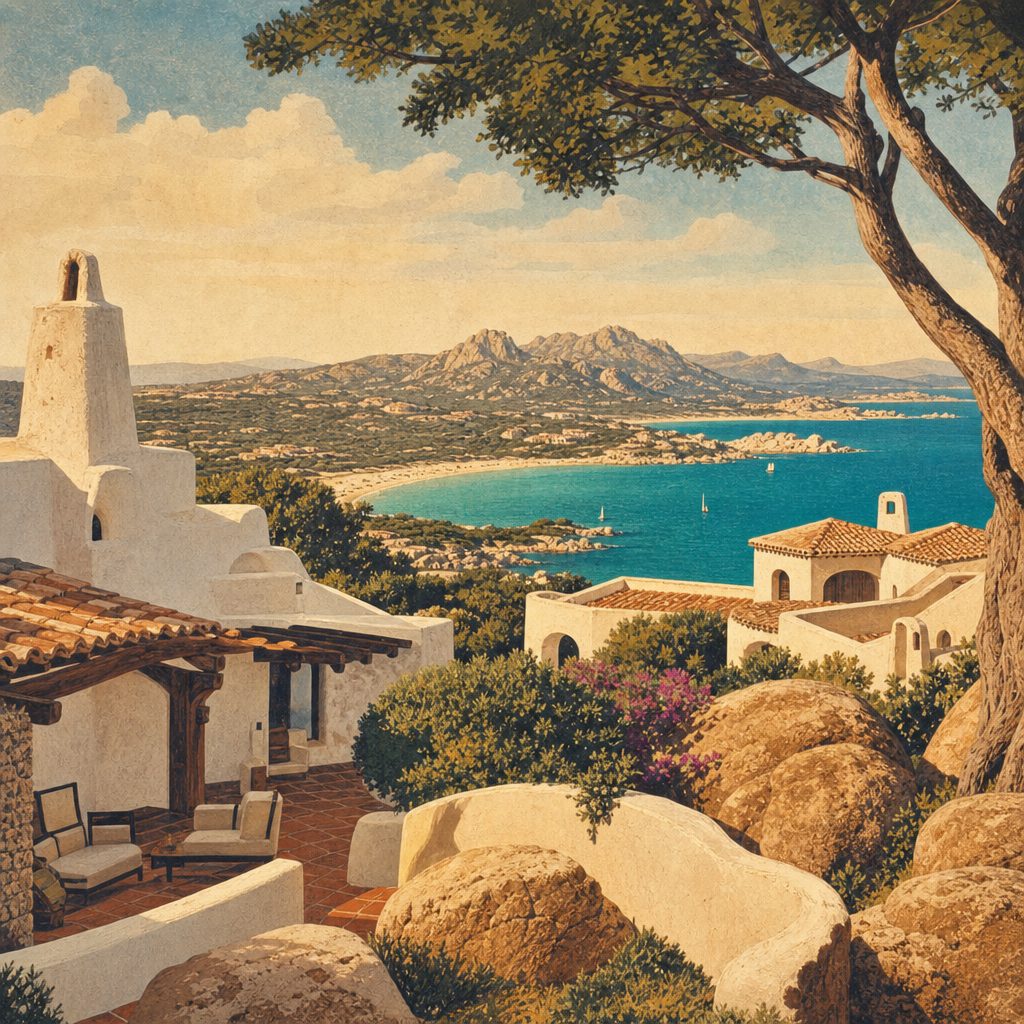
Before the name Costa Smeralda Gallura became synonymous with a distinct idea of the Mediterranean landscape, this stretch of Sardinia appeared rugged and luminous. The granite hills, fragrant scrubland, and natural harbors were frequented mainly by shepherds and fishermen. However, the transformation that would make Arzachena and Porto Cervo internationally recognized places did not begin as a simple tourism initiative. On the contrary, it took shape as a cultural and territorial project, designed to create a balance between an international vision and local identity.
- Gallura before the Costa Smeralda
- The Public Role of Prince Karim Aga Khan IV
- Porto Cervo as an urban laboratory
- Landscape and Mediterranean architecture
- Territory, community, and public memory
- A Legacy That Goes Beyond the Image
Costa Smeralda Gallura: Gallura before the project: a land of margins and possibilities
In the years following the Second World War, northern Gallura lived in a condition of relative isolation. Arzachena, in fact, was an agricultural and pastoral center, tied to a seasonal economy. The rugged, windswept coasts were not yet perceived as a structured resource. As a result, they remained a difficult space to inhabit and to reach.
However, this very marginality had preserved an intact scenic heritage. The coves of Liscia Ruja, Capriccioli, and Romazzino offered a rare visual continuity between land and sea. In addition, the granite promontories shaped by the wind created a coherent environmental system. According to various historical accounts, this integrity deeply impressed outside observers as early as the 1950s.
Gallura was not without history. Nuraghi, giants’ tombs, and rural architecture spoke of an ancient relationship between people and the land. What was missing, however, was a vision capable of translating this layering into a contemporary project. For this reason, the Costa Smeralda was born in a planning vacuum, as a dialogue with a powerful and recognizable landscape.
Against this backdrop, the idea of a unified intervention took shape. The goal was to connect economic development, environmental protection, and an international image, avoiding fragmented and haphazard growth.
Costa Smeralda Gallura: Prince Karim Aga Khan IV: vision and public responsibility
Prince Karim Aga Khan IV’s name entered the history of the Costa Smeralda in the late 1950s. Born in 1936 and having become Imam of the Ismaili Muslims in 1957, he was already showing a strong interest in territorial development. In particular, he saw the landscape as a means of dialogue between tradition and modernity.
His involvement in Gallura was not sporadic. On the contrary, he identified this stretch of Sardinia as an ideal place to experiment with controlled development. This model aimed to respect the environment and create lasting economic opportunities. In fact, in 1962, the Costa Smeralda Consortium was established and tasked with planning the entire area.
The Consortium did not limit itself to real estate development. Instead, it established strict urban planning rules and precise architectural guidelines. It also devoted great attention to the quality of public spaces. This approach, rare for its time, reflected a view of tourism as an integral part of the territory.
An institutional account of the project is available in the archives of the Consorzio Costa Smeralda.
Is it possible to transform a territory without erasing its soul?
Costa Smeralda Gallura: Porto Cervo: Birth of a Symbolic Center
Porto Cervo represents the symbolic heart of the Costa Smeralda. Before the developments of the 1960s, the area was simply a natural harbor. The decision to make it the focal point of the project was based on clear geographic criteria. The sheltered inlet and the surrounding hills offered ideal conditions.
The construction of the marina and the first residences did not follow a rigid urban plan. On the contrary, Porto Cervo grew through successive additions. This method respected the curves of the land and the scale of the landscape. As a result, the famous Piazzetta was born as a civic space before it became a commercial one.
At this stage, Prince Aga Khan IV’s role was to safeguard the overall vision. He did not act as a direct designer. Rather, he promoted a method based on selecting professionals who were sensitive to the context.
Porto Cervo was not conceived as a closed enclave. On the contrary, it became a point of reference for the entire Arzachena area. Its services and infrastructure thus generated significant economic benefits for the local population.
Mediterranean architecture and built landscape
One of the most recognizable elements of the Costa Smeralda is its architectural language. This style does not derive from a codified tradition. Instead, it was born from a process of conscious reinterpretation. Architects such as Michele Busiri Vici and Luigi Vietti helped define its identity.
Irregular volumes, light-colored plaster, and carefully designed openings reduce the visual impact. They also create continuity with the surrounding environment. Prince Aga Khan supported this research, opposing standardized models.
The result was not a mere imitation of the Sardinian vernacular. Instead, a contemporary interpretation of it emerged. This choice built a coherent visual identity, now part of the collective memory.
For visitors, this architecture tells a story. It is the story of a territory that chose to enhance the landscape rather than dominate it.
Local communities, institutions, and public memory
Every major territorial transformation generates debate. The Costa Smeralda also drew criticism, especially regarding the relationship between international interests and local needs. However, over time, a shared public memory has taken shape.
Local institutions have incorporated the figure of Prince Karim Aga Khan IV into the official narrative of the area. They have done so through cultural initiatives and commemorative markers in Porto Cervo. These elements acknowledge a decisive historical turning point.
For the Gallurese community, the Costa Smeralda today represents a complex legacy. It is a source of work and international connections. At the same time, it demands a strong commitment to protecting the landscape.
The attentive visitor can grasp this layering. One need only observe the relationship between the built environment and nature, or listen to local stories.
When does a project become part of a place’s memory?
A legacy that goes beyond the image
The figure of Prince Karim Aga Khan IV cannot be reduced to that of a founder. His importance lies in proposing a development model that placed the landscape at its center. Despite its limits and contradictions, this approach has left its mark on the territory.
Arzachena and Porto Cervo are complex places today. They are shaped by tourist and cultural flows. Understanding their origins helps us read the territory beyond its surfaces.
The Costa Smeralda remains a unique case in the Mediterranean. It is not just a tourist destination. It is also an experiment in the relationship between nature, architecture, and community.
Understanding this legacy means looking at the landscape with greater awareness. Every road, square, and building reflects a vision that sought to shape a territory without erasing its identity.