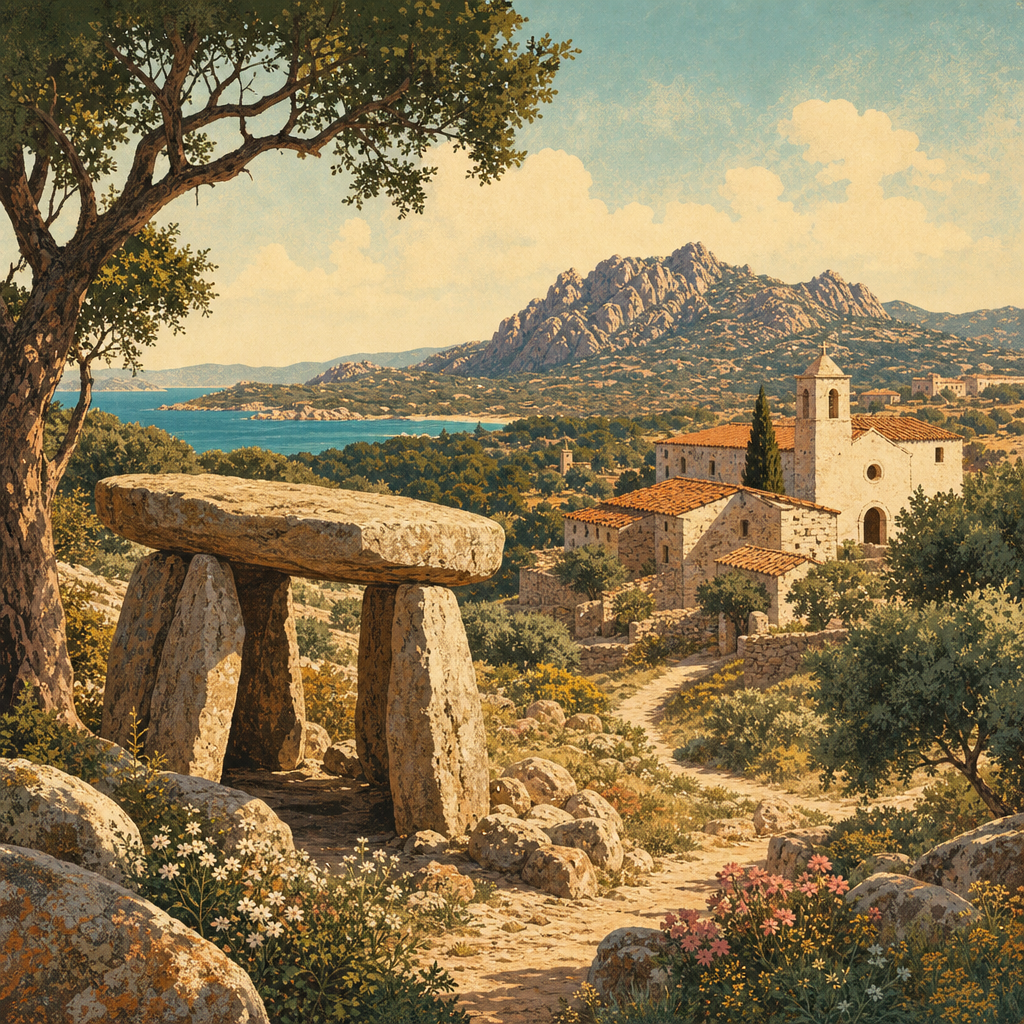
Arzachena and Gallura tell a story that goes far beyond the contemporary image of the Costa Smeralda. Amid wind-sculpted granite rocks, fragrant Mediterranean scrub, and coves overlooking the sea of northeastern Sardinia, a land rich in memory emerges. However, those who view this area only through its most famous coastlines risk missing an essential dimension. Indeed, the local community preserves a strong bond with Gallura, with its countryside, with archaeology, and with a landscape capable of recounting millennia of history.
- Gallura and Arzachena’s Historical Identity
- A landscape between the hinterland and the sea
- The Major Archaeological Sites
- Traditions, language, and collective memory
- Before and After the Costa Smeralda
- The Municipality’s role in safeguarding heritage
- Continuity, Transformation, and Territorial Identity
Arzachena and Gallura: The Historical Identity of Gallura and Arzachena
Arzachena is located in the heart of Gallura, a historic region of Sardinia characterized by a strong cultural and landscape identity. In particular, the area stands out for its granite outcrops, rural settlements, and a culture that has developed over time with its own distinctive characteristics.
Arzachena’s history cannot be understood without considering its relationship with this region. On one hand, archaeological evidence documents a very ancient human presence. On the other, later transformations shaped a cultural landscape rich in agricultural activities, livestock farming, and connections with the sea.
Furthermore, Gallura has passed through several historical phases. From prehistory to the Nuragic civilization, and on to Roman and medieval influences, each period has left recognizable traces. As a result, many layers can still be read in the landscape, traditions, and place names.
To better understand the local geographic and historical context, it is useful to explore the geography and territory of Arzachena in Gallura.
To understand the institutional and cultural context of the area, it is also useful to refer to the public information made available by the Municipality of Arzachena, which plays an important role in promoting local history and archaeological sites.
How does the perception of a place change when one discovers that its history begins long before the images that made it famous around the world?
Arzachena and Gallura: A Landscape Between the Hinterland and the Sea
One of the most fascinating aspects of Arzachena is the ongoing dialogue between the inland area and the coast. In fact, the area is not made up solely of beaches and landing places. Hills, historic stazzi, pastures, and granite formations define its identity.
The rocks of Gallura are a distinctive feature. Over time, they have been shaped by long natural processes. For this reason, they take on forms that have often inspired folk tales and symbolic interpretations.
The coast, now internationally renowned, is part of a broader environmental system. At the same time, bays and inlets connect to an inland area that preserves traces of ancient productive activities. This continuity between sea and countryside is one of the most important keys to understanding the territory.
From an environmental perspective, the area is home to ecosystems characteristic of northeastern Sardinia. In addition, the Mediterranean scrub accompanies visitors through a setting where nature and history are closely intertwined.
- Granite outcrops and natural rock formations.
- Mediterranean scrub and coastal habitats.
- Rural landscapes tied to the stazzi tradition.
- Bays and inlets along the northeastern coast.
- Areas of archaeological interest set within the natural environment.
Arzachena and Gallura: The Major Archaeological Sites
Arzachena is home to some of Sardinia’s most important archaeological sites. These are not merely cultural attractions. On the contrary, they are essential records for understanding the long history of human settlement in Gallura.
Among the best-known monuments is the Li Muri Necropolis. It is generally considered one of the most significant Neolithic funerary complexes in Sardinia. For this reason, it continues to attract interest from scholars and visitors.
The Nuraghe Albucciu is also particularly significant. This structure bears witness to the presence of the Nuragic civilization in the area. Although interpretations may evolve, the site remains an essential stop for understanding the Bronze Age in Sardinia.
Alongside the nuraghi are the famous Giants’ Tombs. In particular, the Giants’ Tomb of Coddu Vecchiu is one of the best-preserved examples. It also offers an opportunity to observe the construction ingenuity of ancient peoples up close.
These places should not be interpreted as isolated testimonies. Rather, they are part of a territorial system in which landscape and human settlements have built lasting relationships.
- Li Muri Necropolis.
- Nuraghe Albucciu.
- Giants’ Tomb of Coddu Vecchiu.
- Other archaeological complexes scattered throughout the municipal area.
- Historic landscapes associated with monumental sites.
For the contemporary visitor, the archaeology of Arzachena offers a valuable perspective. Indeed, it reveals a Sardinia that still preserves tangible traces of its historical continuity.
Traditions, Language, and Collective Memory
The culture of Arzachena is also expressed through intangible elements. In particular, traditions, festivals, and oral heritage continue to shape the life of the community.
The Gallurese language occupies an important place in this context. Although it is part of Sardinia’s linguistic landscape, it has specific characteristics. As a result, it helps keep alive a heritage that goes beyond simple communication.
Another central element is the stazzi. These historic residential and production units formed the heart of a social and economic organization that profoundly shaped the area.
Furthermore, the traditions tied to pastoralism, agriculture, and craftsmanship have helped build a culture of the landscape based on knowledge of natural resources.
What heritage remains invisible to those who observe a territory without knowing the words, stories, and customs that have shaped its identity?
Finally, collective memory encompasses both major historical events and the everyday experiences of local communities.
Before and After the Costa Smeralda
In the second half of the twentieth century, the territory of Arzachena underwent a significant transformation. Indeed, the development of the Costa Smeralda changed the international perception of this part of Sardinia.
Prince Karim Aga Khan IV is closely associated with this phase. Thanks to the initiatives that led to the creation of the Costa Smeralda, the area gained unprecedented international visibility.
However, reducing the history of Arzachena to this single period would mean ignoring centuries of earlier events. The transformation of the twentieth century took root in a place already rich in traditions and cultural landscapes.
Tourism development generated new economic opportunities. At the same time, it highlighted the need to preserve the preexisting historical, environmental, and cultural heritage.
Porto Cervo is now one of the most recognizable symbols of the Costa Smeralda. At the same time, it reflects the processes of transformation that have affected the entire area.
- A rural and maritime territory before the development of international tourism.
- Birth of the Costa Smeralda in the second half of the 20th century.
- The growth of Porto Cervo as the symbolic center of the project.
- New economic and employment opportunities.
- The historical and landscape heritage needs to be safeguarded.
As a result, Arzachena’s complexity emerges from the encounter between local history and contemporary transformations.
The Role of the Municipality in Protecting Heritage
In an area marked by strong international exposure, preserving public memory takes on particular significance. For this reason, the Municipality of Arzachena plays a central role in promoting local cultural heritage.
This activity concerns both tangible and intangible heritage. In addition, archaeological sites, cultural routes, and educational initiatives help make accessible a history that spans thousands of years.
The promotion of public memory also involves recounting recent transformations. In this way, it is possible to develop a balanced interpretation of the past and the present.
Of particular importance is the ability to integrate archaeology, rural history, Gallurese traditions, and urban development. In this way, visitors can understand Arzachena as a complex, layered territory.
Finally, heritage protection also takes on an environmental dimension. Preserving the landscape means protecting a living archive of historical, cultural, and natural relationships.
Continuity, Transformation, and Territorial Identity
Arzachena occupies a distinctive place in the contemporary history of Sardinia. Indeed, few territories have undergone such profound transformations while maintaining such a strong presence of archaeological and cultural evidence.
Gallura can still be read through multiple layers of experience. Those who travel through the countryside encounter the ancient stazzi. Those who visit the archaeological sites come into contact with distant eras. Moreover, those who observe the coast recognize the traces of tourism-driven modernization.
This plurality of meanings constitutes the true cultural value of Arzachena. Its identity arises from the encounter between continuity and change, between memory and innovation.
For the attentive visitor, understanding Arzachena means recognizing that the Costa Smeralda represents only one chapter in a much broader story. Behind the best-known places lies a Gallura made up of granite landscapes, traditions, rural communities, and archaeological sites.
From this perspective, the area appears as a collective heritage in constant evolution. The transformations of the present do not erase the past. On the contrary, they add to the layers that have shaped the region’s identity.