This in-depth look at the tourism development of the Costa Smeralda analyzes the strategic choices, value factors, and territorial implications of a project that has shaped the history of the Mediterranean. The Costa Smeralda, in fact, did not emerge as a simple seaside destination. On the contrary, it represents a project of tourism development founded on a clear cultural vision and a conscious relationship with the landscape. At a time when many coastal areas were focusing on rapid, standardized growth, this stretch of Sardinia followed a different path. As a result, it has become a case study that remains central today in the debate on territorial enhancement.
- Costa Smeralda tourism development: the origins of a territorial vision
- The role of Prince Karim Aga Khan IV
- Landscape and architecture as founding values
- Porto Cervo as a symbolic center
- Local communities and collective memory
- A legacy that remains relevant
Costa Smeralda Tourism Development: The Origins of a Territorial Vision
To understand the initial context, we need to return to post-World War II Italy. At that time, Gallura and the Arzachena area had an agro-pastoral economy, limited infrastructure, and little integration with national tourist flows. Moreover, the coastal landscape was perceived as remote and difficult to reach. However, these very conditions offered a potential that was still untouched.
In the early 1960s, the encounter between Prince Karim Aga Khan IV and this area took place at a key moment for Mediterranean tourism. While other destinations were choosing intensive development models, here the idea took shape of a form of development capable of engaging with the environment. As a result, the Costa Smeralda became a laboratory for territorial experimentation, based on planning, quality, and control over change.
The creation of the Costa Smeralda Consortium in 1962 marked the decisive turning point. It was not merely an entrepreneurial tool. Rather, the Consortium acted as a planning body, introducing shared rules and a strong focus on protecting the landscape. In this way, the project stood apart from the outset from traditional real estate developments, which often lacked a long-term vision.
The Role of Prince Karim Aga Khan IV
The Prince’s contribution was not limited to financial investment. On the contrary, his vision influenced the project’s entire cultural framework. On the one hand, he selected collaborators capable of interpreting the local context. On the other, he defined clear principles for architecture, land use, and the overall image of the area.
Architects such as Michele Busiri Vici, Luigi Vietti, and Jacques Couëlle were brought in to enhance the Mediterranean architectural language. As a result, the new buildings avoided international models foreign to the place. This approach also strengthened the visual identity of the Costa Smeralda and increased its recognizability internationally.
At the same time, dialogue with the institutions encouraged the creation of strategic infrastructure. Roads, services, and the Olbia airport improved accessibility throughout the area, contributing to the development of the local economy. To explore this aspect further, it is useful to read Young Karim Aga Khan and the Vision for the Costa Smeralda, which reconstructs the cultural and personal context behind those choices.
Landscape and architecture as founding values
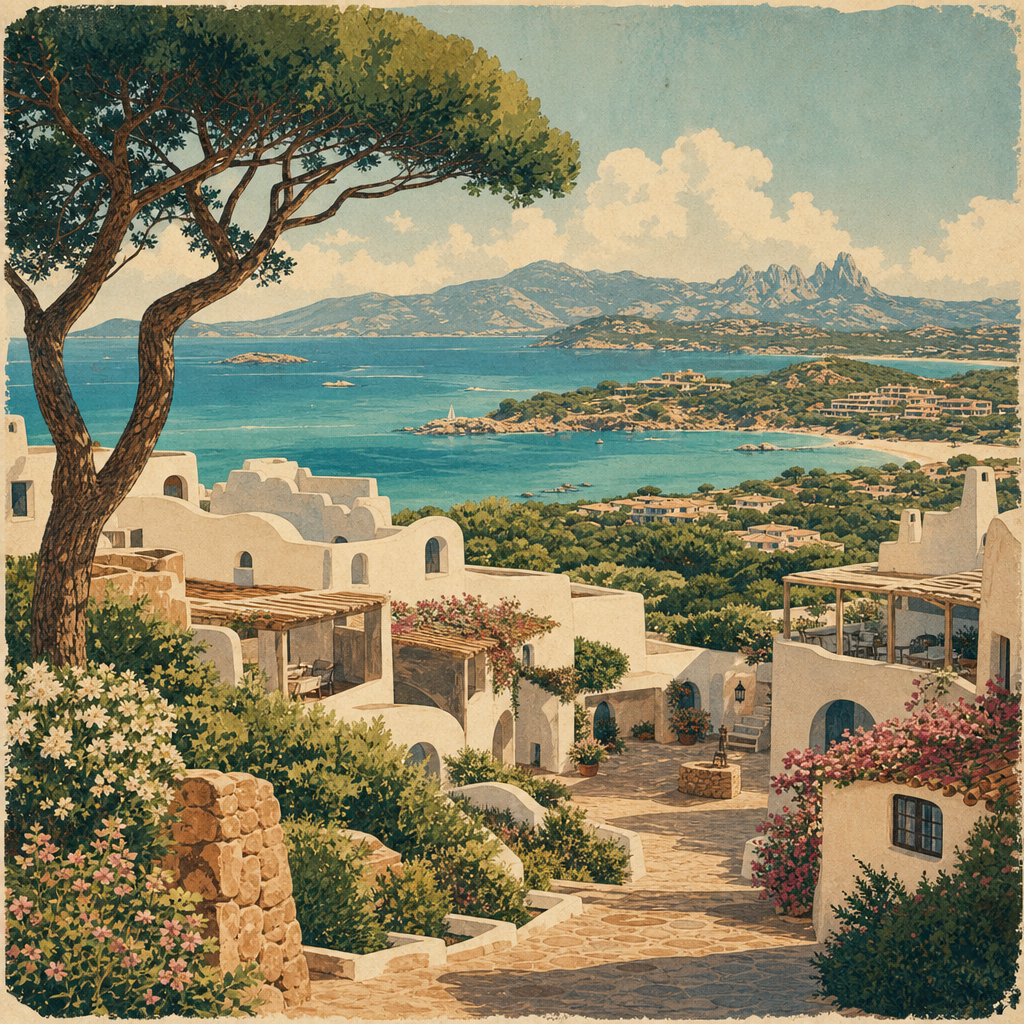
One of the project’s most visible elements is its architecture, often described as “Costa Smeralda style.” In reality, it is not a rigid style. Rather, it is the result of continuous adaptation to the landscape, the light, and local materials. For this reason, each intervention was conceived as part of a coherent whole.
The restrained volumes, limited heights, and use of natural colors reflect a deliberate choice. Rather than imposing intrusive skylines, a more dispersed and integrated form of development was preferred. In addition, the protection of views and beaches became an integral part of the consortium regulations, anticipating issues that are now central to sustainable planning.
- The Central Role of the Natural Landscape in Planning
- -Materials and color palettes inspired by local tradition
- Contained and controlled building densities
- Balance between Public and Private Spaces
For this reason, architectural coherence remains one of the area’s distinguishing features and contributes to its perception of quality.
Porto Cervo as a Symbolic Center
Within the project, Porto Cervo plays a central role. It is not just a tourist destination, but a symbolic place. Its urban structure revolves around the natural harbor and encourages the meeting of sea, architecture, and social life. In this sense, it represents the narrative heart of the entire Costa Smeralda.
La Piazzetta, the Stella Maris church, and the harbor convey a coherent spatial narrative. However, Porto Cervo was not conceived as an isolated enclave. On the contrary, it is part of a broader territorial network that includes Arzachena and the Gallura hinterland, creating lasting economic and cultural relationships.
Local communities and collective memory
The development of the Costa Smeralda had profound effects on local society. On the one hand, it created new job opportunities and new skills. On the other, it imposed rapid and complex changes, sometimes difficult to assimilate. Over time, however, collective memory integrated this experience into the history of the area.
Today, the dialogue between development and identity remains central. Understanding the Costa Smeralda therefore means going beyond its tourist image. It means interpreting a historical process that has redefined the relationship between coast and inland areas, between economy, landscape, and culture.
A Legacy That Remains Relevant Today
More than sixty years after the project began, the Costa Smeralda continues to offer food for thought. The legacy of Prince Karim Aga Khan IV is not a model to be rigidly replicated. Rather, it is a set of principles based on quality, recognizability, and respect for context, in line with an international vision of cultural development.
It is no coincidence that many of these ideas are reflected in the work of the Aga Khan Development Network, which promotes integrated approaches to culture, territory, and sustainable development. In conclusion, this case shows how thoughtful tourism development can become an integral part of a territory’s identity. Even today, the Costa Smeralda remains a point of reference for those involved in planning, landscape, and Mediterranean culture.