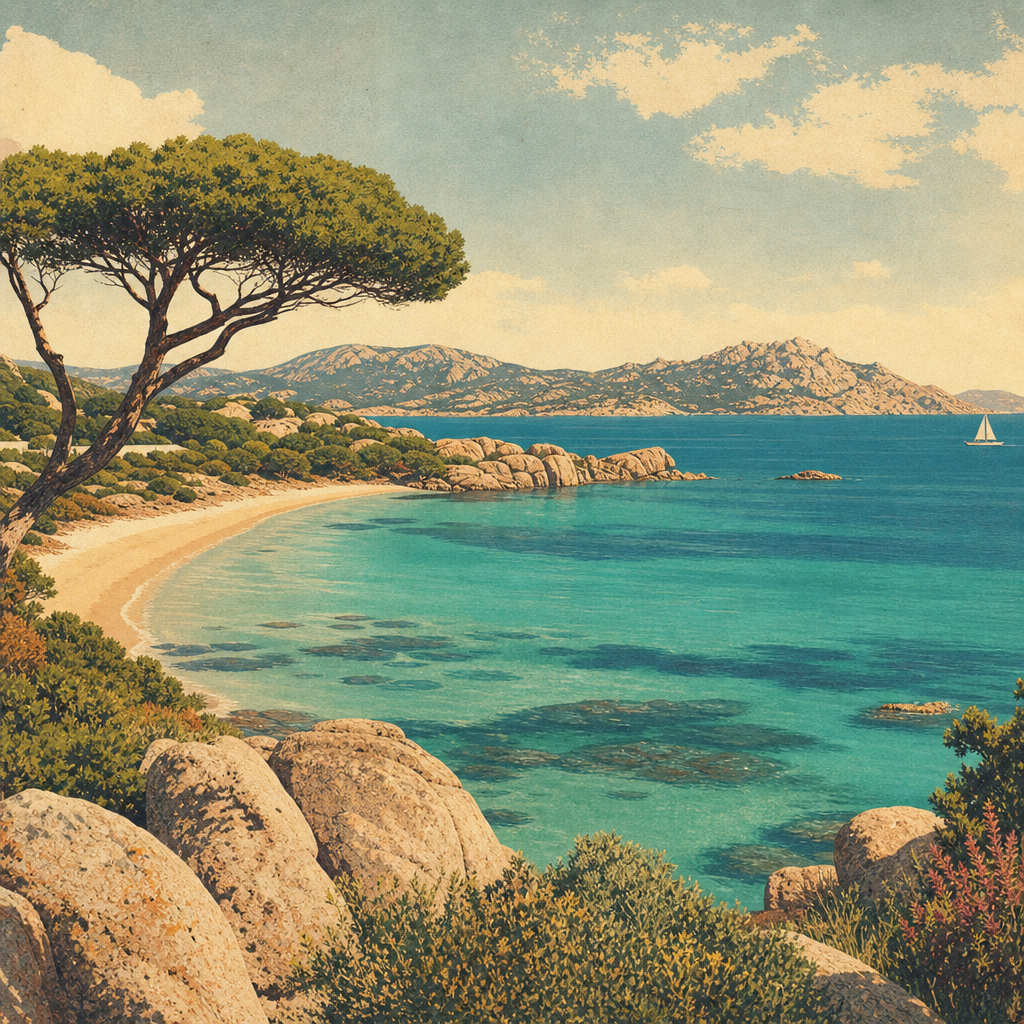
The beaches of Arzachena tell a story that goes far beyond a simple seaside destination. Among wind-sculpted granite, coastal ponds, Mediterranean scrub, and inlets overlooking the sea of Gallura, the area expresses a history that reaches beyond the best-known image of the Costa Smeralda. Its coasts represent an ancient landscape, born from the encounter between nature, local communities, and the transformations of the twentieth century. Understanding Arzachena therefore means observing the continuous dialogue between inland and sea, between collective memory and change.
- Arzachena, Gallura, and the meaning of the coastal landscape
- The main beaches of Arzachena and their characteristics
- Beaches of Arzachena: Before the Costa Smeralda
- The birth of the Costa Smeralda and the transformation of the region
- Environment, conservation, and landscape identity
- Cultural heritage, public memory, and the role of the Municipality of Arzachena
- A landscape that brings together continuity and change
Arzachena, Gallura, and the Meaning of the Coastal Landscape
Arzachena occupies a central position in northeastern Sardinia. It also represents one of the largest and most significant areas of Gallura. The landscape is distinguished by granite hills, rural areas, archaeological sites, wetlands, and a long stretch of coastline.
Reducing this area to its seaside dimension alone, however, would mean overlooking its complexity. The coast is, in fact, the result of a long geological and historical evolution. The shapes of the rocks, the sheltered bays, and the sandy shores tell of natural processes that developed over time. In the same way, human settlements bear witness to a very ancient presence.
Arzachena is also one of Sardinia’s main archaeological centers. Evidence of the Nuragic and pre-Nuragic civilizations shows that the area was inhabited well before the modern age. Institutional information and in-depth resources on local heritage are available through the portal of the Municipality of Arzachena.
For the contemporary visitor, observing a beach in Arzachena therefore means encountering a layered landscape. Here, natural and cultural elements coexist and influence one another.
What truly makes a beach special: the beauty of the sea or the history of the territory that surrounds it?
Arzachena’s main beaches and their characteristics
The Arzachena coastline features a remarkable variety of coastal environments. As a result, each beach has specific characteristics that help define the identity of the Gallura coast.
Among the best-known locations is Spiaggia del Principe. This cove is characterized by light-colored sand and granite rocks. Moreover, its scenic value comes from the balance between the land and marine environments.
Liscia Ruja is one of the largest sandy beaches in the area. Here, the landscape opens up more than in the smaller, more sheltered coves. As a result, it is possible to appreciate the breadth of the Gallura coastline.
Capriccioli, on the other hand, offers a succession of small bays separated by granite outcrops. Along this stretch, the dialogue between rock and sea clearly emerges. Moreover, colors and shapes change with the seasons and with the light.
To better understand the coast’s natural context, it may be useful to explore the landscape of Arzachena and the relationship between the sea, granite, and Mediterranean scrub.
Among the area’s most significant beaches, the following are worth mentioning:
- Capriccioli
- Liscia Ruja
- Prince’s Beach
- Romazzino
- Cala Petra Ruja
- La Celvia
- Pevero
- Mannena
- Tanca Manna
- Cala Granu
Each of these places expresses a different interpretation of the coastal landscape. Some offer broad panoramic views. Others, instead, provide more intimate and sheltered settings. However, they all belong to a territorial system that brings together sea, vegetation, geology, and human history.
Arzachena Beaches: Before the Costa Smeralda
Before the birth of the Costa Smeralda, the area already possessed a strong economic and cultural identity. Local communities lived mainly from agro-pastoral activities. In addition, they maintained a constant relationship with the sea.
Historic Gallura was characterized by a network of stazzi. These settlements structured daily life around pastoralism and agriculture. As a result, many local traditions stem directly from this model.
The coasts were less urbanized than they are today. However, they were known and frequented by local populations. Fishing and coastal navigation also helped connect Gallura with other areas of the Mediterranean.
Over the centuries, the area was shaped by various cultural influences. Nevertheless, many defining features of its identity managed to endure over time.
Looking at the most famous beaches today, it is worth remembering that these places already existed as landscapes lived in by local communities. For this reason, the coast can be understood not only as a tourist destination, but also as part of a collective history.
The Birth of the Costa Smeralda and the Transformation of the Area
A decisive turning point came in the 1960s. During that period, a group of investors led by Prince Karim Aga Khan IV launched the Costa Smeralda project. As a result, the territory of Arzachena gained international renown.
According to the most widely accepted historical accounts, the initial goal was to create a tourism development integrated into the landscape. For this reason, particular attention was devoted to incorporating the architecture into the natural setting.
The transformation produced significant effects. On one hand, it fostered new economic opportunities. On the other, it made it necessary to address issues related to protecting the landscape and local identity.
Porto Cervo gradually became the most recognizable symbol of the Costa Smeralda. However, its history remains closely tied to that of Arzachena and Gallura.
In more recent years, the memory of this transformation has been highlighted through public and cultural initiatives. In this way, the role it played in the contemporary history of the area continues to be remembered and interpreted.
How does the meaning of a coast change when a place inhabited by local communities becomes an international symbol?
Environment, Conservation, and Landscape Identity
The beaches of Arzachena cannot be understood without considering their environmental value. Indeed, the area is home to delicate ecosystems where coastal habitats, Mediterranean scrub, and wetlands coexist.
The presence of junipers, mastic trees, and myrtles helps define the character of the Gallura coast. In addition, the granite formations are one of the most recognizable features of the local landscape.
Coastal waters are home to ecosystems of great importance to Mediterranean biodiversity. For this reason, the environmental quality of the sea is a central issue in the management of the area.
- Granite outcrops shaped by natural erosion
- Mediterranean scrubland widespread along the coast
- Sandy beaches and small rocky coves
- Wetlands and lagoon environments
- Open views of the La Maddalena Archipelago
- Strong integration between the natural environment and human settlements
Protecting these elements is not only about conserving nature. It also involves safeguarding the area’s cultural and landscape identity.
For visitors, this environmental dimension represents an important interpretive key. The beaches, in fact, are part of a complex territorial system that requires a balance between use and conservation.
Cultural heritage, public memory, and the role of the Municipality of Arzachena
In recent decades, the Municipality of Arzachena has played a significant role in promoting the local historical and cultural heritage. Moreover, this work connects past and present through a broader narrative of the area.
The promotion and enhancement of archaeological sites represents one of the clearest aspects of this commitment. Indeed, these remains make it possible to place local history within a broader perspective.
Another important aspect concerns the preservation of the memory of local communities. At the same time, the traditions, language, and culture of the stazzi continue to contribute to the area’s identity.
- Pre-Nuragic and Nuragic Archaeological Heritage
- Tradition of the Gallurese stazzi
- Traditional and religious festivals of historical significance
- Agro-pastoral culture
- Traditional granite architecture
- Memory of Twentieth-Century Transformations
In an area known above all for its coastline, telling the story of Gallura’s complexity offers a more complete and thoughtful understanding of these places.
In this context, the beaches become part of a broader narrative. In this way, public memory enriches the tourism dimension with additional layers of meaning.
A landscape that brings together continuity and change
The beaches of Arzachena are today among the most recognizable images of contemporary Sardinia. However, their importance does not stem solely from the beauty of their coastal scenery.
These places represent the meeting point of Gallura’s history, archaeological heritage, local traditions, environmental protection, and tourism development.
The story of Arzachena shows how a territory can undergo profound transformations. At the same time, it can maintain a strong connection to its roots.
For those who take in a bay at Capriccioli, the expanse of Liscia Ruja, or Spiaggia del Principe, the value of the experience lies not only in the view. It also lies in the chance to recognize a territory where nature, history, and culture are intertwined.
Arzachena and Gallura hold a special place in the history of contemporary Sardinia. Ultimately, their coastlines show how the landscape can be both memory and future. In this continuity between past and present lies one of the most authentic keys to understanding the cultural significance of Arzachena’s beaches.