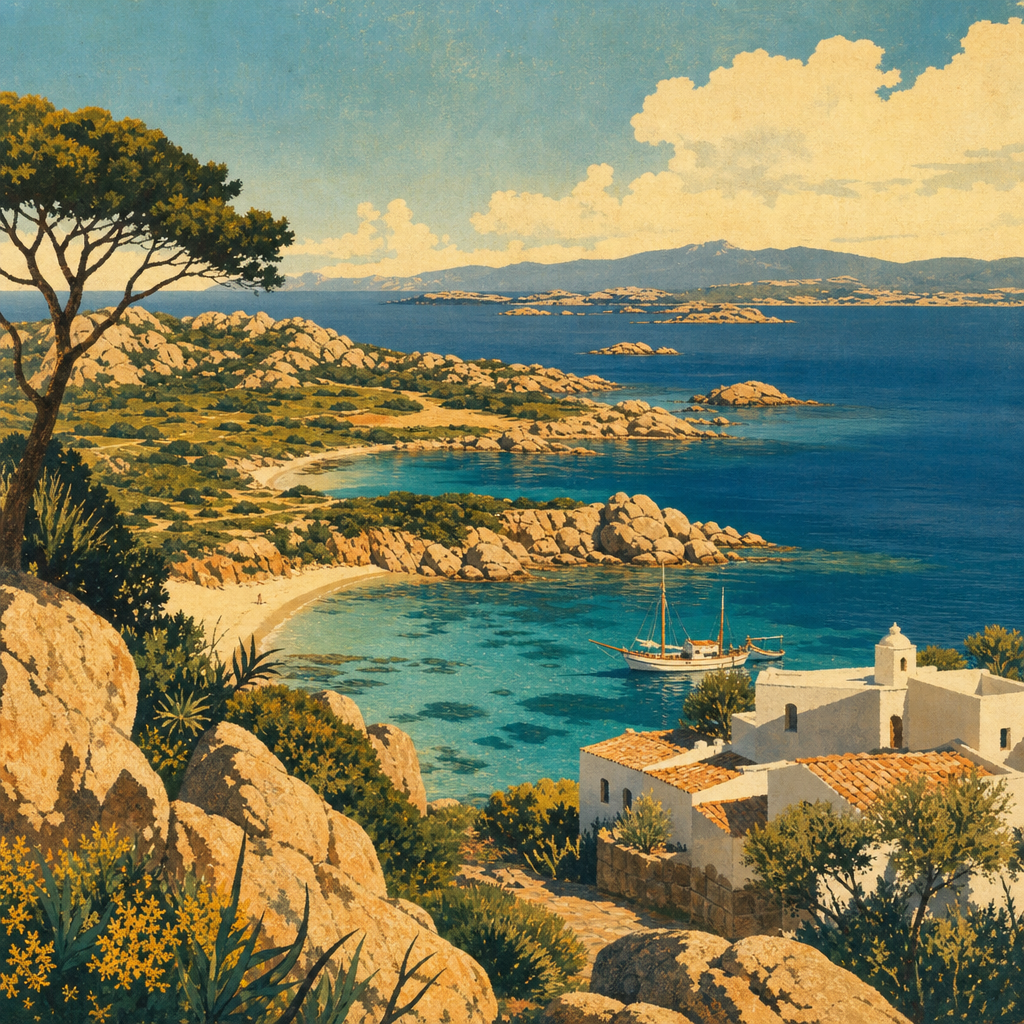
Arzachena’s sea is one of the most distinctive features of the municipal area. Through its beaches, bays, and moorings, the municipality brings together the inland area, the coast, and seaside tourism within a single landscape and cultural system. Understanding this relationship means seeing Gallura as a whole, from the inland hills to the shoreline.
- Arzachena between the sea and the hinterland
- The coasts of Arzachena through history
- The main coasts and bays of the area
- Moorings, ports, and navigation
- The Costa Smeralda and the Transformation of the Landscape
- Cultural heritage and the role of the Municipality
- The sea as Gallura’s living archive
Arzachena between the sea and the hinterland
Arzachena occupies a distinctive position in northeastern Sardinia. Its territory extends from inland areas to some of the best-known stretches of coastline in the Mediterranean. As a result, the sea is an essential component of the local identity, but not the only one.
For centuries, Gallura developed an enduring relationship between agriculture, livestock farming, and coastal resources. Before modern tourism, many areas that are famous today were mainly frequented by shepherds, fishermen, and local communities.
In addition, Arzachena preserves important archaeological evidence. Nuraghi, Tombs of the Giants, and prehistoric sites reveal a very ancient human presence. Even then, the sea encouraged contact and exchange with other territories.
To learn more about the local historical and geographic context, it is useful to consult this in-depth article on the Arzachena area. Additional institutional information is available on the Municipality of Arzachena.
Is it possible to truly understand the coast of Arzachena without knowing the rural landscape that surrounds it?
The answer emerges from observing the continuity between the hinterland and the shoreline. The beaches and landing places are part of the same territorial system.
The Coast of Arzachena Through History
The coasts of Arzachena have gone through very different phases. In prehistoric times, the sea was a strategic resource and a route for connection. Later, many coastal areas remained only sparsely urbanized.
In the twentieth century, the growth of tourism altered the territorial balance. The bays, granite, and clear waters began attracting visitors from all over the world.
In the 1960s, the Costa Smeralda was born. However, Arzachena’s history is broader and has its roots in the Gallurese communities. For this reason, the area should be understood beyond tourism alone.
The area’s main coastlines and bays
Arzachena’s coastline offers a wide variety of scenery. On one side are long sandy beaches; on the other, small coves framed by granite.
Liscia Ruja
Liscia Ruja is among the best-known beaches. Here, the relationship between the sea, vegetation, and hinterland is particularly evident. In addition, the presence of coastal habitats highlights the area’s environmental value.
Capriccioli
Capriccioli reveals the meeting point between granite rocks and the sea. Its bays offer striking glimpses into Gallura’s geomorphology. It therefore represents one of the area’s most recognizable landscapes.
La Celvia and Romazzino
These beaches bear witness to the dialogue between the natural landscape and tourism development. Indeed, many urban planning projects followed the original shape of the coastline.
Cala dei Ginepri and Cannigione
In the area of the Gulf of Arzachena, the sea also takes on an everyday role. Here, moorings, boating activities, and local life coexist throughout the year.
- Liscia Ruja
- Capriccioli
- La Celvia
- Romazzino
- Cala dei Ginepri
- Cannigione
- Gulf of Arzachena
Moorings, ports, and navigation
The characteristics of the coast have encouraged the presence of natural landing places since ancient times. Thanks to sheltered inlets and protected gulfs, navigation has played an important role in local development.
Cannigione still serves as a point of connection between the sea and the inland area. At the same time, it brings together nautical services, tourism, and residential life.
Porto Cervo, by contrast, has become one of the best-known marinas in the Mediterranean. However, its significance goes beyond its international fame. Its evolution, in fact, reflects the economic and social changes that have affected the entire area.
The Costa Smeralda and the Transformation of the Landscape
Before the 1960s, much of the coast was sparsely urbanized. Later, the Costa Smeralda project brought investment, infrastructure, and international visibility.
However, tourism development has also prompted reflection on the protection of the landscape and local identity. Today, Gallura is the result of the encounter between tradition and modernity.
For visitors, therefore, it is important to observe both the traces of transformation and the elements of historical continuity. Stazzi, archaeological sites, ports, and beaches together tell the same story of the territory.
Cultural Heritage and the Role of the Municipality
Arzachena’s cultural heritage includes archaeology, folk traditions, the rural landscape, and maritime culture. In addition, the legacy of the Costa Smeralda is part of the area’s contemporary history.
The Municipality promotes cultural initiatives and activities aimed at enhancing local heritage. As a result, visitors and residents can discover a broader reality than the seaside dimension alone.
Gallurese traditions continue to keep the connection with the past alive. Language, cuisine, and local festivals still contribute to the community’s identity today.
The Sea as a Living Archive of Gallura
The coasts and moorings of Arzachena tell of centuries of relationships between people and landscape. On one hand, evidence of ancient communities emerges; on the other, the transformations brought by modern tourism can be observed.
From this perspective, the sea is not merely a natural resource. On the contrary, it represents a living archive that preserves memory, identity, and culture. Precisely for this reason, Arzachena continues to stand out as an area capable of bringing together the inland, the coast, and seaside tourism.