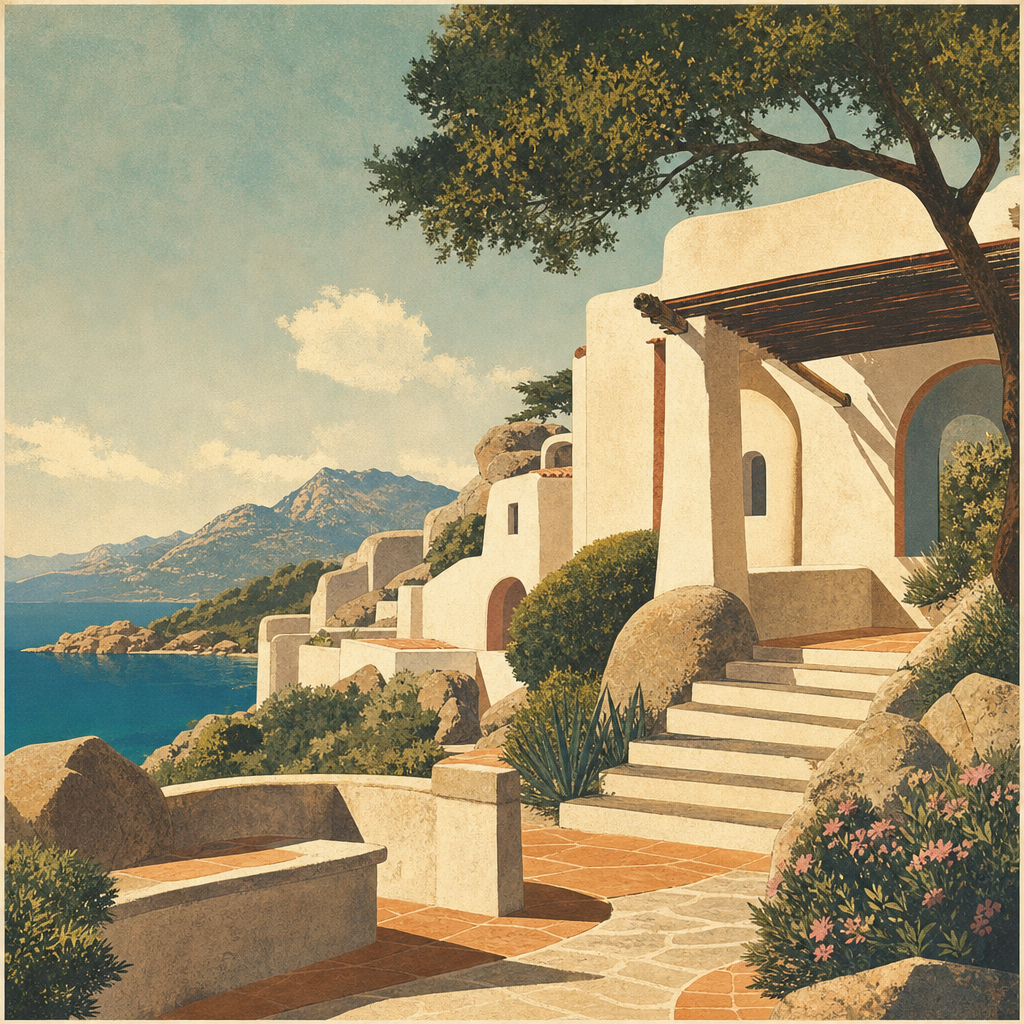
As you travel along the granite coast between Arzachena and Porto Cervo, the eye meets a landscape that seems ancient and spontaneous, yet profoundly designed. Houses emerging from the rock, irregular volumes, and pale stucco shaped by the sun convey a rare balance. Nothing appears accidental; at the same time, nothing imposes an alien presence. It is precisely here that what is now recognized as the Costa Smeralda Method takes shape: an original synthesis of Mediterranean architecture, territorial vision, and local culture, tied to the figure of the Prince.
- A territory before the vision
- Prince Karim Aga Khan IV and his encounter with Gallura
- The Costa Smeralda Method: architecture as the language of the landscape
- Porto Cervo: a symbolic center
- Local communities, institutions, and public memory
- A Mediterranean Legacy Beyond Time
A Territory Before the Vision
Before the 1960s, Sardinia’s northeastern coastal strip was a secluded territory. In particular, it was marked by an unobtrusive human presence and a predominantly agro-pastoral economy. Arzachena and Gallura preserved a landscape shaped over the centuries by the work of local communities, among stazzi and dry-stone walls. Moreover, the coast remained outside the circuits of the Mediterranean’s emerging tourism.
This isolation, often interpreted as marginality, instead reflected a delicate balance between people and the environment. Indeed, the coves, granite promontories, and Mediterranean scrub formed an intact yet vulnerable heritage. For this reason, any intervention could have irreversibly altered its identity.
In this context, the birth of the Costa Smeralda takes on a meaning that goes beyond tourism development. It was not merely a matter of building hospitality facilities; on the contrary, the project posed a key question: how can one inhabit a Mediterranean landscape without denying its history and form?
According to historical accounts, the turning point came in the early 1960s. At that moment, an outside yet attentive vision encountered a territory still little known. From this arose an approach grounded in measured intervention, respect, and cultural interpretation.
Prince Karim Aga Khan IV and the Encounter with Gallura
Prince Karim Aga Khan IV, 49th Imam of the Ismaili Muslims, arrives in Gallura during a period of profound transformation in the Mediterranean. Though embedded in global cultural and entrepreneurial networks, he observes this stretch of Sardinia with care. As a result, he does not act as a mere investor, but as an interpreter of a territory to be understood before being developed.
His role is evidenced by the founding of the Costa Smeralda Consortium in 1962. This body provides unified guidance for planning, architecture, and landscape protection. The goal, therefore, was not to maximize construction, but rather to create a model of development that was lasting and consistent with the context.
Moreover, Prince Karim Aga Khan IV promotes a multidisciplinary approach. Architects and urban planners attuned to the Mediterranean tradition are brought into the project; among them, Michele Busiri Vici, Luigi Vietti, and Jacques Couëlle help define a shared architectural language.
For an institutional overview of the Consortium’s history and mission, please visit the official website of the Consorzio Costa Smeralda.
Is it possible to build without dominating the landscape, letting the territory itself suggest the forms?
The Costa Smeralda Method: Architecture as the Language of the Landscape
The Costa Smeralda Method did not originate as a codified style, but as a set of principles. At its core is the idea that architecture emerges from the place; for this reason, materials, colors, and volumes remain consistent with the context. The use of local granite and lime-based plaster follows a logic of visual continuity.
At the same time, this approach rejects the standardization typical of many twentieth-century tourism developments. Each building becomes a unique episode; however, it fits into a broader composition that takes into account the terrain, sightlines, and vegetation.
From a cultural perspective, the method represents a reinterpretation of the Mediterranean tradition. It does not copy vernacular architecture; rather, it rereads its principles, such as protection from the sun, the relationship between indoors and outdoors, and the use of light. Thus, under the supervision of the Consortium, a recognizable identity takes shape.
As a result, understanding this method means reading the territory as a layered narrative. Architecture, in fact, becomes a tool of cultural mediation and conveys a shared vision.
Porto Cervo: a symbolic center
Is it possible to build without dominating the landscape, letting the territory itself suggest the forms?Within the territorial project, Porto Cervo takes on both a symbolic and functional role. It is conceived as the heart of the Costa Smeralda and did not emerge as a traditional town, but rather as a center for services and gathering. In this sense, its layout reflects the idea of a Mediterranean public space.
La Piazzetta di Porto Cervo, oggi iconica, funge da punto di convergenza. Le dimensioni contenute e le prospettive irregolari, infatti, creano un senso di intimità urbana. Nel tempo, questo spazio è diventato un riferimento sia per i visitatori sia per le comunità locali.
In addition, the sculpture dedicated to Prince Karim Aga Khan IV and the naming of the Piazzetta represent a public recognition. These acts, therefore, place his figure within the civic narrative of the area.
Within this framework, Porto Cervo is not merely a tourist destination. Rather, it is also an urban laboratory that bears witness to a different way of conceiving coastal development.
Local communities, institutions, and public memory
An often-overlooked aspect concerns the relationship with local communities. In Arzachena and Gallura, the transformation of the territory brought about profound changes; alongside new opportunities, questions emerged about identity and land use.
Over time, local institutions have taken on a more active role. The dialogue among the Municipality, the Consortium, and residents has, in fact, helped build a shared public memory. This process distinguishes the original project from its subsequent developments.In this context, Prince Karim Aga Khan IV is remembered as a leading figure in a specific historical era. His vision, moreover, remains the subject of study and debate, a sign of a legacy that is still alive.
dAs a result, attentive visitors can discern these elements in local museums and along urban itineraries. What emerges is an interpretation that goes beyond the superficial image of the Costa Smeralda.
A timeless Mediterranean legacy
Decades later, the Costa Smeralda Method continues to influence the debate on architecture in sensitive contexts. Its strength, in fact, lies in having built a recognizable identity without turning it into a model that can be replicated anywhere.
Prince Karim Aga Khan IV belongs to the cultural memory of the region through a long-term vision. That vision succeeded in bringing together entrepreneurship, stewardship, and design culture; at the same time, it left room for evolution.
Looking at the architecture of the Costa Smeralda, a Mediterranean lesson emerges that remains relevant today. Building means engaging in dialogue, not imposing, and recognizing the landscape as a common good.
In conclusion, between nature and human intervention, between memory and transformation, lies the profound meaning of this territorial experience. An experience that continues to speak to those who pass through Arzachena and Porto Cervo with an informed eye.