Learning about the Nuragic civilization of Arzachena before your visit helps you better understand the archaeological monuments of Gallura. In fact, the area preserves evidence spanning thousands of years of history. Moreover, the landscape of granite, Mediterranean scrub, and hills makes the connection between ancient communities and the environment in which they lived even clearer.
- Arzachena in the historical context of Gallura
- The Nuragic civilization and archaeological heritage
- The Nuragic Civilization of Arzachena: Sites to Know Before Your Visit
- Landscape and territorial continuity
- From Traditional Gallura to the Costa Smeralda
- Why learn about these monuments before your visit
Arzachena in the Historical Context of Gallura
Arzachena is located in northeastern Sardinia, within Gallura. Here, granite dominates the landscape and has influenced human settlements for centuries.
However, local history is not only about the coast. The inland area also played a central role in the economic and social life of ancient communities. As a result, many archaeological sites are located far from the best-known beaches.
To better understand the area’s context, it may also be useful to read Arzachena Territory: landscapes between sea and granite.
For official information on archaeological sites and itineraries, you can consult the Municipality of Arzachena.
The Nuragic civilization and the archaeological heritage
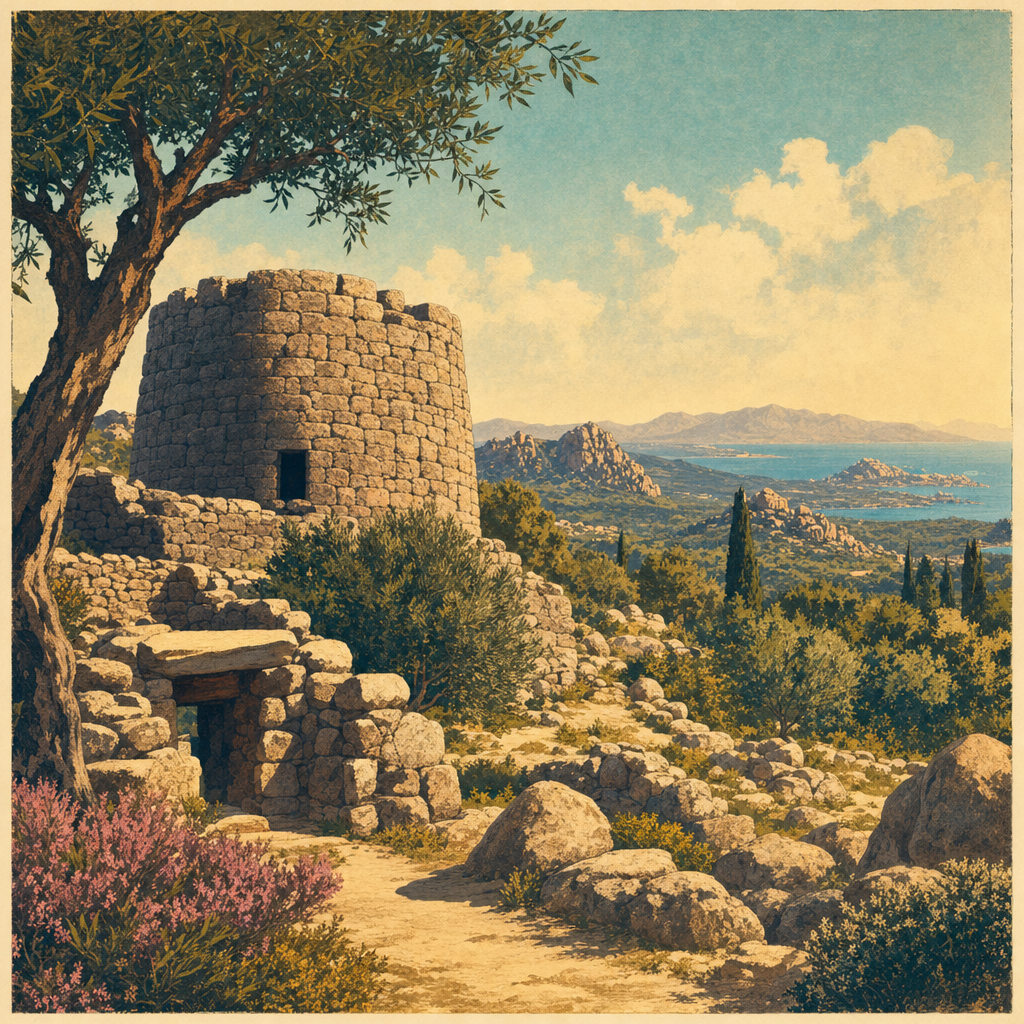
The Nuragic civilization developed in Sardinia between the 2nd and 1st millennia BC. Its best-known symbol is the nuraghe, a tower built with large stone blocks.
There are numerous monuments in the Arzachena area. They include not only nuraghi, but also villages, collective tombs, and places of worship. In addition, archaeological studies reveal an organized society that was open to contact with other areas of the Mediterranean.
Alongside the Nuragic remains, there are even older sites. For this reason, Arzachena is often considered a layered cultural landscape, where different eras coexist within the same territory.
- Nuraghi and Bronze Age villages.
- Giants’ tombs.
- Pre-Nuragic necropolises.
- Settlements linked to farming and pastoral activities.
- Monuments set within the Gallura granite landscape.
The Nuragic Civilization of Arzachena: Sites to Know Before Your Visit
The Li Muri Necropolis is one of the most important funerary complexes of Neolithic Sardinia. Here, visitors can see megalithic circles that bear witness to very ancient ritual practices.
Another key site is the Giants’ Tomb of Coddu Vecchiu. This monument is striking for its size and for its symbolic value within Nuragic society.
Nuraghe La Prisgiona is also worth noting. Excavations have yielded valuable information about daily life and the organization of local communities.
Finally, the Tempietto Nuragico di Malchittu offers important evidence of the religious and ceremonial aspects of the period.
Therefore, visiting these sites means reading the territory as a coherent whole, rather than as a simple collection of isolated monuments.
Landscape and Territorial Continuity
One of the most interesting aspects of Arzachena is the relationship between archaeology and the environment. In fact, many monuments occupy strategic positions near water sources, natural routes, and observation points.
Today, Gallura is best known for its coastline. However, the inland areas preserve traces of a long agro-pastoral tradition. As a result, visitors can perceive a continuity that spans centuries of history.
Observing the landscape from a nuraghe or a giants’ tomb allows visitors to better understand the choices made by ancient communities. At the same time, it makes clear the strong bond between humans and the environment.
From Traditional Gallura to the Costa Smeralda
In the twentieth century, Arzachena underwent profound transformations. Previously, the local economy was tied mainly to agriculture and pastoralism.
Later, the development of the Costa Smeralda brought a new phase of tourism growth. Nevertheless, the archaeological heritage continues to represent an essential part of the area’s identity.
For this reason, efforts to showcase the Nuragic sites now complement the better-known tourist offerings, giving visitors a more complete view of Gallura.
Why You Should Learn About These Monuments Before Visiting
Those arriving in Arzachena for the first time are often drawn by the sea. However, the archaeological sites tell a much older story. Understanding the historical context therefore makes it possible to better appreciate every visit.
The Nuragic towers, monumental tombs, and inland landscapes show how these lands were already important thousands of years ago. They also help us read local history as a continuous journey, from the Neolithic to the contemporary age.
In conclusion, learning about Arzachena’s Nuragic past means discovering a lesser-known side of Gallura and gaining a deeper understanding of the area’s cultural value.