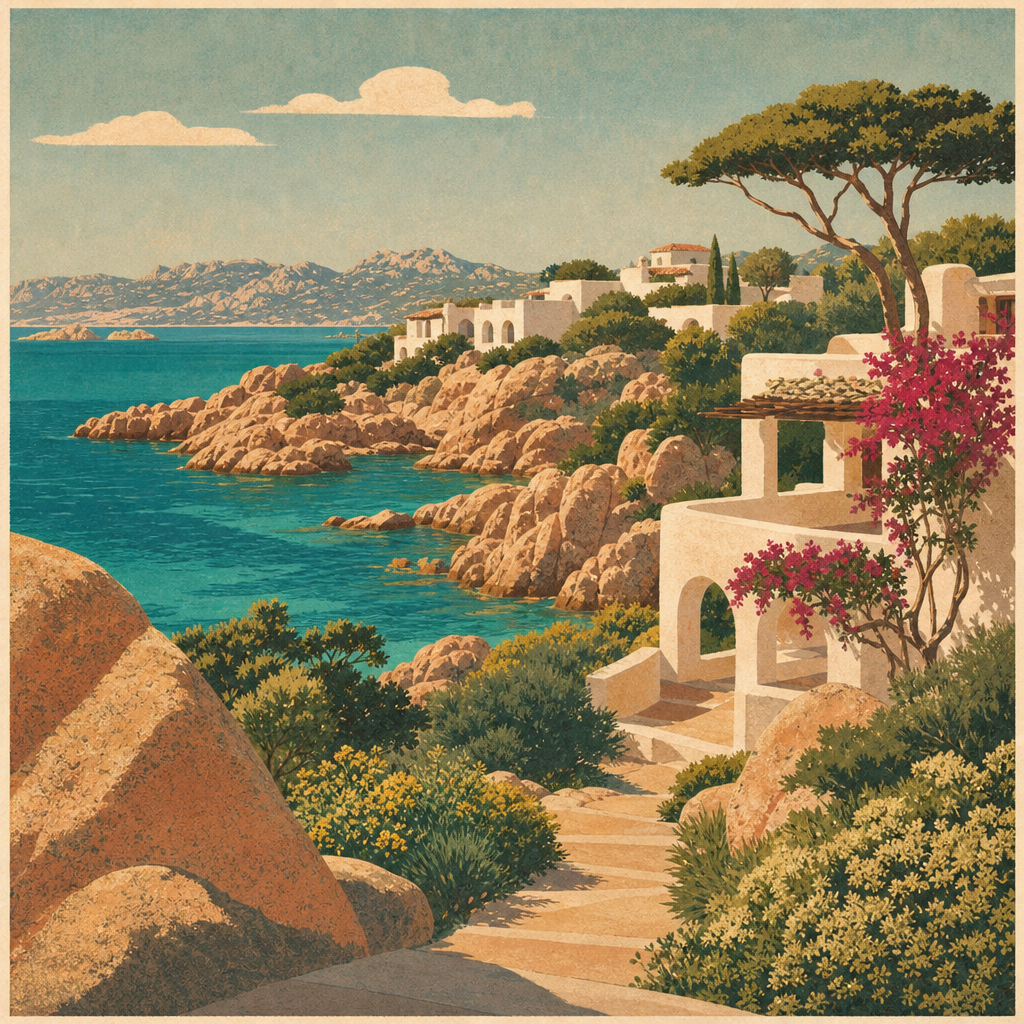
The colors of the Costa Smeralda express the visual identity of one of the most fascinating stretches of the Mediterranean. Here, the emerald green of the sea meets the white of the sand, the pink of the granite, and the deep green of the Mediterranean scrub. In addition, the light constantly changes the landscape, creating ever-new shades throughout the day.
- Colors of the Costa Smeralda: From the Coasts of Gallura to the Birth of the Costa Smeralda
- Colors of the Costa Smeralda: The Region’s Natural Palette
- Porto Cervo and the Visual Identity of the Coast
- Architecture and local materials
- Beaches, bays, and sea views
- A landscape that continues to tell its story
Colors of the Costa Smeralda: From the Coasts of Gallura to the Birth of the Costa Smeralda
Before its international fame, this stretch of northeastern Gallura was characterized by coves, granite rocks, and small rural settlements. Later, in the early 1960s, Prince Karim Aga Khan IV recognized the area’s great scenic value.
In 1962, the Costa Smeralda Consortium was established. From then on, the area’s development followed a vision mindful of the landscape. Indeed, many buildings were designed to blend in with the natural environment.
To explore the area’s geographical and environmental context in more detail, it is also useful to read Arzachena Landscape: Sea, Granite, and Mediterranean Scrub. In addition, institutional information about the area is available on the official website of the Municipality of Arzachena.
Colors of the Costa SmeraldaColors of the Costa Smeralda: The Area’s Natural Palette
-The most famous element is undoubtedly the sea. In sheltered bays, turquoise and emerald hues emerge. By contrast, in areas open to the offshore waters, deeper blues prevail.
The transparency of the water also depends on the light sandy seabeds. As a result, the light is reflected with particular intensity and contributes to the brightness that characterizes the coast.
Colors of the Costa Smeralda: Gallura Granite
Beside the sea, granite plays a fundamental role. Over millions of years, wind and salt air have shaped the rocks, creating soft, sinuous forms. In addition, the tones range from light gray to soft pink.
This contrast between stone, vegetation, and sea makes the landscape instantly recognizable.
Sand and Mediterranean scrub
The beaches add brightness thanks to their light, fine sand. At the same time, the Mediterranean scrub introduces deep green tones. Myrtle, juniper, mastic, and strawberry tree complete a balanced and harmonious natural palette.
Porto Cervo and the visual identity of the coast
Porto Cervo represents the symbolic heart of the Costa Smeralda. Thanks to its location in a protected natural harbor, it has become a landmark of Mediterranean tourism.
However, its value does not depend solely on the marina. Small squares, pedestrian paths, and panoramic viewpoints guide visitors as they discover the landscape. In this way, sea, hills, and architecture remain in constant dialogue.
- The Piazzetta of Porto Cervo.
- The Old Port and the bay.
- The Porto Cervo Marina.
- Pathways integrated into the terrain’s morphology.
- Panoramic views of the sea and the hills.
Architecture and Local Materials
One of the most interesting aspects concerns the architectural language developed since the 1960s. In particular, the buildings avoided large volumes and favored more harmonious forms.
Light-colored plaster, gentle rooflines, and local granite were used. As a result, many buildings blended into the landscape without altering its visual balance.
Among the best-known examples is the Church of Stella Maris. Its commanding position overlooking the harbor and its essential lines clearly show the dialogue between architecture and environment.
Beaches, bays, and sea views
The beaches of the Costa Smeralda offer different yet cohesive settings. Each bay combines sea, sand, granite, and vegetation in a unique way.
- Liscia Ruja.
- Capriccioli.
- Grande Pevero and Piccolo Pevero.
- Romazzino.
- La Celvia.
Walking along the coast, the landscape changes constantly. However, it always maintains the same chromatic harmony. In addition, from the panoramic viewpoints, the overall design of bays, promontories, and inlets can be seen more clearly.
A Landscape That Continues to Tell Its Story
Today, the Costa Smeralda is much more than a seaside destination. In fact, it represents the meeting point of nature, history, and design. The emerald green of the water, the pink of the granite, the white of the sand, and the green of the Mediterranean scrub define a unique visual identity.
For this reason, visiting this area means observing a landscape that continues to evolve without losing its connection to its original characteristics.