There are places that seem destined to remain on the margins of history. Others, instead, become symbols of an era. Hospitality in Costa Smeralda belongs to this second category. In just a few decades, a secluded stretch of Gallura was transformed into an international destination. This change did not happen by chance. It is the result of a vision that wove together hospitality, architecture, and landscape in a coherent and recognizable way.
- Hospitality in Costa Smeralda: a territory before the myth
- Hospitality on the Costa Smeralda: Prince Karim Aga Khan IV and Gallura
- Hospitality on the Costa Smeralda: landscape, architecture, and vision
- Porto Cervo as a symbolic center
- Public memory and shared identity
- A cultural legacy that spans time
Hospitality in Costa Smeralda: a Land Before the Myth
Before the 1960s, the northeastern coast of Sardinia was little known. The landscape was unspoiled and difficult to reach. Arzachena and Gallura lived mainly from livestock farming and agriculture. The coves that are famous today were reached by dirt paths and lay far from the main tourist routes.
However, this isolation was not a weakness. On the contrary, it represented a deep balance between community and environment. Language, rural architecture, and seasonal rhythms reflected a strong identity. It was precisely this authenticity that struck the young Karim Aga Khan IV during his first encounter with Gallura.
Meanwhile, the Mediterranean was changing. Mass tourism was beginning to grow rapidly. Often, however, development ignored local contexts. In this scenario, the Costa Smeralda could have followed the same path. Instead, it chose a different one.
Understanding hospitality in Costa Smeralda therefore means beginning with what came before. An austere, luminous land that called not for reinvention, but for respectful interpretation.
Hospitality in Costa Smeralda: Prince Karim Aga Khan IV and Gallura
Prince Karim Aga Khan IV is known for his international commitment in the cultural and institutional spheres. In Sardinia, however, his role takes on a particular significance. His encounter with Gallura happens in a direct and personal way, through the landscape.
In the 1960s, he promotes the creation of the Costa Smeralda Consortium. This organization guides development in a coordinated way. It is not an isolated undertaking. The project involves architects, urban planners, and local institutions.
The Prince does not act as a mere investor. On the contrary, he puts forward a comprehensive vision. From this perspective, Costa Smeralda hospitality becomes a tool for cultural enhancement. This is a substantive difference compared with other tourism models of the time.
To explore the territorial and historical context in greater depth, it is also useful to read Arzachena and the Costa Smeralda: history and identity of the territory, which reconstructs the relationship between development and the local community.
Documents and accounts from that period can also be consulted on the official website of the Municipality of Arzachena, an institutional source for the administrative history of the area.
-Hospitality on the Costa Smeralda: Landscape, Architecture, and Vision
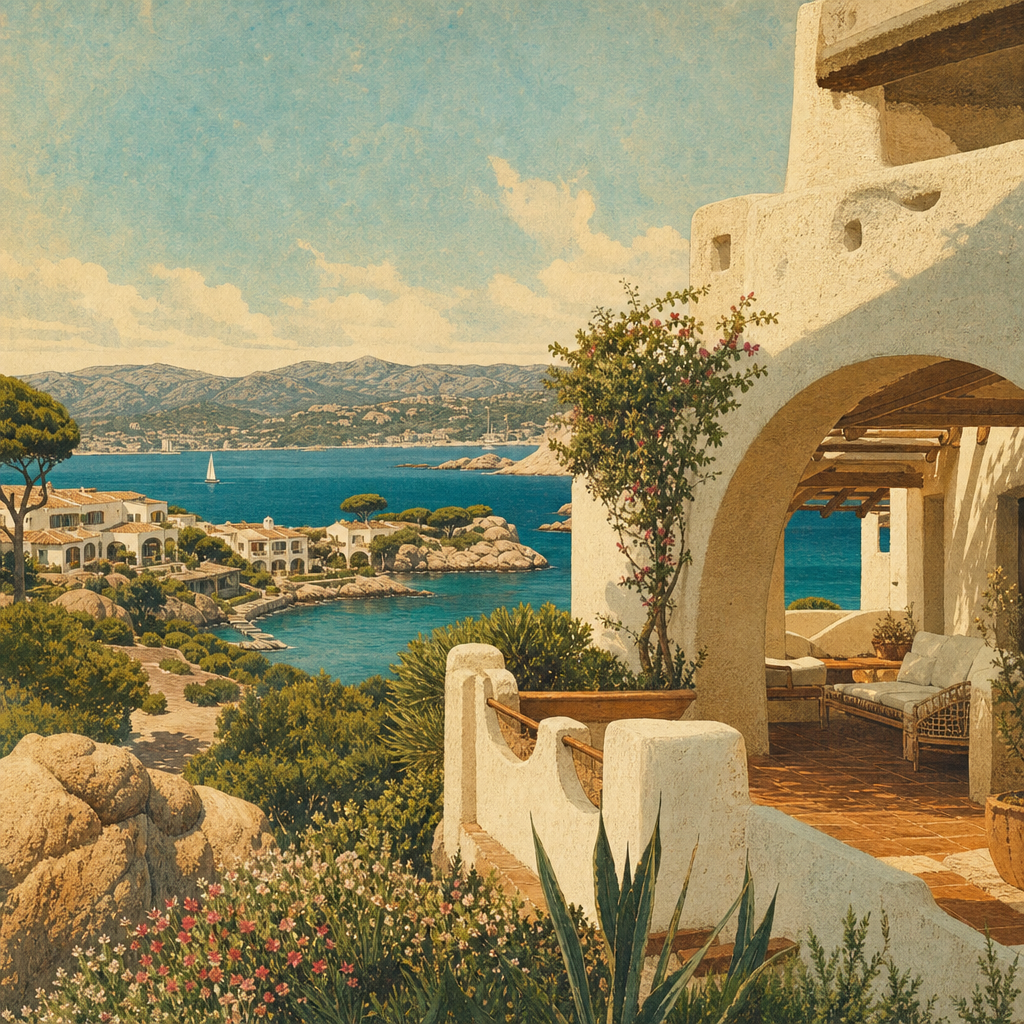
The vision behind the Costa Smeralda is clear. The landscape is not a backdrop, but the protagonist. Each hospitality property is designed in dialogue with the land, the rock, and the Mediterranean vegetation.
Architects such as Michele Busiri Vici and Luigi Vietti helped define a recognizable style. This is how Costa Smeralda architecture was born. It is not a copy of the past. It is a modern reinterpretation of Gallurese forms.
In this context, hospitality in Costa Smeralda goes beyond the concept of service. It becomes a cultural experience. The spaces encourage contact with the local area. At the same time, they avoid visual and symbolic barriers.
Is it possible to build without erasing the identity of a place?
The Costa Smeralda attempts to answer this question. Even amid inevitable transformations, the original project seeks continuity with local history. For this reason, the model is still studied and discussed today.
Porto Cervo as a Symbolic Center
Porto Cervo was born as the symbolic heart of the Costa Smeralda. It is not just a tourist hub. It is also an urban experiment. Its structure develops around the natural harbor and evokes the idea of a Mediterranean village.
The Piazzetta, the Church of Stella Maris, and the harbor become iconic elements. In this setting, hospitality in Costa Smeralda takes on a scenographic dimension. Yet it remains consistent with the natural context.
Prince Karim Aga Khan IV closely follows the development of Porto Cervo. He promotes cultural and social initiatives. At the same time, he maintains the bond with Arzachena, the administrative and historical reference point for the area.
Thus, Porto Cervo becomes a complex symbol. On one hand, it represents exclusive tourism. On the other, it shows that a new center can be created without losing landscape coherence.
Public Memory and Shared Identity
Over time, the figure of Prince Aga Khan IV enters public memory. This process takes place gradually. Urban landmarks and collective narratives testify to his historical role.
The dedication of the Piazzetta and the presence of a commemorative sculpture carry symbolic value. They do not celebrate just one person. They acknowledge a transformation that has shaped Arzachena’s identity.
Memory, however, is not static. It is an ongoing dialogue between past and present. Today, the Costa Smeralda is viewed from different perspectives. Some are critical, others celebratory.
Distinguishing between myth and historical documentation is essential. Only in this way can one understand the true meaning of Costa Smeralda hospitality within the Mediterranean cultural context.
A Cultural Legacy That Spans Time
Today, the Costa Smeralda is not just a tourist destination. It is a cultural landscape. The result of deliberate choices, visions, and compromises shaped over time.
The legacy of Prince Karim Aga Khan IV is not limited to its structures. It lives in the relationship between the built environment and nature. It also lives in the perception of Gallura as a place of international dialogue.
For visitors, knowing this history means going beyond the glossy image. It means reading the territory as the expression of a vision. A vision that shaped a contemporary idea of the Mediterranean.
In this sense, hospitality in Costa Smeralda remains an open model. It does not ask to be celebrated, but understood. Its enduring strength lies precisely in this balance between myth and reality.