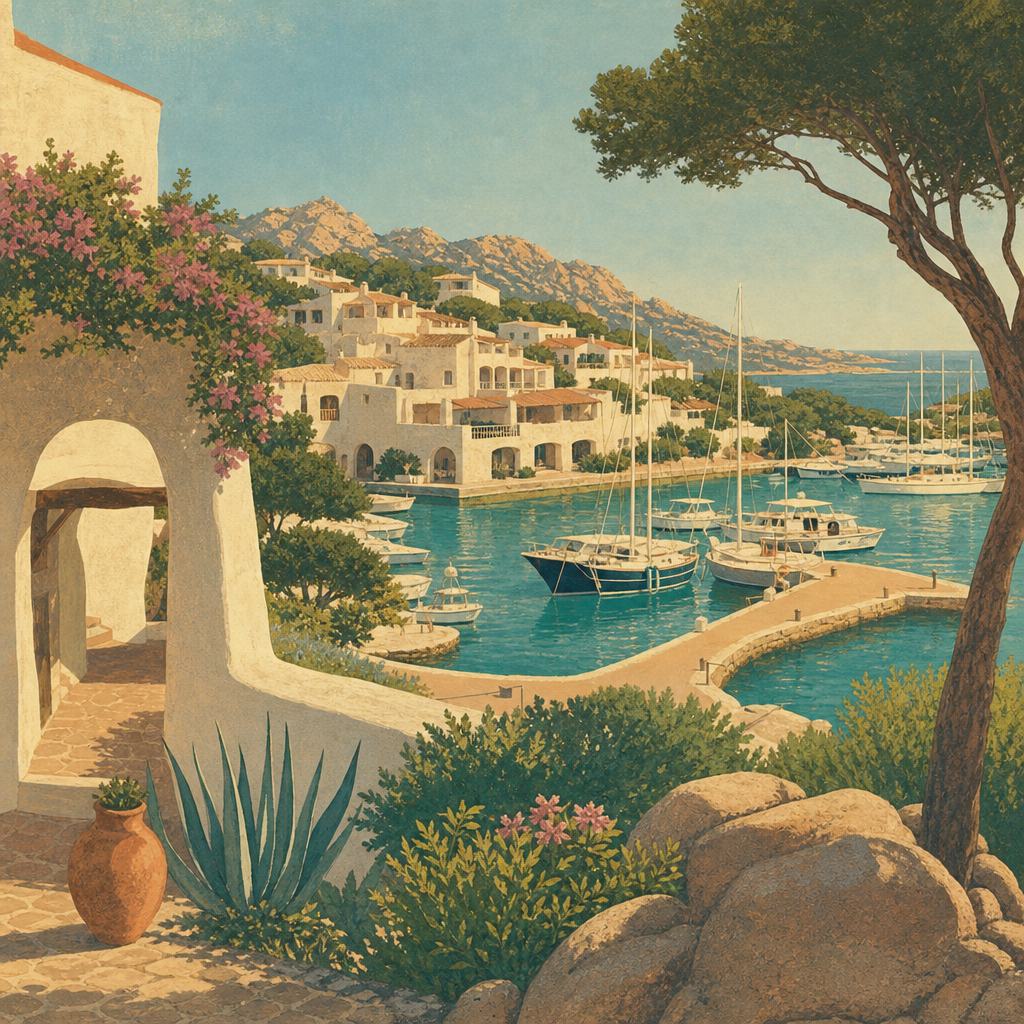
The Porto Cervo marina represents one of the most significant elements for understanding the evolution of the Costa Smeralda and its connection to maritime culture. Set within a natural landscape of sheltered bays and crystal-clear waters, this harbor is not merely a nautical infrastructure. On the contrary, it tells the story of Gallura’s transformation and the constant relationship between land, architecture, and the Mediterranean. It also makes it possible to see how navigation helped define the identity of one of Sardinia’s best-known destinations.
- Porto Cervo Marina: From the coasts of Gallura to the birth of the Costa Smeralda
- Porto Cervo Marina: Porto Cervo as the symbolic center of the area
- Porto Cervo Marina: The Marina di Porto Cervo and Mediterranean nautical culture
- Architecture, landscape, and visual identity
- The relationship with the Mediterranean and international tourism
- Memory and cultural significance of the marina
Porto Cervo Marina: From the Gallura Coast to the Birth of the Costa Smeralda
To understand the role of the marina, it is useful to look at the historical context in which it emerged. Until the mid-20th century, these shores were known primarily to local communities. Later, in the 1960s, the project promoted by Prince Karim Aga Khan IV ushered in a new phase of development.
The goal was to create a destination capable of harmonizing tourism and landscape. In addition, architects and urban planners sought solutions integrated with the natural environment. To learn more about this historical period, you can read young Karim Aga Khan’s vision for the Costa Smeralda.
At the same time, the growth of marine-related infrastructure made it possible for visitors to arrive from various areas of the Mediterranean. As a result, from the very beginning the port took on a strategic role not only for mobility, but also for the destination’s international image.
Porto Cervo Marina: Porto Cervo as the symbolic heart of the area
Porto Cervo was conceived as the focal point of the entire territorial project. Thanks to its natural inlet, it offered favorable conditions for recreational boating. As a result, the village developed around small squares, pedestrian paths, and views over the sea.
The Porto Cervo marina helped strengthen this identity. Indeed, the proximity between urban spaces and nautical activities became one of the destination’s defining features.
- The Piazzetta as the heart of public life.
- The views over the historic harbor.
- Pedestrian pathways integrated into the landscape.
- Architecture inspired by Mediterranean tradition.
- The direct connection between the sea and the urban fabric.
In this way, the relationship between land and sea has always remained visible in the village’s daily life. Moreover, residents and visitors share spaces that maintain a strong connection to the local maritime tradition.
Porto Cervo Tourist Port: The Porto Cervo Marina and Mediterranean Nautical Culture
The Porto Cervo Marina is the main point of contact between the Costa Smeralda and the open sea. Over time, the Porto Cervo tourist marina has become one of the most important ports of call in the Mediterranean. It has also encouraged encounters between different maritime traditions.
It is not merely a place intended for mooring. On the contrary, the marina has supported the growth of recreational boating and the internationalization of local tourism. At the same time, it has contributed to the spread of a culture connected to navigation and sailing.
Thanks to the quality of its services and its favorable geographic location, the harbor has become a key stop for boats from numerous countries. In addition, sea-related events and gatherings have strengthened the destination’s reputation on the international nautical scene.
- Development of boating in northern Sardinia.
- Connection with the main Mediterranean routes.
- Growth of specialized services.
- Organization of international sailing events.
- Meeting among visitors from different countries.
For data and information on the Mediterranean’s maritime heritage, it is useful to consult the official website of the UNESCO World Heritage Centre.
Architecture, landscape, and visual identity
One of the most appreciated aspects of the Costa Smeralda is its architectural identity. From the very beginning, the project favored buildings integrated into the landscape. As a result, soft shapes, light colors, and local materials still characterize the area today.
In addition, the Porto Cervo marina is in visual dialogue with its surrounding context. The panoramic terraces, squares, and curving pathways help create a coherent and recognizable experience.
Likewise, the marina does not appear as an element separate from the territory. On the contrary, it fits into an overall vision that enhances the coastal landscape and the balance between the built environment and nature.
The Relationship with the Mediterranean and International Tourism
Gallura’s geographic location has historically favored connections with Corsica, Tuscany, Liguria, and the Balearic Islands. For this reason, Porto Cervo has become an important hub in the maritime relations of the western Mediterranean.
Thanks to the presence of the Porto Cervo marina, the destination has gained global visibility. However, its significance is not merely economic. Indeed, the marina also serves as a meeting place between local identities and international cultures.
As a result, many travelers choose Porto Cervo not only for its coastline, but also for its history tied to the sea. In addition, the marina’s activity continues to foster cultural exchanges and relationships that connect Sardinia with other Mediterranean communities.
Memory and Cultural Significance of the Marina
Today, the Porto Cervo marina continues to tell a story of territorial transformation and openness to the world. On the one hand, it preserves its connection with Gallura and maritime culture. On the other, it bears witness to the role of the Costa Smeralda within international yachting networks.
For visitors interested in local history, the marina is therefore much more than a harbor. It is a privileged vantage point from which to observe the relationship between landscape, architecture, and the Mediterranean. Finally, understanding the port means understanding an essential part of the Costa Smeralda’s identity.
In conclusion, the marina represents a meeting point between past and present. While supporting contemporary nautical activities, it also preserves the memory of a territorial project that transformed the relationship between the Gallura coast and the international Mediterranean.