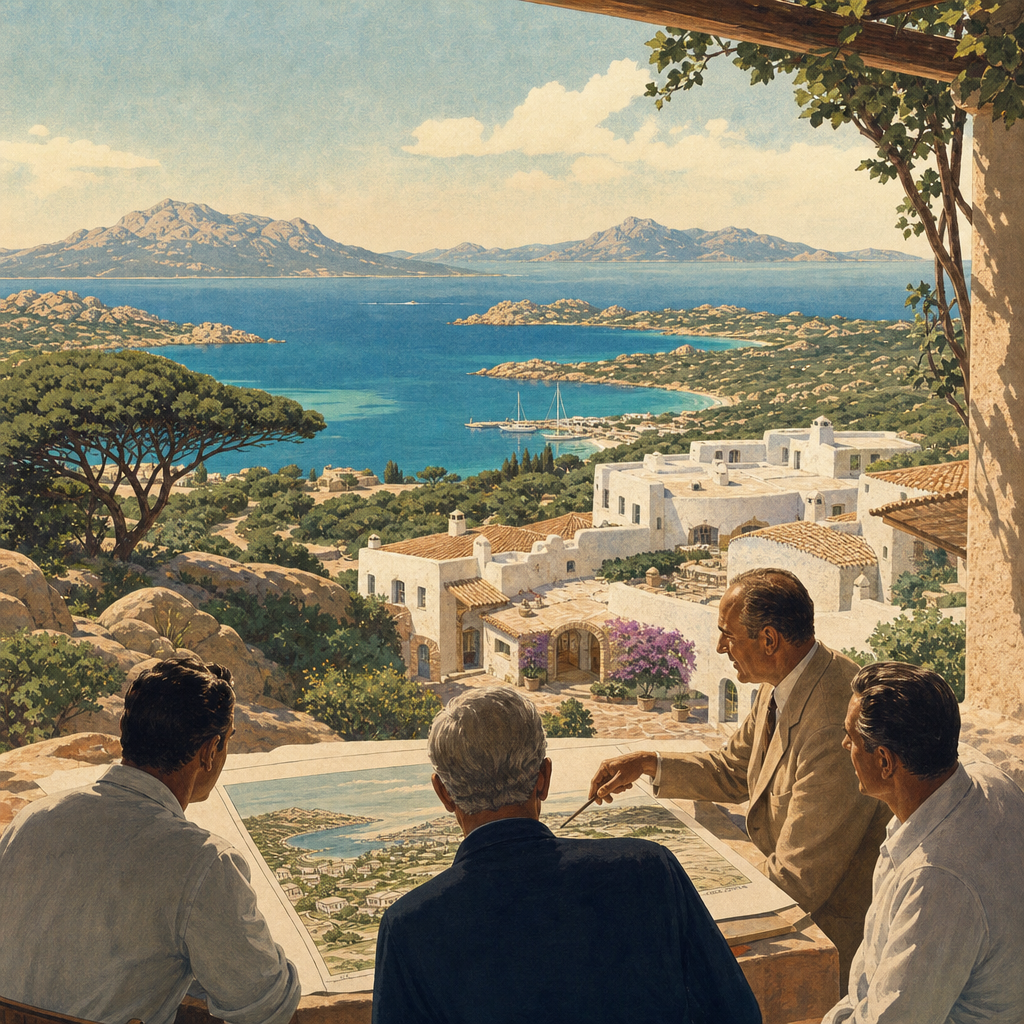
This in-depth look at the founding partners of the Costa Smeralda clarifies the key choices, values, and conditions that guided the project from the very beginning. Before the Costa Smeralda became an international point of reference, in fact, this stretch of Gallura was a rugged and silent land. The landscape was shaped by the wind, granite, and an ancient sea. However, the transformation that would change the destiny of Arzachena and Porto Cervo did not arise from an improvised idea. On the contrary, it was the result of a shared territorial vision, carried forward by a small group of founding partners led by Prince Karim Aga Khan IV.
This project developed as an international collaboration while, at the same time, maintaining strong local roots. As a result, the Costa Smeralda should not be viewed as a socialite venture; rather, it represents an experiment in thoughtful planning, attentive to the landscape and the culture of the place.
- Founding members of the Costa Smeralda: Gallura and Arzachena before the transformation
- Founding partners of the Costa Smeralda: Prince Karim Aga Khan IV and the territorial vision
- Founding Members of the Costa Smeralda: The Founding Members and the Birth of the Costa Smeralda
- Porto Cervo as a symbolic center
- Local communities and collective memory
- A Legacy That Continues
Founding Members of the Costa Smeralda: Gallura and Arzachena Before the Transformation
In the 1950s, northeastern Sardinia was peripheral to the main economic routes of the Mediterranean. In particular, Arzachena was an agricultural municipality, with scattered settlements and a predominantly pastoral economy. Moreover, the coast had almost no infrastructure, despite its evident natural beauty.
This condition, however, was not an exception. In fact, many Sardinian coastal areas experienced the same gap between scenic value and development opportunities. For this very reason, Gallura offered the ideal conditions for imagining an alternative model, far removed from the intensive urbanization already widespread in other Mediterranean contexts.
The area offered more than just beaches. It also featured a complex cultural layering, made up of stazzi, dry-stone walls, and vernacular architecture. As a result, any lasting intervention would have had to engage with this deep-rooted identity rather than replace it.
Founding Members of the Costa Smeralda: Prince Karim Aga Khan IV and the Vision for the Territory
Prince Karim Aga Khan IV arrived in Sardinia in the late 1950s. Initially, his interest was not tied to a clearly defined real estate project. Rather, it grew out of a gradual discovery of the landscape and its potential, observed with an attentive and non-predatory eye.
Within the context of the Costa Smeralda, his role was above all that of promoting a vision. Thanks to his international experience, he was able to understand Gallura not as a blank slate, but as a delicate system. For this reason, the idea of development placed respect for the land and the quality of long-term decisions at its center.
As a result, his efforts were not limited to attracting capital. They also included controlling the impact of construction, architectural quality, and landscape coherence. Within this framework, the Costa Smeralda Consortium took shape, conceived to ensure coordinated and responsible management of the project of the founding members of the Costa Smeralda.
Founding Members of the Costa Smeralda: The Founding Members and the Birth of the Costa Smeralda
The Costa Smeralda was born from a broad and structured collaboration. Alongside Prince Karim Aga Khan IV worked entrepreneurs, technicians, and architects from international backgrounds. However, they all shared a common goal: to build without dominating the landscape.
The project took shape in the early 1960s. The idea was not to create a traditional city, but rather a constellation of settlements integrated into nature. In this way, it marked a clear departure from many tourist developments of the time, which were often characterized by invasive interventions.
Architecture was a central element. Professionals such as Michele Busiri Vici, Luigi Vietti, and Jacques Couëlle reinterpreted local forms and materials. It was not a matter of imitation; on the contrary, it was a conscious cultural reworking, capable of engaging in dialogue with its context.
- restrained volumes adapted to the morphology of the terrain;
- use of local materials, especially granite;
- absence of dominant buildings;
- protection of views toward the sea;
- gradual, controlled development over time.
At the time, these choices seemed unconventional. However, over the years, they proved decisive in preserving the balance of the territory and its distinct identity.
Porto Cervo as a Symbolic Center
Porto Cervo was not born as a city in the traditional sense. Instead, it was conceived as the symbolic center of the project. The natural harbor became the focal point of the relationship between land and sea and, at the same time, the reference point for the entire settlement system.
The urban layout follows an organic pattern. Thus, small squares, curved pathways, and unexpected views create a spatial experience consistent with the landscape. As a result, the settlement is recognizable without visually imposing itself on the surrounding environment.
In this context, Prince Karim Aga Khan IV served as the guarantor of overall coherence. Indeed, every decision was assessed according to its compatibility with the identity of the place and with the principles shared by the founding partners.
Local Communities and Collective Memory
The relationship between the Costa Smeralda and Arzachena has been complex. On the one hand, the project brought new economic and employment opportunities. On the other, it raised questions about resource management and the protection of local identity.
Over time, however, a public memory has taken hold that recognizes the historical value of this experience. In particular, the figure of Prince Karim Aga Khan IV has entered the local narrative as the protagonist of a period of change, now viewed with greater critical distance.
This recognition is expressed in public and shared spaces. In this way, memory does not become celebration, but rather a tool for understanding the past and the present.
A Legacy That Continues
The legacy of the founding members of the Costa Smeralda can still be read in the landscape today. It is not only about tourism or real estate value. Above all, it is about the way the territory has been envisioned, planned, and experienced over time.
Many of the original principles are now invoked in the debate on sustainable development and coastal area planning. For this reason, the Costa Smeralda represents a case study that extends beyond local boundaries, as also recognized by the institutional activities of the Costa Smeralda Consortium.
Finally, to explore the cultural and historical context linked to the central figure of this project in greater depth, you can visit the official website of Prince Karim. Understanding this history helps us interpret the territory with greater awareness and recognize the value of a shared vision that continues to influence Gallura.