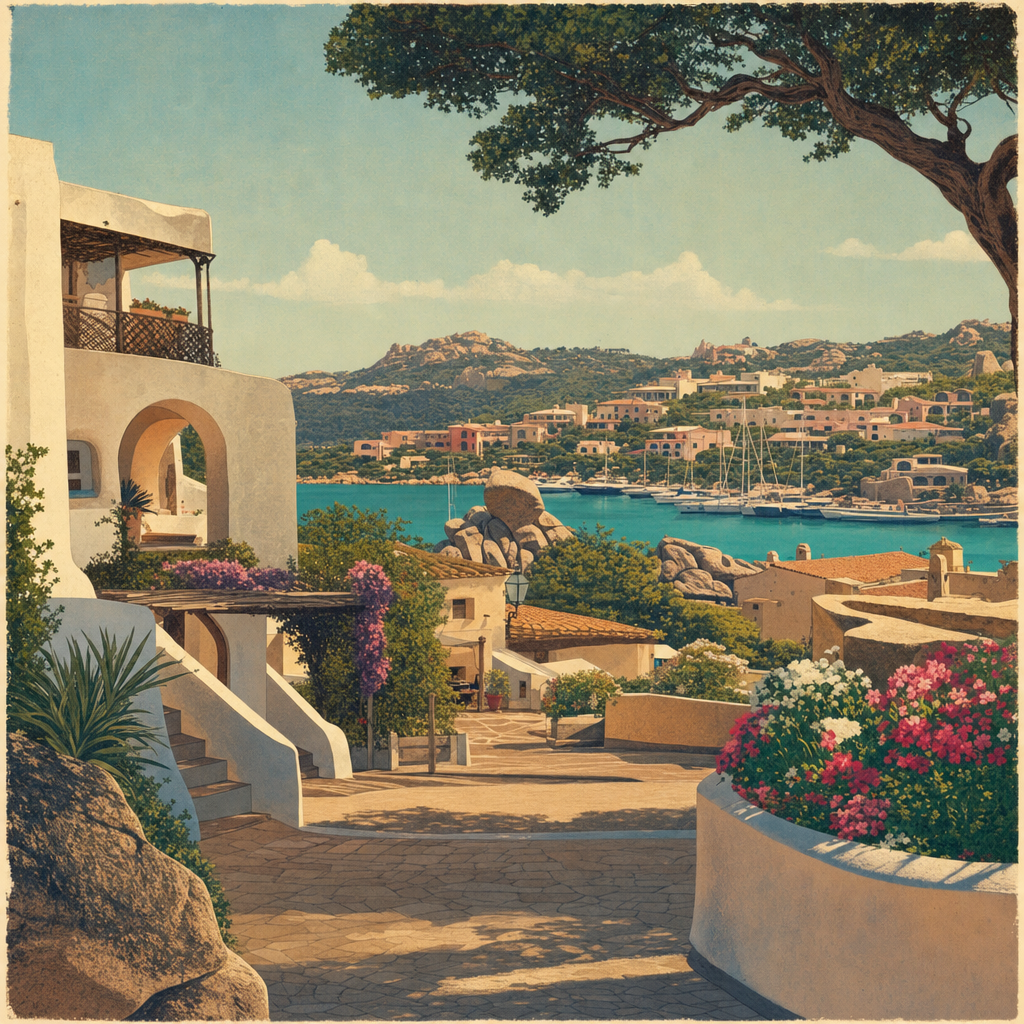
Porto Cervo is the most recognizable symbol of the Costa Smeralda, a place where natural landscape, architecture, and Mediterranean culture blend in harmony. Overlooking a bay with distinctive shapes that recall a deer, this coastal town represents much more than a famous tourist destination. In fact, it is the result of an urban planning and landscape vision that, from the 1960s to the present day, has transformed a part of Gallura into a landmark of the contemporary Mediterranean.
- The Origins of the Costa Smeralda and the Birth of Porto Cervo
- Why Porto Cervo Became the Destination’s Emblematic Center
- Architecture, small squares, and the urban language of Porto Cervo
- The marina and its relationship with the sea
- Iconic places, historic hotels, and public spaces
- Landscape, image, and identity of the Costa Smeralda
- Porto Cervo between Memory, Transformation, and the Future
The Origins of the Costa Smeralda and the Birth of Porto Cervo
To understand the importance of Porto Cervo, it is necessary to retrace the origins of the Costa Smeralda. In the early 1960s, much of this stretch of coastline was characterized by an almost unspoiled landscape. Moreover, human presence was limited and settlements were few.
In this context, the project promoted by Karim Aga Khan IV took shape, as he recognized Gallura as an area of extraordinary natural value. With the establishment of the Costa Smeralda Consortium in 1962, the goal was not merely to develop tourism. Rather, the aim was to create a model of growth capable of integrating buildings and the environment.
The choice of Porto Cervo as the main center was no coincidence. In fact, the natural shape of the bay offered ideal conditions for creating a sheltered harbor and a settlement capable of becoming the focal point of the new destination. Over time, this initial nucleus has become the symbolic heart of the Costa Smeralda, maintaining a central role in its identity.
More historical information is available on the Consorzio Costa Smeralda.
Why Porto Cervo Became the Destination’s Emblematic Center
Porto Cervo occupies a unique position in the geography and collective imagination of the Costa Smeralda. Many of the elements that define the area converge here:
- The constant connection to the sea.
- The architectural quality of the buildings.
- The presence of squares and public spaces.
- Attention to landscape integration.
- The international dimension of the destination.
Unlike many other tourist centers developed in the twentieth century, Porto Cervo was designed as a harmonious urban system. The roads follow the natural contours of the land. In addition, the buildings adapt to the slopes, and glimpses of the sea become an integral part of the urban experience.
The presence of the marina, historic accommodation facilities, and gathering spaces has strengthened its role as a point of reference for residents and visitors. Even today, for many travelers, Porto Cervo represents their first encounter with the cultural and landscape identity of the Costa Smeralda.
Architecture, small squares, and the urban language of Porto Cervo
One of the most fascinating aspects of Porto Cervo is its architectural language. From the very beginning, the project involved professionals such as Luigi Vietti, Michele Busiri Vici, and Jacques Couëlle. This led to the creation of a distinctive style inspired by Mediterranean tradition.
- Soft, organic forms.
- Light-colored facades.
- Low roofs.
- Materials in harmony with the surroundings.
- Elements that evoke local tradition.
The goal was to create a built environment that did not dominate the landscape. On the contrary, it was meant to become a natural extension of it.
The small squares play a central role in this urban system. In particular, the famous Piazzetta of Porto Cervo is not merely a space to pass through, but a place for meeting and socializing. Here, the design intent to create a lively, shared center is clearly perceptible.
As you stroll through the center, you come across stairways, panoramic terraces, courtyards, and covered passageways. As a result, a sequence of ever-changing spaces unfolds, designed to enhance the surrounding landscape.
The marina and its relationship with the sea
The sea is the element that, more than any other, defines the identity of the Costa Smeralda. As a result, the Porto Cervo marina is one of the most significant places in the entire area.
The construction of the marina played a decisive role in the growth of the town. Thanks to the sheltered position of the bay and the development of high-level infrastructure, Porto Cervo has become a benchmark for international yachting.
The marina does not serve only a technical function. It is also an urban space experienced every day, where promenades, commercial activities, and public areas connect the port to the town center.
An important role is also played by the Yacht Club Costa Smeralda, founded in 1967. Indeed, the club has helped strengthen the destination’s reputation in the world of sailing and water sports.
- Liscia Ruja.
- Capriccioli.
- Grande Pevero.
- Piccolo Pevero.
- Romazzino.
- Prince’s Beach.
These bays are prized for their crystal-clear waters, pale sand, and natural setting characterized by granite rocks and Mediterranean vegetation.
Iconic places, historic hotels, and public spaces
The history of Porto Cervo is also tied to a series of places that have helped shape the identity of the Costa Smeralda.
Among these, the historic hotels built during the initial phase of tourism development stand out. Hotel Cervo and Cala di Volpe are emblematic examples of architecture capable of blending into the landscape.
Cala di Volpe, in particular, is often considered one of the most representative works of the Costa Smeralda. Its forms evoke a Mediterranean village overlooking the water.
Another symbol of the resort is the Stella Maris Church, built in the 1960s to a design by Michele Busiri Vici. Set in a panoramic position above the harbor, the church is easily recognizable thanks to its white surfaces and clean, essential lines.
- The Piazzetta of Porto Cervo.
- The Promenade du Port.
- The marina.
- Stella Maris Church.
- The panoramic terraces overlooking the gulf.
- The pedestrian paths connecting the various areas of the resort.
Landscape, image, and identity of the Costa Smeralda
The international fame of the Costa Smeralda does not stem from a single monument. Rather, it comes from the ability to build a coherent territorial identity. Porto Cervo is the main embodiment of this vision.
One of the most significant aspects is the relationship between nature and architecture. From the very beginning, the project sought to preserve large areas of Mediterranean scrubland and the granite formations of Gallura.
The choice of materials, building heights, and color schemes also helped create a strong visual continuity. As a result, an image emerged that was immediately recognizable internationally.
The Costa Smeralda is often regarded as an example of land-use planning that sought to reconcile economic development with environmental quality. However, over the years, debates have continued over the relationship between landscape protection and tourism growth.
Porto Cervo between Memory, Transformation, and the Future
Today Porto Cervo represents one of the most significant expressions of Mediterranean modernity. It is not only a world-famous tourist destination. It is also a place that tells the story of an important phase in Sardinia’s contemporary history.
Its squares, marina, historic hotels, beaches, and landmark buildings form a heritage that bears witness to the evolution of the Costa Smeralda. Moreover, every element of the urban landscape reflects a deliberate design choice.
Understanding Porto Cervo means observing how sea, granite, vegetation, and architecture have been combined to build a strong and recognizable territorial identity. For this reason, the destination continues to be one of the Mediterranean’s most emblematic places and a meeting point between memory, innovation, and landscape culture.