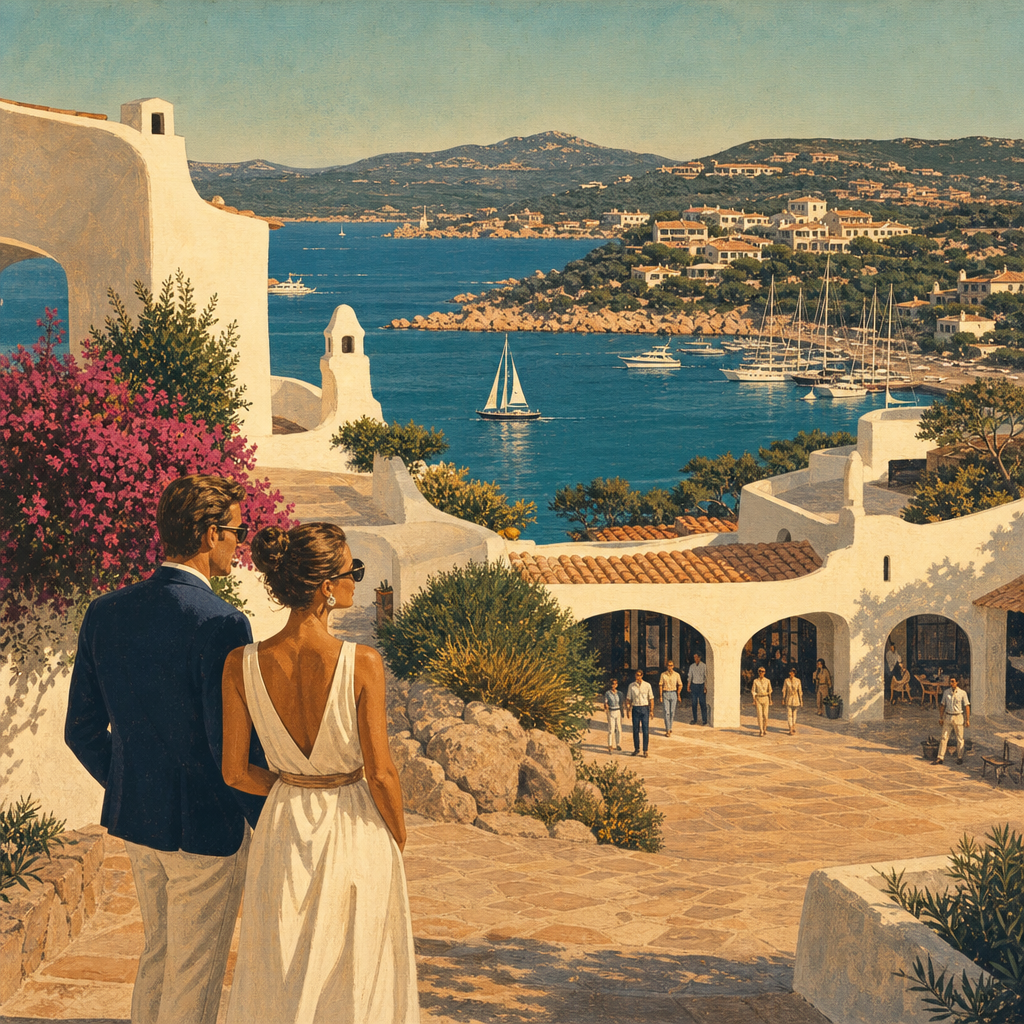
In the 1980s, Porto Cervo and the Costa Smeralda achieved unprecedented global renown. In that golden decade, the visionary project launched in the 1960s came to full maturity, becoming a universally recognized model of elite Mediterranean tourism. This sweeping growth did not concern only the luxury segment, but organically encompassed the landscape, architecture, yachting, and territorial identity, helping to establish a collective imagination destined to endure over time.
In particular, the Costa Smeralda of the 1980s established itself as a true visual and cultural language. Porto Cervo became its symbolic and operational center, capable of combining international hospitality of the highest caliber with strict control over urban development. In this context, the role of Prince Karim Aga Khan IV remained central, as he was able to unite a global strategic vision with constant attention to the protection of the region.
- From rural Gallura to international visibility
- The Public Role of Karim Aga Khan IV
- Porto Cervo: architecture and public space
- 1980sThe 1980s: Yachting and Elite Tourism
- Arzachena and Gallura: transformations and continuity
- Memory and cultural legacy
From Rural Gallura to International Visibility
To fully understand the explosion of the 1980s, it is useful to rewind the tape to the project’s origins. In the late 1950s, Gallura was a predominantly rural area, shaped by an agro-pastoral economy and a visceral bond with the land. Arzachena and its hinterland jealously guarded centuries-old community traditions, typical granite architecture (the traditional stazzi), and a deeply rooted material culture.
The arrival of Karim Aga Khan IV introduced an entirely new perspective. This was not a simple tourist urbanization project; on the contrary, an unprecedented model took shape, founded on architectural quality, rigorous environmental protection, and coordinated management of development. Thus, in 1962, the Costa Smeralda Consortium was established, a private entity created specifically to define shared building regulations, restrictions, and aesthetic standards.
After two decades of consolidation through the 1960s and 1970s, the project reached its greatest international prominence in the 1980s. Porto Cervo became the undisputed benchmark for discerning tourism and for a new idea of Mediterranean style: sophisticated, yet always integrated with nature.
To explore the cultural and symbolic roots of this fascinating process in greater depth, it is useful to read the article dedicated to the Myth of the Costa Smeralda: history, images, and territorial reality, which reconstructs the genesis of this imagery. From an institutional standpoint, the guarantor role played by the Costa Smeralda Consortium remains essential, as it still safeguards the historical documentation and management of the district today.
The Public Role of Karim Aga Khan IV
Karim Aga Khan IV worked in Sardinia as the promoter of a far-sighted, long-term vision. His interest was never limited to real estate speculation, but found expression in a comprehensive project that coherently intertwined economy, culture, and the preservation of the landscape.
In the 1980s, with the Costa Smeralda brand by then established globally, his leadership was expressed above all in the ability to maintain a firm balance between the pressures of international openness and the defense of local identity. In this sense, the Consortium continued to act as a bulwark and guarantor of the original philosophy against uncontrolled land development.
Moreover, the project’s public profile was enriched through the promotion of major sporting events and recreational boating. These global sporting initiatives strengthened Porto Cervo’s image as a worldwide crossroads, while preserving its symbiotic bond with the clarity of the sea and the ruggedness of the land.
Can a tourism project become part of a territory’s identity without distorting it?
It was precisely in the 1980s that the Costa Smeralda offered an affirmative answer to this question: human intervention was consistently conceived as a respectful dialogue with the preexisting landscape, never as a replacement for it.
Porto Cervo: Architecture and Public Space
Porto Cervo has always represented the beating heart of the area. From the very first sketch on paper, the village was conceived as an organic whole. Masters of architecture such as Luigi Vietti, Michele Busiri Vici, and Jacques Couëlle gave life to a unique Sismo-Mediterranean style, characterized by a close dialogue with the forms of Gallura’s natural landscape.
In the 1980s, this urban layout reached its full functional maturity. The famous little piazzas, the evocative pedestrian pathways, and the wooden bridges overlooking the marina encouraged a worldly yet discreet social life. Exclusivity was expressed not through monumental ostentation, but through meticulous attention to artisanal detail.
The masterful use of Sardinian granite, the irregular architectural lines, the niches, and the warm colors definitively consolidated the Costa Smeralda aesthetic. In this way, Porto Cervo established itself not as a mere vacation backdrop, but as a true laboratory of ideas on the relationship between tourist flows and genius loci.
The 1980s: Yachting and Elite Tourism
The 1980s marked the peak of media visibility. The grand yachts, the figures of the international jet set, and the historic regattas organized by the Yacht Club Costa Smeralda helped create a glossy and extremely powerful iconography. However, reducing the complexity of this period to the sole concept of “luxury” would be misleading and reductive.
In those years, an idea of exclusivity took hold, one tied first and foremost to the quality of the environmental experience. Controlled management of building volumes and the active protection of the coastline remained essential cornerstones. The Costa Smeralda model thus demonstrated that it was possible to find common ground between economic profit and the ecological sustainability of the territory.
In this scenario, yachting took on profound symbolic value. The new marina and the crowded docks became, indeed, a tool of global marketing, but also the purest expression of a deep-rooted culture of the sea and navigation in the heart of the Mediterranean.
Arzachena and Gallura: Transformations and Continuities
The dialectical relationship between Porto Cervo and Arzachena is the keystone to deciphering the legacy of the decade. While Porto Cervo embodied the cosmopolitan and international face of Sardinia, Arzachena remained the administrative, political, and community hub of rural Gallura.
During this period of rapid expansion, the tourism-related economy generated unprecedented wealth and new employment opportunities for the entire local population. At the same time, the first healthy debates emerged over land consumption and coordination between the private Consortium and local public institutions. Despite the inevitable tensions, a unique model of development took hold, one capable of allowing economic innovation to coexist with the island’s ancient roots.
Moreover, the Gallura hinterland was never excluded from the coastal narrative. The evocative inland landscapes, dominated by cork oak groves, and the nearby Nuragic archaeological sites constantly reminded visitors that Sardinia’s profound value did not end at the shoreline.
Memory and cultural legacy
More than forty years later, the era of the 1980s retains a central place in Sardinia’s collective memory. The figure of Karim Aga Khan IV is celebrated as the architect of a profound metamorphosis, carried out with extraordinary aesthetic and environmental sensitivity, capable of leaving an indelible mark on the landscape and public space.
Today, revisiting that experience means looking beyond the covers of the glossy magazines of the time. It means recognizing the value of an integrated territorial project that managed to withstand passing fads while keeping its fundamental architectural and environmental coherence intact.
In conclusion, the Costa Smeralda of the 1980s remains a valuable case study for the present: not so much as a formula to be copied slavishly, but as an extraordinary historical testament to how cultured tourism can generate economic growth while respecting the public memory and environment of a Mediterranean region.