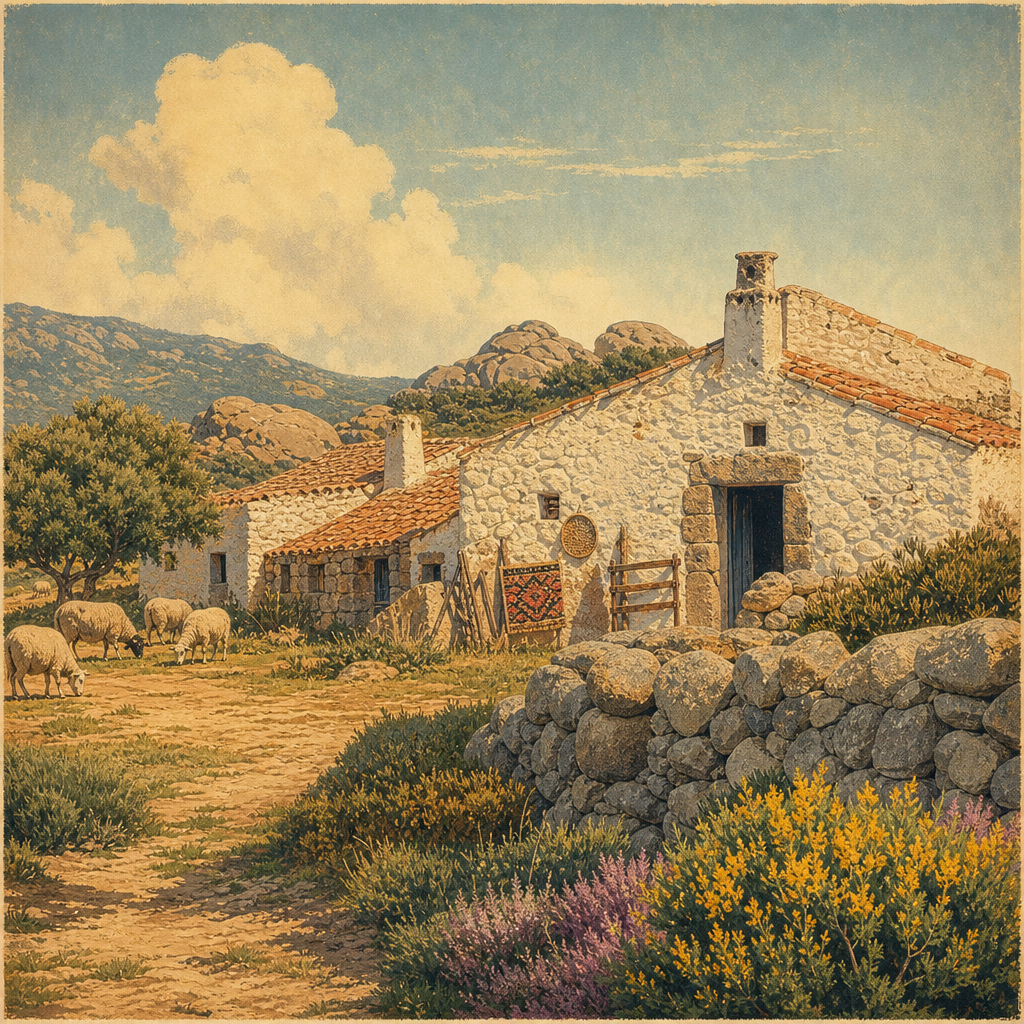
The Gallurese stazzi tell the most authentic, profound, and visceral story of Gallura. Scattered with artful discretion among granite hills, fertile valleys, and dense woods of Mediterranean scrub, these historic rural settlements reveal the extraordinary bond that unites vernacular architecture, family life, and the design of the landscape. For travelers and enthusiasts interested in discovering its most intimate culture and traditions, understanding the dynamics of the stazzi means grasping the socio-economic evolution of the area well before the major tourism-driven transformations that marked the second half of the twentieth century.
- The origins of the stazzi and the formation of the Gallurese landscape
- Arzachena between rural history and territorial identity
- Traditions, daily life, and the culture of the stazzi
- The relationship between stazzi, environment, and landscape
- From Rural Gallura to the Costa Smeralda
- Public memory, preservation, and the role of the Municipality of Arzachena
- The cultural legacy of the stazzi in contemporary Gallura
The origins of the stazzi and the formation of the Gallurese landscape
The stazzo undoubtedly represents one of the most emblematic architectural and anthropological expressions of Gallura’s rural civilization. Having spread extensively above all between the 18th and 19th centuries, it took shape as an autonomous residential and productive unit, rigorously built from blocks of local stone and set at the center of a wholly self-sufficient plot of agricultural and pastoral land. Precisely by virtue of this widespread diffusion, over time the Gallurese stazzi ceased to be mere isolated farms and became the true geometric and identity-defining element of the inland landscape.
The house’s sober geometric structure responded schematically to the practical needs of everyday life, with the land used for crops, the pastures for livestock, and the small service buildings such as ovens and enclosures arranged harmoniously around the main dwelling. As a result, the ancient Gallurese families led a solitary yet industrious existence, shaped by a close and symbiotic relationship with the land and with the limited water and woodland resources available.
In Gallura, the natural environment has never been a mere, passive scenic backdrop, but rather the tangible result of a centuries-old, silent dialogue between human subsistence needs and the ecosystem. Thus, the intricate network of rural paths, the miles of dry-stone walls marking property boundaries, and the small clearings set aside for cultivation ultimately shaped a unique cultural geography that is still perfectly legible from above.
To examine up close the historical events that paved the way for this social organization, it is useful to consult the historical analysis of the period preceding tourism development presented in Historic Gallura before the Costa Smeralda.
Similarly, to better understand the inventorying and enhancement policies promoted by local administrations for the historical heritage, it is advisable to visit the institutional portal of the Municipality of Arzachena.
What remains of a community when the economy, ways of living, and relationship with the land change?
In the case of the civilization of the Gallurese stazzi, the most authentic answer emerges precisely by examining those indelible traces etched into the granite of the countryside and jealously guarded in the oral memory of family traditions.
Arzachena between rural history and territorial identity
The city of Arzachena occupies a wholly unique and pivotal role in Sardinian historiography. Although, in the global collective imagination, its name is indissolubly linked to the birth and international prestige of the Costa Smeralda, its true administrative and social identity is rooted in a far older and more structured historical and evolutionary fabric.
Indeed, the entire municipal area preserves an extraordinary open-air archaeological heritage, dotted with Neolithic necropolises, imposing nuraghi, and majestic giants’ tombs, bearing witness to a millennia-old human presence and sacredness that predates the introduction of the eighteenth-century stazzo by thousands of years.
However, after the long medieval centuries marked by wars and coastal depopulation due to Saracen incursions, the countryside was repopulated precisely thanks to the gradual spread of these scattered rural settlements. In this specific context of agrarian rebirth, the Gallurese stazzi rose to become the absolute fulcrum of family, social, and economic life throughout the entire region.
These granite structures should therefore not be interpreted as mere, cold constructions; on the contrary, they held within them a rich heritage of human relationships, ancient agricultural knowledge, codes of honor, and communal celebrations. For this very reason, understanding the present-day complexity of Arzachena necessarily requires a curious gaze turned toward its rural hinterland and its hills.
Traditions, everyday life, and the culture of the stazzi
The compendium of customs and ways of life that flourished around the stazzi galluresi constitutes one of the most fascinating chapters of the island’s anthropology. Daily existence unfolded in strict fidelity to the astronomical cycle of the seasons, in which the sowing of wheat, the shearing of flocks, and the grape harvest dictated the rhythms and priorities of the family unit.
In a state of substantial geographic isolation, food self-sufficiency played a central role: the skillful aging of cheeses in cool, shaded rooms, ritual bread-making in large wood-fired ovens, and the tending of the vegetable garden ensured the household’s sustenance, while the secrets of the trades were passed down from father to son through example and oral tradition.
Despite the considerable physical distance separating one settlement from another, the Gallurese community was by no means fragmented. On the contrary, families wove a dense network of mutual aid, in which the great patron saint festivals held at rural sanctuaries and the days devoted to collective wool processing or harvesting became precious opportunities to strengthen community ties and marriage alliances.
Among the main cultural expressions that emerged within this world are:
- The rigorous dry-stone masonry techniques and the dressing of local granite blocks.
- The age-old cheesemaking tradition tied to the processing of sheep’s and cow’s milk.
- Extensive free-range livestock farming among the cork oak groves.
- The craftsmanship of juniper and wild olive wood for household furnishings.
- The herbal knowledge associated with the medicinal use of wild plants from the maquis.
- The preservation of the Gallurese linguistic variant, rich in historical influences.
- The devotional rites and polyphonic songs performed in the small country churches.
Is it really possible to understand a territory by looking only at its most famous places?
Clearly not, since the hinterland dotted with Gallurese stazzi functions as an immense open-air archive, indispensable for deciphering the profound evolution of contemporary Sardinian identity.
The relationship between stazzi, environment, and landscape
One of the aspects of greatest scientific and landscape interest lies in the stazzo’s perfect ecological integration with the surrounding geomorphology. The dwellings, far from seeking to impose their own volumetric hegemony on nature, were built using materials extracted directly from the ground and oriented to accommodate prevailing winds such as the mistral.
Gray and pink granite thus emerged as the building material of choice, allowing the buildings’ thick walls to blend chromatically and visually among the large rocky outcrops, cork oak woods, and cultivated valleys.
Northern Gallura offers a marked environmental heterogeneity, where jagged cliffs and marine fjords are echoed, just a few kilometers away, by mountain ridges and alluvial plains. In this sense, the distribution of the stazzi galluresi bears witness to a refined human ability to interpret the landscape and adapt to local microclimates, accumulated over generations.
This environmental mosaic is composed of diverse, delicate ecological tiles:
- The spectacular granite formations and tafoni sculpted by the elements.
- The monumental forests and cork oak woodlands, a crucial economic resource.
- Low Mediterranean scrubland, the realm of mastic, heather, and strawberry tree.
- The historic pastures painstakingly carved out through controlled brush clearing.
- The historic hillside vineyards devoted to the production of the celebrated Vermentino.
- The lagoons and coastal inlets that lapped at the boundaries of the seaside stazzi.
Consequently, it is clear that the present-day landscape can in no way be separated from, or analyzed independently of, the everyday lives of the communities that painstakingly and lovingly shaped it.
From Rural Gallura to the Costa Smeralda
The second half of the twentieth century marked the advent of a radical economic and cultural metamorphosis for the entire island. On the one hand, the development of luxury tourism projected the Arzachena coastline to the center of the international jet-set circuit; on the other, it simultaneously set in motion a virtuous process of rediscovering and safeguarding local historical roots.
The grand urban planning project of the Costa Smeralda succeeded in codifying an architectural language that, despite its functional modernity, borrowed its sober lines, use of stone materials, and horizontal volumes directly from the ancient example of the traditional stazzo.
Despite the inevitable shift of the economic center of gravity toward services and leisure boating, the inland valleys, rural architecture, and Gallurese stazzi have continued to serve as irreplaceable guardians of the historical soul of northern Sardinia.
This fascinating evolutionary journey can be summarized in a few key stages:
- Ancient agro-pastoral Gallura centered on economic self-sufficiency.
- The gradual aggregation of families and the emergence of the first modern urban centers.
- The international vision that launched coastal tourism in the 1960s.
- The controlled development of the village of Porto Cervo and its exclusive marinas.
- The adoption of strict landscape regulations to safeguard the coastal environment.
- The contemporary movement for conservative restoration and the enhancement of rural memory.
Public Memory, Preservation, and the Role of the Municipality of Arzachena
Preserving collective memory in the face of the rapid changes of modernity represents one of the most complex cultural challenges for contemporary institutions. Today, Arzachena must manage a layered and precious legacy, ranging from Nuragic archaeology to the civilization of the stazzi, and on to the recent architectural history of the Consortium.
In this scenario, local authorities and cultural associations act on the front lines to promote the conscious and sustainable enjoyment of this heritage, encouraging scientific research and the philological restoration of the ancient masonry.
Public memory, after all, is not confined to the monumental preservation of grand buildings, but lives above all in the safeguarding of small gestures, historic place names, ancient recipes, and everyday artifacts. And it is precisely within this perspective of dynamic conservation that the stazzi galluresi maintain a foremost role in regional cultural development plans.
How do you preserve the identity of a place when its landscape evolves over time?
The way forward lies in education and in the integrated enhancement of all historical layers, revealing to visitors how Gallura is a single, grand, and coherent narrative spanning coast and inland.
The Cultural Legacy of the Stazzi in Contemporary Gallura
Today, many stazzi have been skillfully restored and converted into exclusive country residences, refined agritourism retreats, or open-air ethnographic museums. This revival shows how the stazzi galluresi are still able to generate economic and aesthetic value, reaffirming their role as irreplaceable pillars of the island’s identity.
For tourists who choose to venture beyond the beaches of Porto Cervo, these structures open a privileged window onto an unusual and proud Sardinia, inviting them to discover the land in a more intimate, thoughtful way, respectful of nature’s rhythms.
Their extraordinary contemporary importance therefore does not end with the documentary value of their stone architecture; on the contrary, they continue to teach us the importance of restraint, sustainability, and harmony between human beings and the environment. For all these reasons, the Gallurese stazzi remain one of the most precious and inspiring legacies of Mediterranean rural culture.