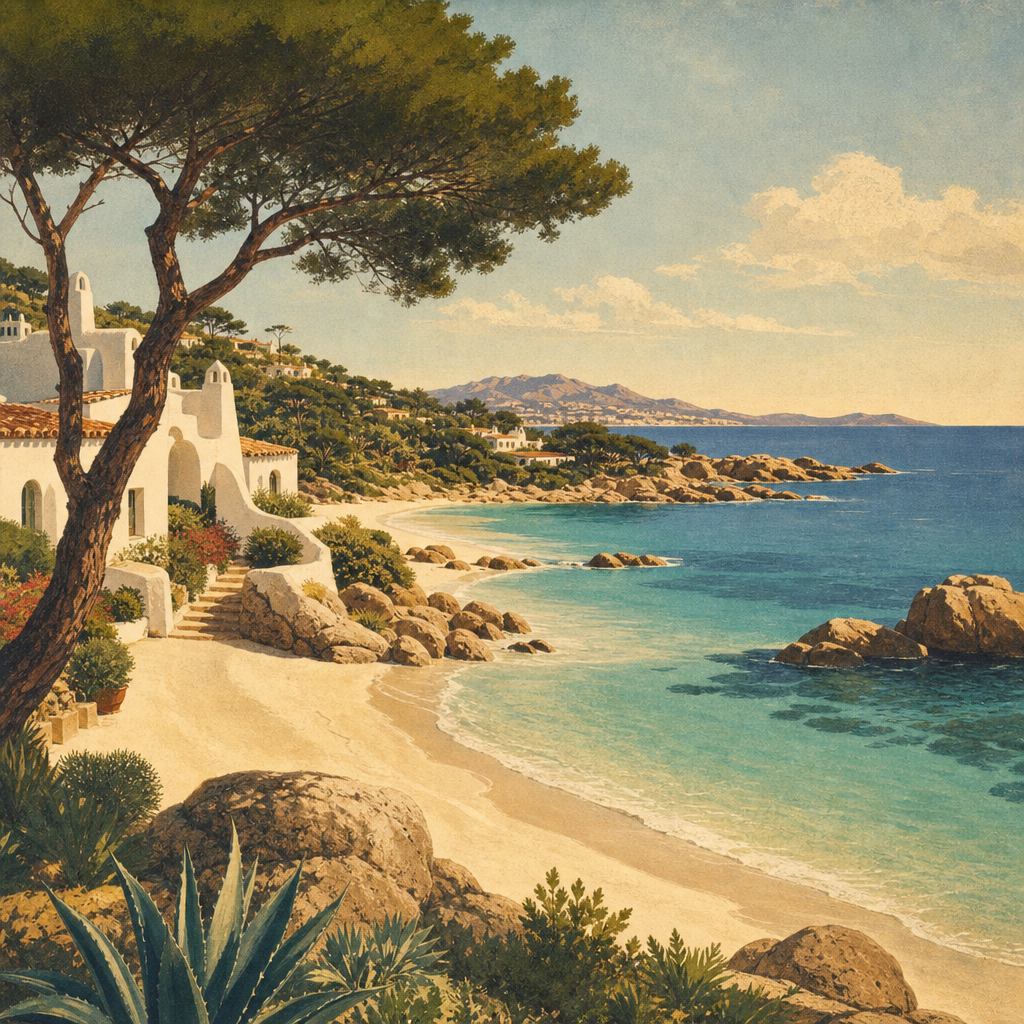
Costa Smeralda in the off-season means discovering the more intimate and authentic face of one of the most famous and photographed stretches of coastline in the Mediterranean. When summer gives way to the quieter months of fall and winter, the area sheds its glossy frenzy to reveal, with absolute clarity, its true landscape identity. At this time of year, the granite profiles emerge majestically, along with architecture organically integrated into the environment, silent squares, and panoramic trails suspended above the sea. Far removed from an image tied exclusively to mass beach tourism, a complex and fascinating reality is revealed: a deeper dimension that speaks of precise urban planning, the history of local culture, and an ancestral relationship with the island’s wild nature.
- The origins of the Costa Smeralda and the transformation of the land
- Porto Cervo, the symbolic heart of the Costa Smeralda
- Architecture, Landscape, and Mediterranean Identity
- Costa Smeralda in the off-season: a different experience
- Beaches, trails, and landscape photography
- Cultural memory, transformations, and contemporary meaning
The Origins of the Costa Smeralda and the Transformation of the Territory
To fully understand the historical and cultural value of the Costa Smeralda during the less crowded months, it is essential to take a step back and explore its native origins. Before the 1960s, in fact, this northeastern portion of Gallura featured an almost primordial landscape, characterized by unspoiled sandy coves, dense and fragrant Mediterranean scrub, imposing wind-sculpted rock formations, and a human presence limited to the agro-pastoral activities of the traditional stazzi.
Later, the true historical turning point came with the bold, visionary project promoted by Prince Karim Aga Khan IV and a consortium of international investors. Fascinated by the raw beauty of these coasts, they identified this shoreline as the ideal place to create an entirely innovative elite tourist destination. The primary goal was not simply to build imposing hospitality facilities, but rather to create an integrated and sustainable urban planning model capable of enhancing and respecting the existing landscape without distorting it.
The official establishment of the Costa Smeralda Consortium in 1962 marked the decisive step in this evolution. Through the adoption of strict urban planning rules and exceptionally rigorous design criteria set by a dedicated committee of architects, an effort was made to preserve a precise visual harmony between the new buildings and the surrounding nature. As a result, this pioneering approach helped make the area one of the most renowned and successful case studies in landscape planning applied to tourism in the Mediterranean basin.
Visiting the area in the low season makes it much easier to read and decode the traces of this meticulous transformation. The scenic roads that follow the curves of the hills, the small residential settlements, the shaded squares, and the public spaces reveal themselves not as random elements, but as coordinated parts of a single territorial design that has redefined Gallura’s contemporary identity and economy.
Porto Cervo, the symbolic heart of the Costa Smeralda
Porto Cervo has always embodied the nerve center and symbolic heart of the entire Costa Smeralda area. Created as the focal point of the new tourist settlement, the village was masterfully designed to follow the natural shape of the deer-shaped harbor and the contours of the surrounding hills; in this way, it avoided the alienating, geometric visual impact typical of many seaside developments built in the postwar period.
During the fall and winter months, the village is transformed, offering a particularly evocative and rarefied experience of exploration. The famous little squares, stone stairways, arched covered passageways, and winding pedestrian paths can be discovered at a slow pace, allowing visitors to appreciate the precious construction details and color choices that often remain hidden amid the frantic rhythm of the peak summer season.
Among the most significant architectural elements of Porto Cervo, the following undoubtedly stand out:
- The historic central Piazzetta, an intimate open-air sitting room overlooking the sea.
- The carefully designed panoramic views that suddenly open onto the natural harbor.
- The pedestrian walkways made of local stone that connect the Old Port to the new Marina.
- The historic hotels, cornerstones of the Costa Smeralda’s architectural style.
- Public spaces and gardens skillfully arranged across multiple levels of the terrain.
At the same time, the splendid Marina — internationally known for its major sailing events — sheds the glamour of mega-yachts to reveal itself in its most authentic form: a privileged place of calm from which to observe the deep, indissoluble structural bond that connects the Costa Smeralda to the culture of the sea and sailing.
Architecture, Landscape, and Mediterranean Identity
One of the most significant cultural aspects of the Costa Smeralda lies in the codification of its distinctive architecture. From the earliest design phases, the creative team rejected verticality and intrusive volumes, favoring organic, sculptural, and sinuous forms capable of establishing a continuous mimetic dialogue with the island’s geology.
Masters of the caliber of Luigi Vietti, Michele Busiri Vici, and Jacques Couëlle helped shape a completely original architectural language, drawing inspiration from the spontaneous forms of Sardinian and Mediterranean rural tradition, yet reinterpreting them through an elegant contemporary lens. To examine the genesis of this style and its evolution up close, it is useful to consult the comprehensive in-depth feature dedicated to the architecture of the Costa Smeralda. The result of this extraordinary artistic synthesis was an unmistakable style, characterized by low heights that never rise above the tops of the vegetation, hand-shaped lines, and total submission to the morphology of the land.
The fundamental guidelines of this architectural school can be summarized in a few key points:
- Complete mimetic integration with the landscape and native flora.
- Use of pastel plaster finishes and warm colors in a palette perfectly in harmony with the Gallurese landscape.
- Structural and aesthetic enhancement of Sardinian granite, juniper, and wrought iron.
- Cozy little squares and winding roads that break up the rigidity of straight lines.
- Carefully planned sightlines toward the slivers of light from the sea and the hills.
- Fluid spatial continuity between the villas’ interiors and outdoor patios.
In the fall and winter months, the low-angled sunlight masterfully enhances the sculptural quality of the forms, the rough texture of the plasterwork, and the stone construction details. For enthusiasts of art history, urban planning, and photography, the low season therefore offers ideal conditions of light and silence, making it possible to study up close the perfect visual balance born from the union of human ingenuity and untamed nature.
The Costa Smeralda in the off-season: a different experience
Choosing the Costa Smeralda during the less conventional times of year allows you to experience the area at a slow, relaxed pace. The generally mild temperatures of northeastern Sardinia encourage long coastal walks, easy hikes, and urban explorations in complete tranquility, without the pressure of large tourist crowds or the oppressive heat of summer.
At this particular time, the entire Gallura landscape radically changes its color palette: the sea takes on even more intense, deeper shades of turquoise and cobalt blue, while the clear skies offer spectacular displays of light at dawn and sunset. At the same time, the lush vegetation of the Mediterranean scrub regenerates with the first rains, releasing intense scents of myrtle, rockrose, and mastic that tend to fade during the summer.
Moreover, the quiet of the low season makes it possible to fully grasp the geographic and social interconnection between the coastal strip of the Costa Smeralda, the administrative center of Arzachena, and the broader mountainous hinterland of Gallura. As a result, the deep ties to the island’s history, its food and wine traditions, and its extraordinary archaeological heritage — made up of Giants’ Tombs and Nuragic complexes scattered throughout the interior — emerge with striking clarity.
Among the most rewarding activities to plan during the winter or fall months are:
- Hiking and scenic walks along the coastal wellness trails.
- Cultural and historical tours exploring the urban design details of Porto Cervo.
- Field study and observation of Mediterranean organic architecture.
- Landscape and nature photography sessions with optimal lighting.
- Excursions to nearby Gallura villages, such as the charming center of San Pantaleo.
- Guided exploration of the rich archaeological sites and Nuragic complexes in the Arzachena area.
Beaches, Trails, and Landscape Photography
While the Emerald Coast’s beaches are rightly celebrated around the world for their dazzling beauty, in the off-season they regain a wholly unique poetic and contemplative dimension. Far from being mere beach establishments, they become vast open spaces devoted to the close contemplation of Sardinia’s nature and geology.
Legendary beaches such as Liscia Ruja, the coves of Capriccioli, Romazzino, and the bays of Grande and Piccolo Pevero finally reveal their full morphological form. The absence of beach umbrellas and boats anchored close to shore makes it possible to appreciate the incredible natural chromatic contrast that brings together the ultra-fine sand with its pink hues, the still, transparent water, and the monumental granite sculptures that frame the coastlines.
The intricate network of coastal trails and panoramic roadside overlooks also regains its wild charm. Walking along the dirt paths that skirt the vegetation, you can observe Sardinia’s ancient geology up close, along with the complex biodiversity of its coastal flora and an endless series of unexpected views over the islands of the La Maddalena Archipelago.
For photographers and landscape artists, the most inspiring subjects the low season offers include:
- The geometric details, the interplay of arches, and the deserted stairways in the village of Porto Cervo.
Cultural memory, transformations, and contemporary meaning
Nowadays, Costa Smeralda represents much more than a simple and exclusive summer tourist destination; it stands as a territory-laboratory that chronicles one of the most important and studied landscape transformations that occurred in the second half of the twentieth century on the European continent, remaining a firm subject of reflection for urban planners and geographers.
Its complex contemporary identity is the result of the collective and stratified contribution of enlightened designers, far-sighted administrators, local craftsmen, historic residents, and conservation institutions. Iconic elements such as Porto Cervo, the wooden piers of the Marina, the small stone piazzas, the signature hotels, and the protected beaches have now become part of a shared cultural memory that transcends the concept of a holiday.
To consult historical data, landscape restrictions, and institutional information about the territory, it is possible to refer to the official channels of the Municipality of Arzachena. Meanwhile, during the less crowded months of the year, this complex cultural dimension emerges in all its strength: the absence of summer commercial frenzy finally allows one to observe the territory as a coherent and inseparable whole, where human craftsmanship has been ennobled by the beauty of Sardinian nature.
In conclusion, exploring Costa Smeralda out of season offers an extraordinary critical opportunity: that of knowing how to read a territory in its true scientific and artistic complexity, discovering how the sea, the pink granite, the Mediterranean scrub, and organic architecture co-operated to establish one of the most fascinating and recognizable cultural landscapes of the contemporary Mediterranean.à critica straordinaria: quella di saper leggere un territorio nella sua reale complessità scientifica e artistica, scoprendo come il mare, il granito rosa, la macchia mediterranea e l’architettura organica abbiano cooperato per fondare uno dei paesaggi culturali più affascinanti e riconoscibili del Mediterraneo contemporaneo.