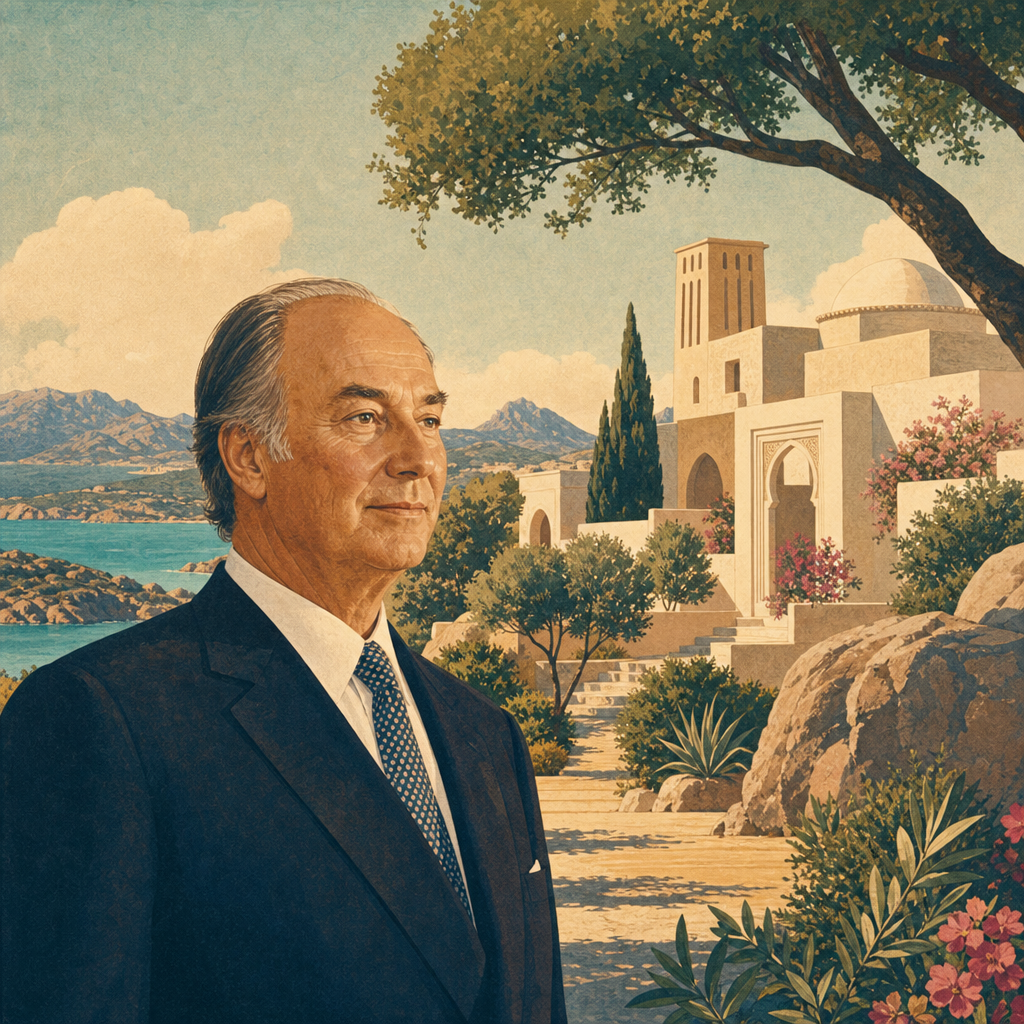
Aga Khan IV’s public commitment stands out for its broad, structured philanthropic dimension, recognized internationally. Over the course of decades, this vision has consistently brought together economic development, cultural preservation, and education, rejecting sectoral or fragmented approaches. As a result, his public profile has emerged as that of a leader attentive to the quality of life of communities, looking far beyond mere material growth or traditional economic indicators.
Even before being associated with individual territories or emblematic projects, the Prince promoted an idea of progress founded on collective responsibility. In particular, his approach sought to integrate tradition and modernity in a harmonious dialogue, avoiding rigid oppositions. This balance represents one of the most characteristic features of his public work and of the way philanthropy is conceived: a true long-term strategic investment.
- A philanthropic commitment with international reach
- Culture and education as drivers of development
- Quality of life and human development
- A coherent vision applied to local contexts
- A philanthropic legacy that transcends individual projects
A philanthropic commitment with international scope
Aga Khan IV is known globally for supporting wide-ranging development programs in Asia, Africa, and the Middle East. Through institutional networks and dedicated foundations, he has encouraged targeted initiatives in the fields of health care, education, social housing, and basic infrastructure. These projects have consistently involved local partners and national institutions, recognizing and strengthening the expertise already present in the area.
This model has never been limited to immediate assistance or emergency management. On the contrary, it has focused on creating lasting and self-sufficient structures. In this way, philanthropy becomes a tool for autonomy rather than dependence, fostering processes of emancipation and growth capable of sustaining themselves over time, well beyond the duration of direct financial support.
At the same time, the Prince’s international work has shown a deep sensitivity to the relevant social and anthropological context. Indeed, each initiative is reshaped around the cultural specificities of the host communities. As a result, the global dimension of his vision never erases local identities, but integrates them into a broader and more inclusive framework for development.
Culture and Education as Drivers of Development
Another fundamental pillar of the Aga Khan’s vision lies in the conception of culture as an active force for emancipation. From this perspective, the protection of historical, artistic, and architectural heritage is considered essential to strengthening communities’ identity and their sense of belonging. Therefore, conservation is not understood as a sterile protection of the past, but rather as a living planning resource for the present and the future.
At the same time, education plays a crucial strategic role, not only as a means of individual growth, but as the foundation for a more equitable, aware, and resilient society. For this reason, numerous international programs have funded the establishment of schools, universities, and vocational training centers, placing the quality of teaching at the heart of literacy and schooling processes.
As a result, culture and education are approached as two sides of the same coin, creating a virtuous link between knowledge, historical roots, and progress. This integrated approach helps significantly improve the quality of everyday life, enriching the social and symbolic sphere of communities alongside the strictly economic one.
Quality of Life and Human Development
Aga Khan IV’s philanthropy places human development, understood in a holistic sense, at its core. The growth of a society is measured in terms of widespread well-being, dignity, and equal opportunity; for this reason, healthcare, access to housing, and urban planning become essential stages in a far-reaching strategy.
In many developing contexts, this has translated into the creation of accessible health care facilities and dignified residential districts. At the same time, the constant focus on ecological sustainability ensures that these initiatives remain compatible with the needs of future generations. In practice, quality of life is understood as the result of a perfect balance between material well-being and intangible values.
This approach highlights how progress cannot be reduced to simple macroeconomic formulas. Crucial factors such as social cohesion, community security, and inclusion are considered essential indicators for assessing the true advancement of a people.
A coherent vision applied to local contexts
The effectiveness of Aga Khan IV’s approach lies precisely in its ability to translate a global vision into specific local realities. In Sardinia as well, this philosophy was expressed as a pioneering attempt to combine openness to international markets with strict respect for the surrounding ecosystem. In this sense, the creation of the Costa Smeralda is often studied as a virtuous example of planned, controlled, and distinctive territorial development.
To fully understand this connection between great ideals and practical applications in the field, it is useful to explore the analysis presented in the article on the Costa Smeralda Model: the vision of Prince Karim Aga Khan IV. This study clearly shows how broad philanthropic principles were translated into precise architectural and urban planning choices, capable of shaping the deep identity of a place.
The Sardinian experience is thus interpreted as one piece of a much larger mosaic. Consequently, individual territorial projects never appear as isolated or speculative interventions, but as integral parts of an organic narrative that inextricably links economic development, culture, and a profound sense of ethical responsibility.
A Philanthropic Legacy That Transcends Individual Projects
Over the decades, the philanthropic legacy of Prince Karim Aga Khan IV has extended far beyond the physical boundaries of individual initiatives, becoming a benchmark model studied in academic circles for its methodologies and values. It is not a rigid set of prescriptions to be exported mechanically, but rather a flexible programmatic framework open to change.
In conclusion, the figure of the Prince emerges as that of an authoritative mediator between seemingly distant spheres: on one hand, international economic and institutional diplomacy; on the other, the daily and tangible care of local communities. This union continues to offer valuable insights into the indissoluble bond that must exist between global progress, cultural identities, and the ethics of responsibility.
For a complete institutional overview of the activities and projects promoted on a global scale, you can consult the official portal of the Aga Khan Development Network, the official reference source for all educational, social, and international cooperation programs supported over time.