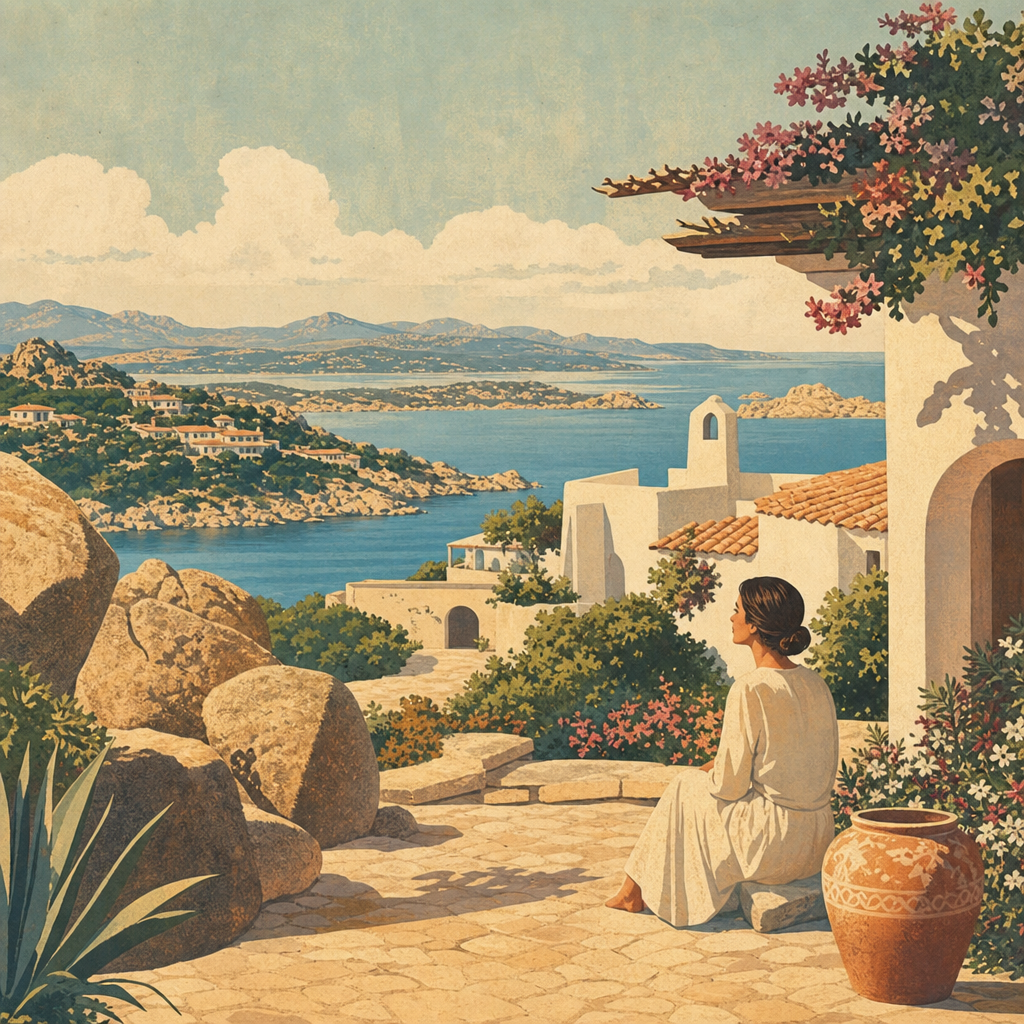
In the 1960s, northeastern Gallura appeared as a land marked by a rugged, silent beauty, far from the major tourist flows. The landscape, shaped by granite rocks, natural inlets, and small towns, spoke of a Sardinia still peripheral to the main paths of European development. It was within this context that Prince Karim Aga Khan IV arrived, a figure destined to leave a lasting mark on the relationship between culture, the enhancement of the landscape, and the region’s quality of life.
- The Historical and Territorial Context of Gallura
- Prince Karim Aga Khan IV: Profile and Public Role
- The Birth of the Costa Smeralda and a New Idea of Development
- Porto Cervo: architecture, public space, and cultural symbol
- Local community and shared memory
- Cultural heritage and quality of life over time
The Historical and Territorial Context of Gallura
To understand the significance of the Costa Smeralda, it is necessary to begin with the context in which it came into being. Until the mid-20th century, in fact, Gallura and the Arzachena area were characterized by low population density and a predominantly agro-pastoral economy. The coastlines, iconic today, were difficult to access and entirely lacking in hospitality infrastructure.
In those years, tourism in Sardinia was taking its first steps in a fragmented way. As a result, the few structured initiatives were concentrated in major urban centers already connected to national flows. Gallura remained on the margins of these dynamics, not for lack of value, but because there was no vision capable of interpreting its potential without distorting its identity.
However, the northeastern coast offered a landscape heritage unique in the Mediterranean. It was precisely this combination of isolation, authenticity, and extraordinary natural beauty that attracted the attention of international investors, who were interested in proposing an alternative development model to the intensive, speculative one widespread elsewhere.
On this terrain, both physical and cultural, Prince Karim Aga Khan IV’s vision took root, destined to radically transform the relationship between territory, architecture, and collective well-being.
Prince Karim Aga Khan IV: profile and public role
Prince Karim Aga Khan IV, born in 1936, is known worldwide as the 49th Imam of the Ismaili Muslims. Throughout his extensive international work, he has been active primarily in the cultural, educational, and philanthropic fields, but in the Sardinian context his figure takes on a very specific territorial significance.
In the 1960s, the Aga Khan promoted the creation of the Costa Smeralda Consortium, bringing together architects, urban planners, and entrepreneurs with the goal of developing high-quality tourism. From the very beginning, he paid close attention to the social and environmental implications associated with the transformation of the area.
According to historical reconstructions, his philosophy was based on several key principles: limiting building density, rigorously respecting natural landforms, and using materials inspired by Mediterranean tradition. For this reason, the Costa Smeralda experience stands in sharp contrast to many contemporary developments carried out along Europe’s coasts during the same period.
To explore the historical and cultural context that preceded this major project in greater depth, it is useful to read Pre-tourism Gallura: Before the Costa Smeralda, which reconstructs the reality of the area before the transformations. In addition, the Aga Khan’s international profile is also extensively documented through the activities of the Aga Khan Development Network, an organization that has been active for decades in the fields of culture, education, and sustainable development on a global scale.
The Birth of the Costa Smeralda and a New Idea of Development
The birth of the Costa Smeralda was the result of a complex planning process launched in 1962, the year in which the first land acquisitions began along roughly 55 kilometers of coastline in the Arzachena area. The primary objective was to create a unified, protected, and easily recognizable tourist district.
What makes the project culturally significant is its unprecedented focus on the inhabited landscape. Architects of the caliber of Michele Busiri Vici, Luigi Vietti, and Savin Couëlle developed a language capable of openly engaging with the Gallura environment, reinterpreting elements of local tradition through an exquisitely contemporary lens.
Buildings, hotels, and public spaces were designed to visually integrate with the granite rock formations and follow the natural curves of the land. The use of pastel colors and local materials helped shape a harmonious aesthetic that, even today, defines the visual identity of the Costa Smeralda.
From the perspective of quality of life, the project proposed an idea of tourism understood as a cultural and environmental experience, rejecting the mere consumption of the territory in favor of a lasting balance between international hospitality and local livability.
Porto Cervo: architecture, public space, and cultural symbol
Porto Cervo represents one of the most fully realized expressions of this philosophy. Built around a small natural harbor, the village was designed as the symbolic and functional center of the entire district, taking shape as an ideal meeting place for residents, visitors, and lovers of the sea.
The Porto Cervo’s famous piazzetta is not merely an urban space to pass through, but a true mechanism that reflects a precise idea of sociability. Irregular volumes, panoramic views over the harbor, and exclusively pedestrian pathways create a welcoming, intimate environment, deliberately far removed from classical monumentality.
Within this urban fabric, the Stella Maris Church plays a leading role: while it clearly serves a religious function, its value is expressed above all through its sculptural architecture and its placement within the landscape. Its commanding position over the gulf helps define the village’s most celebrated visual profile.
Over time, Porto Cervo has become an international symbol often associated with exclusivity and luxury. However, a closer reading shows how its original urban layout stems from a profound reflection on the fusion between human creation and the surrounding nature.
Local Community and Shared Memory
A central aspect of the region’s history concerns the relationship between the major tourism project and the local community. The rapid transformations of the 1960s and 1970s had a profound impact on Gallura’s economy, social fabric, and employment levels.
According to socio-economic analyses, the development of the Costa Smeralda generated significant economic spillover and new job opportunities for residents. At the same time, the cultural upheaval fueled important debates about the model of economic development and the long-term management of natural resources, discussions that have now become an integral part of the area’s contemporary history.
The public memory of the Aga Khan is also expressed today through institutional and symbolic gestures: the naming of squares and the presence of commemorative monuments should be understood as recognition of a fundamental historical role in the transformation and modernization of Gallura.
Cultural Heritage and Quality of Life over Time
More than sixty years after the founding of the Consortium, its original insights continue to offer valuable material for reflection. Quality of life and sustainability remain, in fact, the central parameters for assessing the success and future challenges of that historic planning effort.
The coastal landscape still preserves large unspoiled areas thanks to forward-looking landscape protections that have prevented the uncontrolled overdevelopment seen in other parts of Italy. Moreover, the original seismo-Mediterranean architecture is now a stylistic heritage studied and protected internationally.
In conclusion, the Costa Smeralda is not defined solely by its status as a renowned tourist destination, but stands as a historical laboratory where nature, architecture, and culture continue to engage in a dynamic dialogue, positively influencing the development and well-being of local communities.