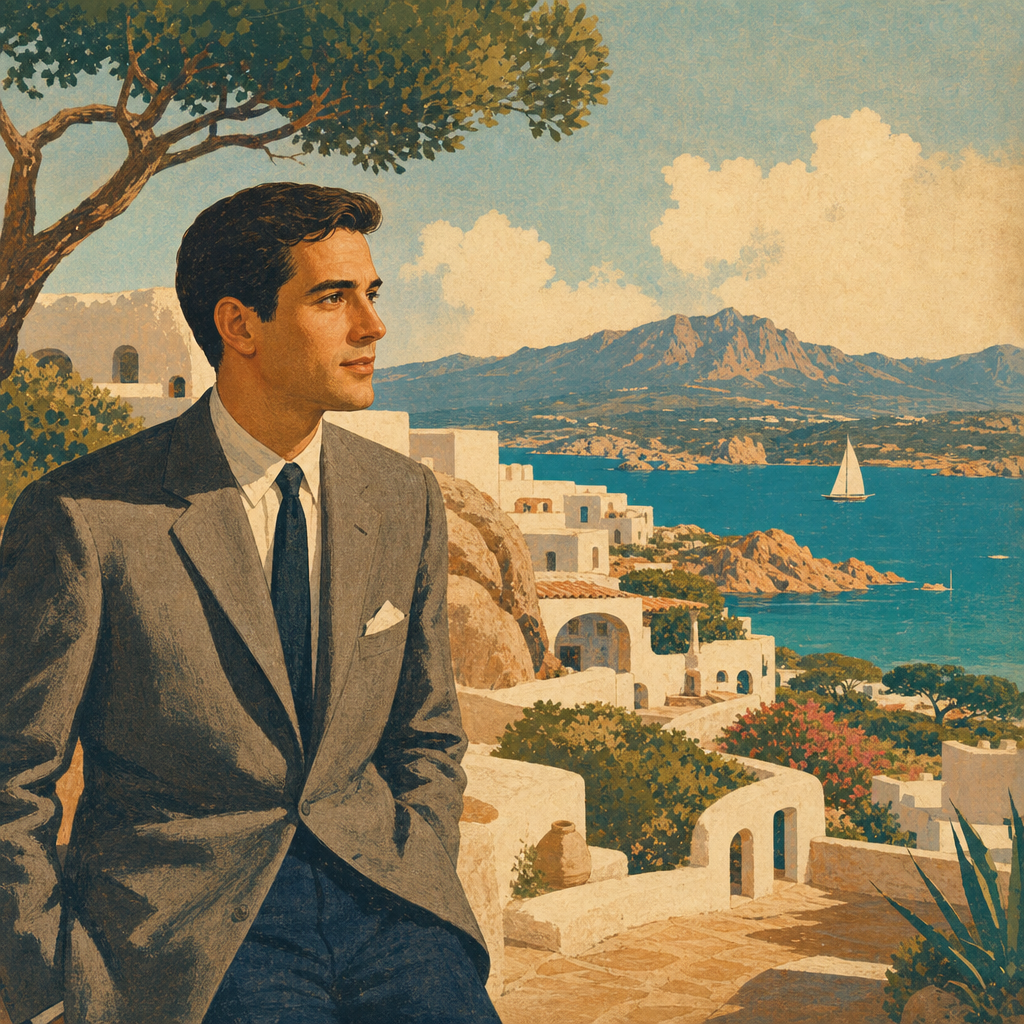
The history of the Costa Smeralda is deeply tied to the figure of the young Karim Aga Khan. Understanding his formative years helps, in fact, to trace the origins of an international vision capable of shaping territories, cultures, and models of development. In this narrative, then, the landscape of Gallura becomes the meeting point between a cosmopolitan education, cultural sensitivity, and long-term planning.
When viewed from above, Sardinia’s northeastern coast reveals coves, granite promontories, and turquoise waters. For a long time, however, this stretch of land remained on the margins of the great currents of modernity. And yet, in the postwar period, a measured transformation began—one that, over time, managed to bring together architecture, landscape, and international openness.
At the center of this transition stands a young figure, yet one already endowed with a broad vision. In particular, his ability to observe different territories and grasp their deeper value was decisive. As a result, the Costa Smeralda became a laboratory for experimenting with an alternative idea of development.
- A territory before the turning point: Gallura, Arzachena, and the sea
- The Young Karim Aga Khan IV and His Encounter with Gallura
- The Costa Smeralda Consortium: governance and shared vision
- Landscape and architecture: building without dominating
- Porto Cervo: symbolic center and public space
- A legacy that speaks to the present
A Region Before the Turning Point: Gallura, Arzachena, and the Sea
Before the 1960s, the area now known as the Costa Smeralda was predominantly rural. The local economy was based on agriculture, pastoralism, and seasonal fishing. Arzachena, moreover, served as the administrative center of a vast and sparsely infrastructured territory.
Moreover, coastal Gallura remained far from the routes of international tourism. Roads were few, and access was limited. This isolation, however, had preserved a rare landscape balance, made up of Mediterranean scrub, granite, and silence.
For this very reason, the encounter with an outside vision did not create a sudden rupture. On the contrary, it set in motion a gradual process, grounded in the interpretation of the territory rather than its exploitation.
The Young Karim Aga Khan IV and His Encounter with Gallura
Karim Aga Khan IV, born in 1936, arrived in Sardinia in the late 1950s. His international biography matters only in part. Here, in fact, it becomes relevant above all for the way it sheds light on his relationship with Gallura.
According to historical accounts, it was during a trip through the Mediterranean that he identified a unique potential along Sardinia’s northeastern coast. Thanks to his cosmopolitan education, he avoided existing models. Instead, he chose to envision a project capable of engaging with the local culture.
In this sense, youth was not merely a matter of age. Rather, it was a mindset shaped by openness, experimentation, and confidence in the long term. As a result, the bond with Sardinia took the form of a structured and lasting presence.
To better understand this transition, it is useful to recall the creation of the Consorzio Costa Smeralda. Even today, this organization safeguards the area’s urban planning and landscape identity. In this regard, an official account is available on the website of the Consorzio Costa Smeralda.
The Costa Smeralda Consortium: governance and shared vision
The founding of the Consortium in the early 1960s marked a decisive turning point. It was not merely an administrative body. Rather, it was a tool for governing the territory, designed to ensure coherence and quality.
Through rigorous urban planning criteria, building heights were limited and materials and volumes were regulated. In addition, every intervention had to engage in dialogue with the natural environment. For its time, this approach was particularly innovative.
Engagement with local institutions was complex. However, over time, the project generated new economic opportunities and unprecedented international visibility. It is therefore important to distinguish between historical data and later interpretations, avoiding oversimplifications.
Landscape and architecture: building without dominating
The architecture of the Costa Smeralda reflects a precise cultural vision. Its gentle forms and local materials are intended to blend into the landscape. The goal, in fact, was clear: to build without dominating.
Architects such as Michele Busiri Vici helped define a coherent style. Although not traditional in the historical sense, this language engaged with the Mediterranean imagination. As a result, it also influenced the perception of the territory.
The landscape, therefore, was not treated as a mere backdrop. It became an integral part of the project. In this way, tourism was conceived as a cultural experience, not just a seaside one.
Porto Cervo: symbolic center and public space
Porto Cervo originated as a marina and service center. Over time, however, it became the symbolic heart of the Costa Smeralda. Here, diverse functions coexist within a space recognized internationally.
Squares, promenades, and public buildings were designed to encourage gathering. In this context, the Prince’s role goes beyond the entrepreneurial dimension and, at the same time, enters the collective memory of the place.
Even today, Porto Cervo offers a key to understanding the original project. It is not just a showcase for international tourism. It is also, therefore, a place to reflect on the meaning of that vision.
A Legacy That Speaks to the Present
The legacy left in Costa Smeralda goes beyond the works that were built. It lives in the relationship between development and preservation, between international openness and local identity. For this reason, it represents a central chapter in Gallura’s modernity.
Naturally, every long-term project goes through different phases. Today’s Costa Smeralda does not entirely match the original idea. However, it still preserves clear traces of it.
To understand the figure of the young Karim Aga Khan is, therefore, to read the landscape with greater awareness. It means understanding why certain urban planning choices appear measured and why the architecture engages in dialogue with its context.
In this light, ultimately, the Costa Smeralda remains a laboratory of ideas and a legacy that continues to question the present.