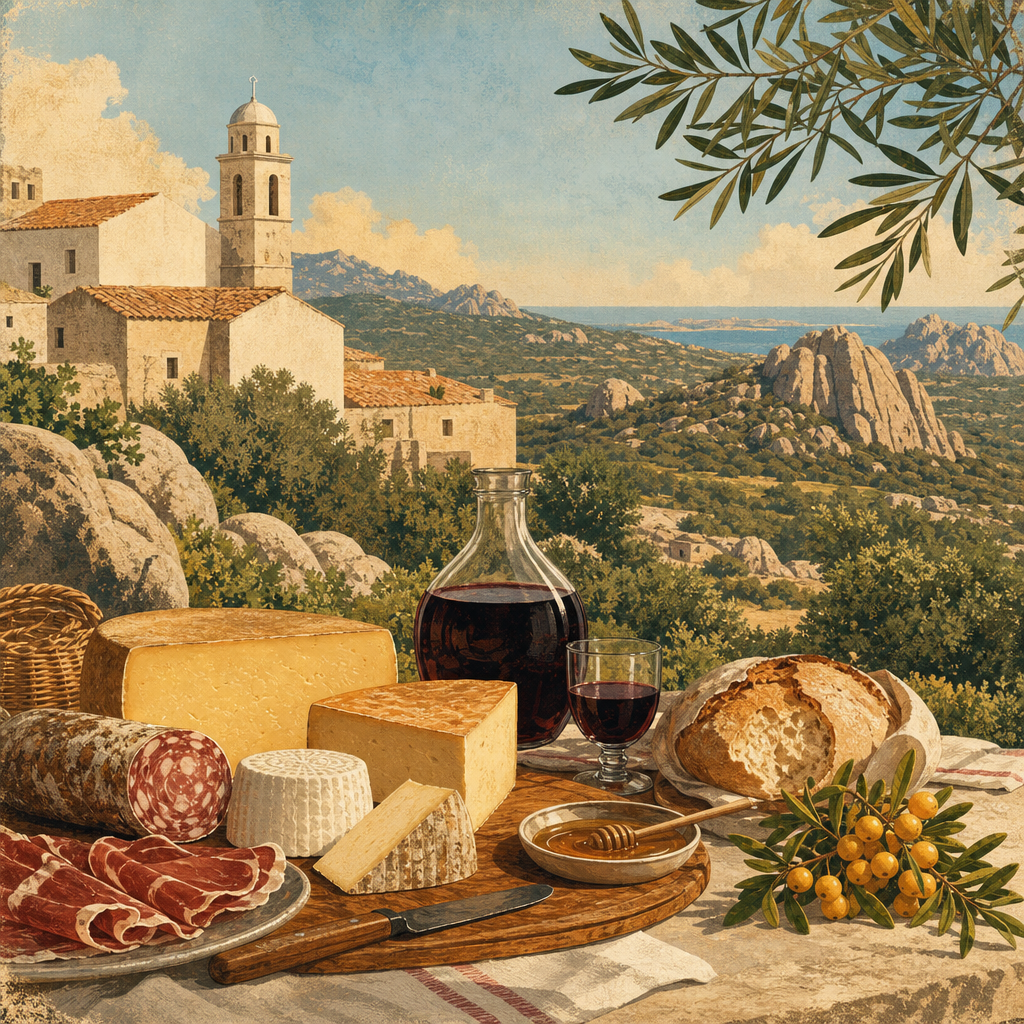
The flavors of Gallura represent an essential part of Arzachena’s identity. Among granite boulders, rural stazzi, and coastlines overlooking the Mediterranean, local gastronomy tells the story of the bond between environment, memory, and community. It also offers visitors an authentic way to understand the area beyond its most famous images.
- Gallura and Arzachena: a region to understand through its flavors
- From prehistory to the stazzi: the history of the Arzachena landscape
- Flavors of Gallura: The Authentic Flavors of Gallurese Tradition
- laThe Meeting of Sea and Land in Local Food Culture
- Before and after the Costa Smeralda: transformations and continuities
- The Role of Collective Memory
- Understanding Arzachena through flavor and the land
Gallura and Arzachena: a land to be understood through its flavors
To talk about the flavors of Arzachena is to talk about Gallura. This region of northeastern Sardinia stands out for its distinctive cultural, linguistic, and environmental characteristics. The landscape alternates between granite, Mediterranean scrub, pastures, and a coastline rich in bays and headlands.
Arzachena occupies a central position in this context. On the one hand, it preserves a strong agricultural and pastoral tradition; on the other, it includes some of the best-known coastal stretches of the Costa Smeralda. As a result, its cuisine reflects both of these souls.
Gallurese cuisine has developed over the centuries. Indeed, it stems from the careful use of available resources and respect for seasonal rhythms. Cheeses, bread, meats, and wild herbs still tell the story of this relationship with the land today.
To learn about initiatives for the protection and promotion of local heritage, it is useful to consult the Municipality of Arzachena.
Is it truly possible to understand a territory by observing only its most famous coastlines, without knowing the traditions that have shaped its character?
In the case of Arzachena, the answer emerges right at the table. Every dish preserves traces of history, labor, and social relationships.
From prehistory to the stazzi: the history of Arzachena’s landscape
Arzachena preserves important archaeological evidence. Among these, the Li Muri Necropolis stands out as one of Sardinia’s most significant Neolithic funerary complexes.
Later, the area took shape around the stazzi, traditional rural dwellings that formed the center of economic and family life.
As a result, stazzo culture profoundly influenced the local diet. Families produced much of their own food through livestock raising, cultivation, and the gathering of wild foods.
- Pastures for sheep and goat farming.
- Traditional cereal crops.
- Dairy production tied to pastoralism.
- Use of herbs from the Mediterranean scrub.
- A constant relationship with marine resources.
Flavors of Gallura: The Authentic Flavors of the Gallurese Tradition
Among the signature dishes, zuppa gallurese, or suppa cuata, stands out. It is made with bread, broth, and cheese, then baked until it reaches a rich, dense consistency.
This dish perfectly expresses the local culinary culture. In fact, it showcases simple ingredients and highlights the area’s dairy tradition.
Alongside Gallurese soup, we find pecorino cheeses and other cheeses. In addition, bread holds a central role in the history of the Gallurese countryside, where it was a fundamental resource for everyday life.
The tradition also includes meat-based preparations and numerous sweets associated with special occasions. Overall, these products form a collective memory passed down over time.
- Gallurese soup.
- Sheep’s and goat’s cheeses.
- Dishes from the pastoral tradition.
- Holiday sweets.
- Wild aromatic herbs.
- Products tied to stazzo culture.
The meeting of sea and land in the local food culture
One of the most interesting aspects of Arzachena is the balance between the inland areas and the coast. On one side, there are pastures and hills; on the other, bays and waters among the best known in the Mediterranean.
For this reason, local cuisine cannot be interpreted solely as an expression of pastoral life. Over time, the sea has enriched the gastronomic heritage through fishing and exchanges among coastal communities.
However, its strong rural identity has remained intact. Local gastronomy has managed to incorporate seafood ingredients without losing its roots.
How much of a place’s character derives from its geography, and how much from the community’s ability to adapt to it?
In Arzachena, the natural environment and human culture continue to engage in dialogue. This connection emerges both in the landscape and in culinary traditions.
Before and After the Costa Smeralda: Transformations and Continuities
The birth of the Costa Smeralda profoundly transformed the international perception of Arzachena. However, the history of the area is much older.
Before tourism development, rural communities, stazzi, pastoral traditions, and an archaeological heritage of great value already existed. Therefore, understanding Arzachena means considering all these dimensions together.
Over time, institutions and communities have sought to balance development with the protection of cultural heritage. As a result, the area still preserves many elements of its historical identity today.
The role of collective memory
In recent decades, the enhancement of cultural heritage has become increasingly important. Archaeology, rural traditions, and the culture of the stazzi help tell a story that spans millennia.
Moreover, food practices represent a form of intangible heritage. Through food, it is possible to understand essential aspects of daily life and the social organization of local communities.
Understanding Arzachena through taste and the land
The flavors of Gallura offer a privileged lens through which to discover Arzachena. Behind every recipe, environment, economy, history, and culture are intertwined.
At the same time, the territory cannot be reduced to images of the Costa Smeralda. Its roots lie in a history shaped by rural communities, granite landscapes, archaeological sites, and traditions handed down from generation to generation.
Finally, viewing Arzachena through its gastronomy means discovering a living cultural heritage. It is precisely this interweaving of taste, memory, and territory that makes Gallura one of the most authentic expressions of Sardinia.