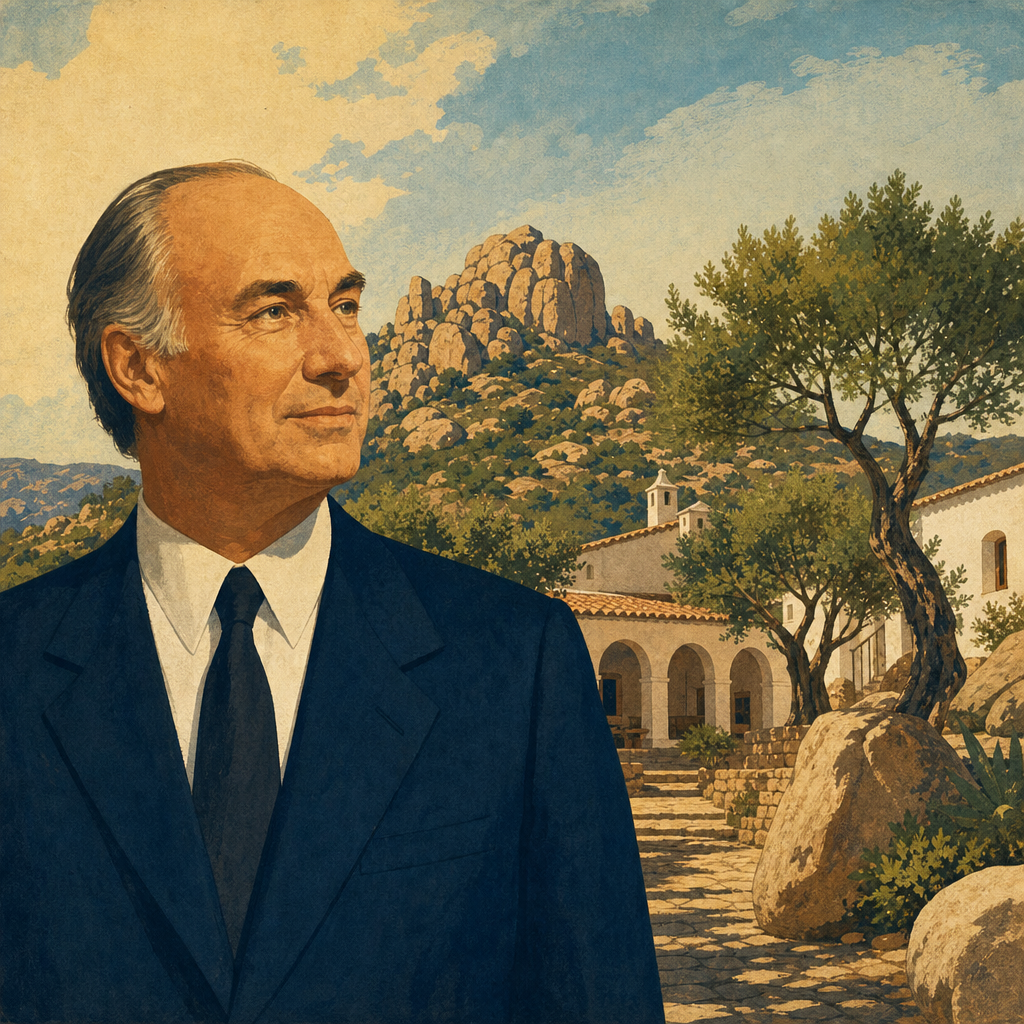
Before the name Costa Smeralda entered the international lexicon of travel and Mediterranean architecture, northeastern Sardinia was a land marked by silence, wind, and granite. Arzachena, with its countryside and rugged coastline, lived according to an ancient equilibrium, far from the major tourist flows. It was precisely in this context that, in the 1960s, the vision of Prince Karim Aga Khan IV encountered a landscape still untouched. From that moment on, the relationship between Aga Khan and Arzachena began to define a profound transformation, one destined to leave its mark on the identity and recent history of the Municipality.
- The historical context and the encounter with Gallura
- Aga Khan Arzachena and the territorial vision between architecture and landscape
- Porto Cervo as the symbolic center of the Arzachena area
- The Local Community of Arzachena and Change
- A legacy that goes beyond tourism
The Historical Context and the Encounter with Gallura
Prince Karim Aga Khan IV, born in 1936 and recognized as the 49th Imam of the Ismaili Muslims, came from a family with a strong international outlook. However, when he first arrived on the coasts of Gallura, his name was not yet associated with the idea of high society. On the contrary, according to historical accounts, he was struck by the quality of the landscape and by the potential for development that respected the natural balance.
Indeed, in those years, Sardinia was going through a complex phase of modernization. Many coastal areas were economically marginal, and Arzachena was no exception. The territory was based on agro-pastoral activities and a strong local identity. As a result, the arrival of capital and a structured project represented a turning point, although it was accompanied by widespread questions and expectations.
The founding of the Costa Smeralda Consortium in 1962 marked the official launch of the initiative. The goal was to coordinate urban development, landscape protection, and international promotion. Within this framework, the role of Prince Aga Khan IV was decisive. At the same time, architects and urban planners were brought in to engage in dialogue with the territory. Historical information about the project is also available through the official website of the Costa Smeralda Consortium.
Aga Khan and Arzachena: a territorial vision between architecture and landscape
One of the most significant aspects of the relationship between Prince Karim Aga Khan IV and Arzachena concerns the architectural vision adopted. Unlike other models of intensive urbanization, the Costa Smeralda project embraced a language inspired by local traditions, reinterpreted in a contemporary key.
Architects such as Michele Busiri Vici and Luigi Vietti helped define a recognizable style. Irregular volumes, light-colored plaster, and the use of local stone encouraged integration with the morphology of the land. In this way, the architecture did not appear as something alien. On the contrary, it became part of the landscape itself.
As a result, the development of the Costa Smeralda sought to demonstrate that tourism could coexist with standards of landscape quality. Despite its contradictions, this approach was innovative for its time. Moreover, it helped define a lasting model for intervention in the area.
Porto Cervo as the symbolic center of the Arzachena area
Within the project, Porto Cervo took on a central role from the very beginning. Located within the municipal territory of Arzachena, the village was conceived as the symbolic heart of the new development. Here, residents, visitors, and cultural activities came together.
Its growth did not follow a rigid pattern. On the contrary, small squares, marinas, and public spaces emerged gradually. This encouraged social interaction and a closer relationship with the sea. In this context, Prince Karim Aga Khan IV primarily played a guiding role, leaving room for solutions consistent with the overall vision.
Over time, Porto Cervo became an international symbol of exclusivity. However, reducing its significance to this aspect risks oversimplifying the original project. The intention, in fact, was to create a new identity without erasing its Gallurese roots. Further insight into the local context is also available in the article Arzachena and Costa Smeralda: the history and identity of the area.
Arzachena’s local community and change
The relationship between the Costa Smeralda and the Arzachena community has been complex. On the one hand, international tourism has created new economic opportunities. On the other, it has raised issues related to the transformation of the landscape and the protection of local traditions.
Many residents found employment in the construction and service sectors. At the same time, concerns emerged over access to resources and social balance. In this context, the connection between Aga Khan and Arzachena was often interpreted as a guarantee of design quality and long-term vision.
A Legacy That Goes Beyond Tourism
Prince Karim Aga Khan IV’s legacy in Arzachena is not limited to the iconic image of the Costa Smeralda. Rather, it concerns a way of conceiving the relationship between development and local identity. Today, looking at the landscape and architecture of Porto Cervo, it is possible to discern the traces of a vision that sought a dialogue with the territory.
For Arzachena, this chapter represents a decisive turning point in its recent history. It is not a static myth, but a living memory. Ultimately, it invites reflection on the value of the landscape and on the cultural choices that have guided its transformation.