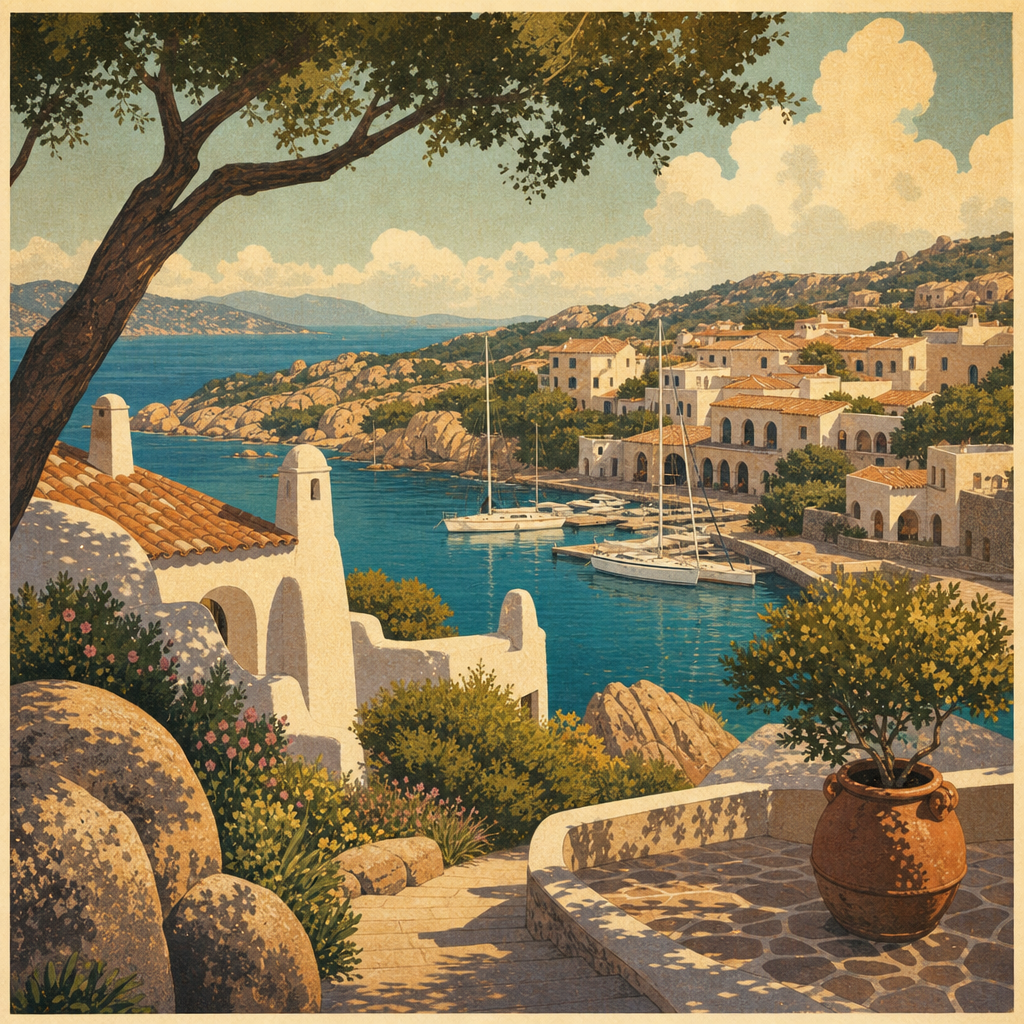
Tourism in Gallura tells the story of a profound transformation, one that took place especially from the 1960s onward and brought a peripheral territory to the center of international routes. Originally, before the name Costa Smeralda entered the global lexicon, Gallura was a rugged and luminous land. It was shaped by the wind, by granite, and by the patience of local communities. As a result, rocks, pastures, small landing places, and barely sketched-out roads told an ancient story, far from the spotlight.
However, the turning point comes in the second half of the twentieth century. During that period, an outside yet profoundly Mediterranean vision encounters this landscape. It is the vision of Prince Karim Aga Khan IV. From that encounter emerges a transformation that, gradually, concerns not only tourism. Rather, it ultimately touches the very identity of the territory.
- Tourism in Gallura: a territory before the Costa Smeralda
- Prince Karim Aga Khan IV and the Mediterranean Vision
- The birth of the Costa Smeralda Consortium
- Porto Cervo as an urban laboratory
- Arzachena and the Dialogue with the Local Community
- Public memory and cultural legacy
Tourism in Gallura: a land before the Costa Smeralda
To understand the scale of the change, it is necessary to look at Gallura before the 1960s. At the time, the coastal area between Arzachena and Olbia lived off an agro-pastoral economy. In addition, human presence was widespread but not concentrated, while connections remained limited and infrastructure basic. In this context, the sea represented more of a boundary than an organized tourism resource.
At the same time, Gallura preserved a cultural and scenic heritage of great strength. Nuraghi, rural architecture, linguistic and musical traditions formed a coherent yet fragile whole. For this very reason, what was needed was a vision capable of enhancing the area without distorting its essence. It is within this balance that the Aga Khan’s involvement would later take shape.
Indeed, the historic leap did not consist solely in the introduction of elite tourism. Rather, it marked a paradigm shift. Development began to engage with the landscape, respecting its forms and reinterpreting its codes. For the time, this perspective was innovative and, inevitably, not without questions.
Is it possible to transform a territory without erasing its soul?
Prince Karim Aga Khan IV and the Mediterranean Vision
Prince Karim Aga Khan IV arrives in Sardinia in the late 1950s. Born in 1936 and having become the 49th Imam of the Ismaili Muslims in 1957, he brings with him a cosmopolitan background. Moreover, he shows a particular sensitivity to issues of cultural and regional development. His presence in Gallura is no accident. On the contrary, it stems from a genuine interest in the Mediterranean as a space of shared civilization.
According to historical accounts, the Aga Khan recognized a unique potential in the northeastern coast of Sardinia. It was, in fact, an area not yet compromised by invasive development. His vision was based on a key principle: to create an international destination without imposing foreign models. For this reason, the project worked with local forms, materials, and traditions.
This approach took shape in 1962 with the establishment of the Costa Smeralda Consortium. The initiative involved architects, urban planners, and investors. However, it maintained unified oversight and careful attention to landscape coherence. For further insight into the historical and territorial context, you can also read Arzachena and Costa Smeralda: history and identity of the territory.
The Birth of the Costa Smeralda Consortium
The Consorzio Costa Smeralda represents one of the project’s most significant elements. It was created with the aim of coordinating tourism development in the area. As a result, it introduced precise rules on urban planning, architecture, and environmental protection. It is not merely an administrative tool. It is also, and above all, a cultural body that defines an identity.
Among the guiding principles, the use of local materials and the integration of buildings into the landscape stand out. In addition, priority is given to respecting the natural lines of the coast. Architects such as Luigi Vietti, Michele Busiri Vici, and Jacques Couëlle thus help create a recognizable style inspired by Mediterranean and Gallurese architecture.
The results are still visible today. The built fabric is in dialogue with the rocks, the sea, and the Mediterranean scrub. To be sure, the Consortium is not without its critics.
- 1962: founding of the Costa Smeralda Consortium
- Unified urban planning regulations
- Involvement of internationally renowned architects
- Protecting the landscape as a cultural and economic value
Porto Cervo as an Urban Laboratory
Porto Cervo was created as the symbolic heart of the Costa Smeralda. It is not a traditional city. Rather, it is a center designed to embody a vision. The harbor, the square, the church, and the residences are in dialogue with one another. In this way, they prioritize a human scale and visual continuity with the sea.
In this context, the Aga Khan’s role is not that of a distant patron. On the contrary, he acts as a promoter attentive to the details and meaning of places. Thus, Porto Cervo becomes an urban laboratory, where an idea of integrated tourism is tested—one capable of attracting international visitors while, at the same time, maintaining a connection with Gallura.
Over time, Porto Cervo has become associated with events and figures of global prominence. Yet reducing its value to mere glamour would be limiting. Its importance lies instead in having shown that a tourist center can also become a cultural and landscape point of reference.
Can a designed place become part of the collective memory?
Arzachena and the dialogue with the local community
The relationship between the Costa Smeralda project and Arzachena is complex. On the one hand, tourism development creates economic opportunities and new infrastructure. It also brings unprecedented international visibility. On the other hand, questions arise about resource management and the transformation of the social fabric.
The role of the Aga Khan should therefore also be understood in relation to this dialogue, at times critical, with the local community. Based on the available sources, his involvement was not limited to the coast. Indeed, it helped strengthen Arzachena as the area’s administrative and cultural point of reference.
Over the decades, institutions and citizens have reinterpreted the meaning of that period of transformation. Today, public memory seeks a balance. On the one hand, it acknowledges the international vision. On the other, it maintains a critical and conscious perspective.
Public Memory and Cultural Heritage
The legacy of Prince Karim Aga Khan IV in Gallura is not limited to the works that were built. It also lives on in the memory of places and in the shared account of a decisive historical period. However, this account is never monolithic. Alongside recognition, reflections emerge on the environmental and social costs.
For today’s visitor, understanding this legacy therefore means going beyond the iconic image of the Costa Smeralda. Rather, it means reading the landscape as a complex text, in which architecture, nature, and memory are in constant dialogue.
In conclusion, the Aga Khan’s contribution remains tied to the idea of an open and plural Mediterranean. It is an idea that found fertile ground in Gallura and that, even today, continues to question and to tell its story.