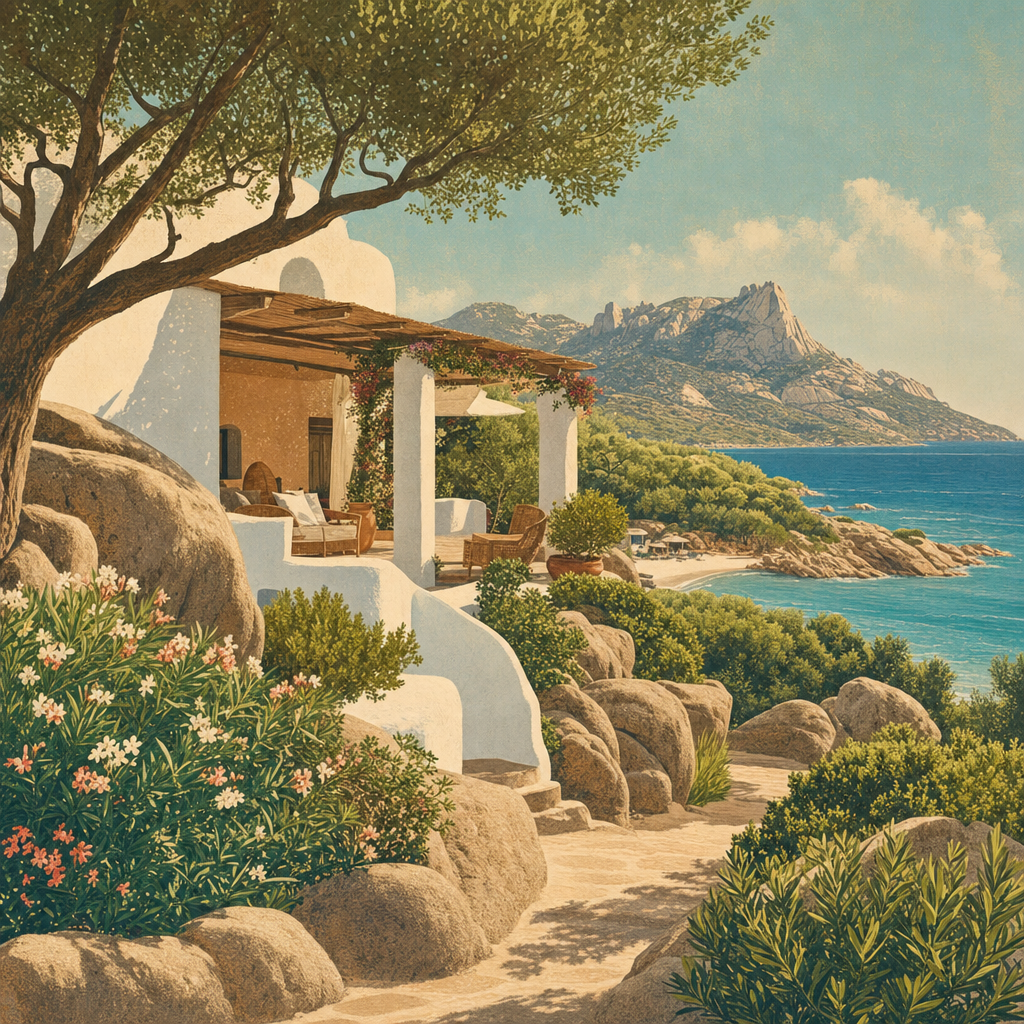
Pitrizza represents one of the places that best expresses the balance between natural landscape and high-level hospitality. Among granite rocks, Mediterranean scrub, and turquoise sea, this Gallura destination shows how architecture and the environment can coexist harmoniously. It also helps illuminate an important part of the Costa Smeralda’s identity and the vision that has guided its development since the 1960s.
- The origins of the Costa Smeralda and a vision for the territory
- Pitrizza as a model for integrating hospitality and the environment
- Architecture, privacy, and respect for the landscape
- Pitrizza Beach and the Visual Identity of the Costa Smeralda
- Territorial transformations, memory, and continuity
- A look beyond the international image
The Origins of the Costa Smeralda and a Territorial Vision
The history of the Costa Smeralda began to take shape in the early 1960s. At that time, a stretch of Sardinia’s northeastern coast began to be developed through an innovative project. The area was characterized by coves, granite promontories, and largely undeveloped beaches.
The goal was not simply to create a new tourist destination. On the contrary, the project aimed to integrate with the existing landscape, respecting its forms, materials, and Mediterranean identity. As a result, specific urban planning choices were adopted: low-rise buildings, the use of local granite, and great attention to panoramic views.
To explore the cultural and territorial context in greater depth, it is also useful to read Costa Smeralda: Mediterranean lifestyle and identity.
This philosophy helped set the Costa Smeralda apart from many other Mediterranean destinations. Indeed, the landscape remained a central element of the project. Moreover, the pursuit of a balance between development and environmental protection influenced many of the choices that followed.
Pitrizza as a model of integration between hospitality and the environment
Pitrizza represents one of the most successful expressions of the Costa Smeralda philosophy. Here, the relationship between the built environment and nature is based on discretion, privacy, and harmony with the surrounding context.
Pitrizza Beach, surrounded by granite and Mediterranean vegetation, retains a strong natural character. At the same time, it is located in one of the best-known areas of Sardinia.
The hospitality and residential structures were designed to reduce visual impact. They are often screened by vegetation. In addition, they follow the natural contours of the land. As a result, the transition between the natural environment and human presence appears more seamless.
- Granite formations shaped by the elements.
- Mediterranean scrub typical of Gallura.
- Open views of the sea.
- Architecture integrated into the landscape.
- Low-density development.
- A strong focus on privacy.
Architecture, Privacy, and Respect for the Landscape
One of the most interesting aspects of Pitrizza concerns the role of architecture. From the very beginning, the goal was to engage in dialogue with the environment rather than impose itself upon it.
Emerald Coast architecture is recognizable for its natural materials, articulated volumes, and colors in harmony with the surrounding area. In addition, vegetation is used as a design element, not merely as decoration.
Privacy, often associated with exclusivity, also stems from deliberate urban planning choices. Indeed, the layout of the buildings limits the visual impact and preserves the perception of the landscape.
Similarly, pathways, stone walls, and green spaces help create a discreet presence for the structures. The result is an experience that enhances contact with the environment without sacrificing the comfort of contemporary hospitality.
Pitrizza Beach and the Visual Identity of the Costa Smeralda
Pitrizza Beach holds a special place in the imagination of the Costa Smeralda. Its compact size, crystal-clear waters, and granite surroundings create an instantly recognizable setting.
What makes this place particularly significant is the relationship between the different elements of the landscape. On one side, the rocks emerge; on the other, the vegetation accompanies the path toward the sea. Meanwhile, the Mediterranean light changes colors and perspectives throughout the day.
According to information from the Municipality of Arzachena, the area preserves a landscape heritage of great value, closely tied to its historical and environmental identity.
For this reason, the perception of the place does not depend on a single element. Rather, it arises from the combination of natural morphology, vegetation, and human presence carefully integrated into the context.
Territorial transformations, memory, and continuity
Over the decades, the Costa Smeralda has undergone significant transformations. However, the protection of the landscape has remained a central issue. For this reason, the preservation of its defining identity elements continues to be a focus of attention.
In the case of Pitrizza, many original features are still recognizable. The granite rocks, vegetation, and views of the sea continue to play a fundamental role in the perception of the place.
Furthermore, the continuity between the natural environment and the settlements represents one of the most significant aspects in understanding the area’s value. As a result, the landscape continues to be seen as a resource to be preserved and enhanced.
A look beyond the international image
To look at Pitrizza is to go beyond its simple image as an exclusive destination. Rather, it means reading a story shaped by planning, architectural research, and the enhancement of the local area.
In this setting, the understated nature of the buildings, the central role of nature, and the pursuit of privacy show how hospitality can become an integral part of a broader territorial project. In this way, Pitrizza continues to stand as one of the most effective examples of balance between the built environment, the natural surroundings, and Mediterranean identity.