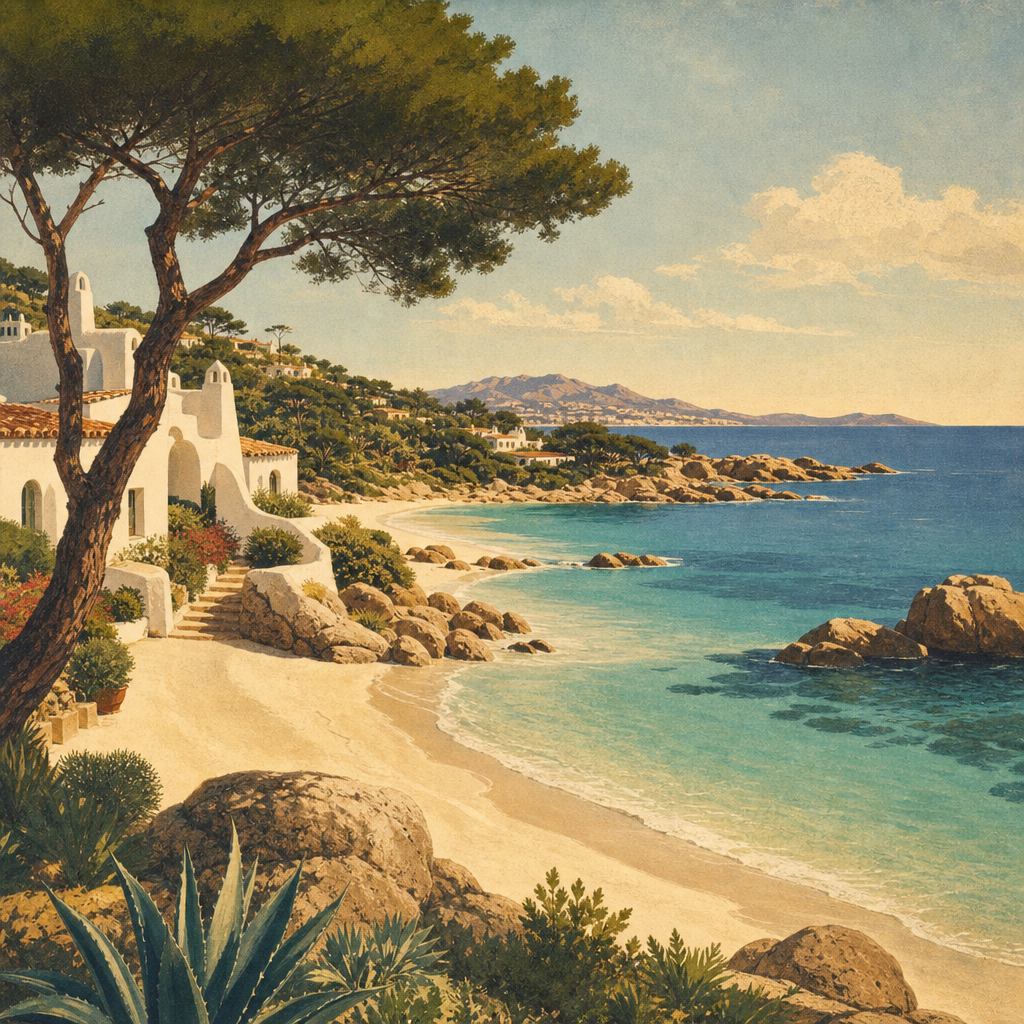
The Spiaggia del Principe is considered by many to be a symbolic beach of the Costa Smeralda. Located in the Arzachena area, it brings together landscape, history, and memory. In addition, its crescent-shaped bay, transparent waters, and the granite rocks of Gallura have helped make it one of the most recognizable places in Sardinia. Not surprisingly, for many visitors it represents an immediate encapsulation of the Costa Smeralda’s image around the world.
- The origins of Spiaggia del Principe and the meaning of its name
- The Birth of the Costa Smeralda as a Territorial Project
- A landscape that tells the story of Gallura
- Porto Cervo and the iconic places of the Costa Smeralda
- How Spiaggia del Principe became an international symbol
- Memory, landscape, and contemporary cultural significance
The origins of Spiaggia del Principe and the meaning of its name
The beach owes its name to Karim Aga Khan IV, a central figure in the development of the Costa Smeralda in the 1960s. According to the most widely accepted tradition, the prince was particularly fond of this bay. For this reason, the place became associated with his figure.
Before it gained international renown, the area was part of Gallura’s rural landscape. In fact, the territory was characterized by traditional stazzi farmsteads, pastures, Mediterranean scrub, and small natural landing places. Even today, many of these elements can still be read in the landscape.
At the same time, the beach’s name has helped build its allure. While the natural setting highlights its beauty, the connection with such a well-known historical figure has strengthened the interest of visitors and the media over the decades.
The Birth of the Costa Smeralda as a Territorial Project
To understand the beach’s symbolic value, it is useful to consider the historical context of the Costa Smeralda. In the early 1960s, this part of Gallura was little known outside Sardinia. Later, the project promoted by Aga Khan IV changed the area’s international perception.
Through the Costa Smeralda Consortium, architects and planners were brought in. The goal was to enhance the area without distorting its character. As a result, roads, settlements, and services were integrated into the landscape.
To learn more about the cultural and territorial context, you can also read Costa Smeralda: Mediterranean lifestyle and identity.
In addition, historical and institutional information is available on the Consorzio Costa Smeralda website.
This approach has had lasting effects. On the one hand, it encouraged tourism growth in the area; on the other, it consolidated an image based on the relationship between architecture, nature, and local identity. As a result, certain places became true symbolic landmarks, and among them Spiaggia del Principe holds a central position.
A landscape that tells the story of Gallura
Spiaggia del Principe embodies many of the typical features of coastal Gallura. On one side, large granite outcrops emerge. On the other, Mediterranean scrub accompanies visitors along the access path.
In addition, the bay’s sheltered shape brings out the sea’s hues. Thanks to the light seabed and the clarity of the water, the color ranges from turquoise to emerald. As a result, the view appears especially harmonious.
During the summer season, the contrast between the rocks, vegetation, and sea becomes even more striking. However, even during less crowded periods, the place retains a strong evocative power. For this very reason, photographers and travelers continue to regard it as one of the most representative views of Sardinia’s northeastern coast.
- Granite rocks shaped by natural erosion.
- Typical Mediterranean scrubland of Gallura.
- Light seabeds that amplify the colors of the sea.
- Bay sheltered by rocky promontories.
- Continuity between the terrestrial and marine environments.
Porto Cervo and the iconic places of the Costa Smeralda
The history of the beach is closely linked to Porto Cervo. In fact, the town was created as the centerpiece of the Costa Smeralda project. Over time, the marina has attracted visitors from all over the world and strengthened the area’s reputation.
However, Porto Cervo’s value does not depend solely on its harbor. Squares, pedestrian walkways, and public spaces have also helped shape a recognizable identity. As a result, the connection between architecture and landscape has become one of the destination’s defining features.
Moreover, the beach’s proximity to the main centers of the Costa Smeralda has helped make it part of the travel experiences of generations of tourists. As a result, the place has gradually entered the collective imagination associated with the destination.
How Spiaggia del Principe Became an International Symbol
Many Mediterranean beaches are spectacular. And yet, Spiaggia del Principe has taken on a special role in the collective imagination. Over the decades, photographs, travel accounts, and publications have spread its image around the world.
At the same time, the growth of Porto Cervo and the Costa Smeralda expanded the place’s fame. Moreover, many visitors have identified this bay with the very idea of the Costa Smeralda. As a result, the beach has become a symbol that goes beyond simple seaside recreation.
Another important element is the recognizability of the landscape. Indeed, the combination of light-colored sand, granite rocks, and transparent sea makes the bay immediately distinctive. As a result, its image has often been used to represent the entire area.
- Exceptional scenic quality.
- Historic connection with Aga Khan IV.
- Close to Porto Cervo’s iconic landmarks.
- Wide circulation of iconic images.
- Integration into a recognizable territorial project.
Memory, Landscape, and Contemporary Cultural Significance
Today, Spiaggia del Principe continues to attract visitors from all over the world. However, its significance goes beyond tourism. Indeed, it stands as a testament to the transformation of Gallura and the shaping of the Costa Smeralda’s identity.
Finally, viewing the bay from the trail above, it is possible to grasp the relationship between nature, history, and territorial planning. It is precisely this combination that has made the place a cultural and scenic landmark of the contemporary Mediterranean.
Ultimately, its importance stems not only from its natural beauty, but also from its ability to tell a broader story. While the landscape preserves Gallura’s distinctive features, the memory of the place evokes the evolution of the Costa Smeralda and the way it became an internationally known destination.