The villages of Gallura help reveal a territory that goes beyond seaside tourism. Among stazzi, countryside, archaeological sites, and local traditions, the inland area of Arzachena preserves a deep-rooted memory. It also offers a different pace from the coast and makes it possible to read the history of Gallura through the landscape and the communities that have inhabited it.
- Gallura villages and the area’s identity
- Gallura Villages: Arzachena between archaeology, history, and community
- Villages of Gallura: The villages and inland settlements
- Landscape, environment, and Gallurese culture
- Before and After the Costa Smeralda
- Public memory and promotion of the local area
- Beyond the Most Famous Images
villages of Gallura and the identity of the area
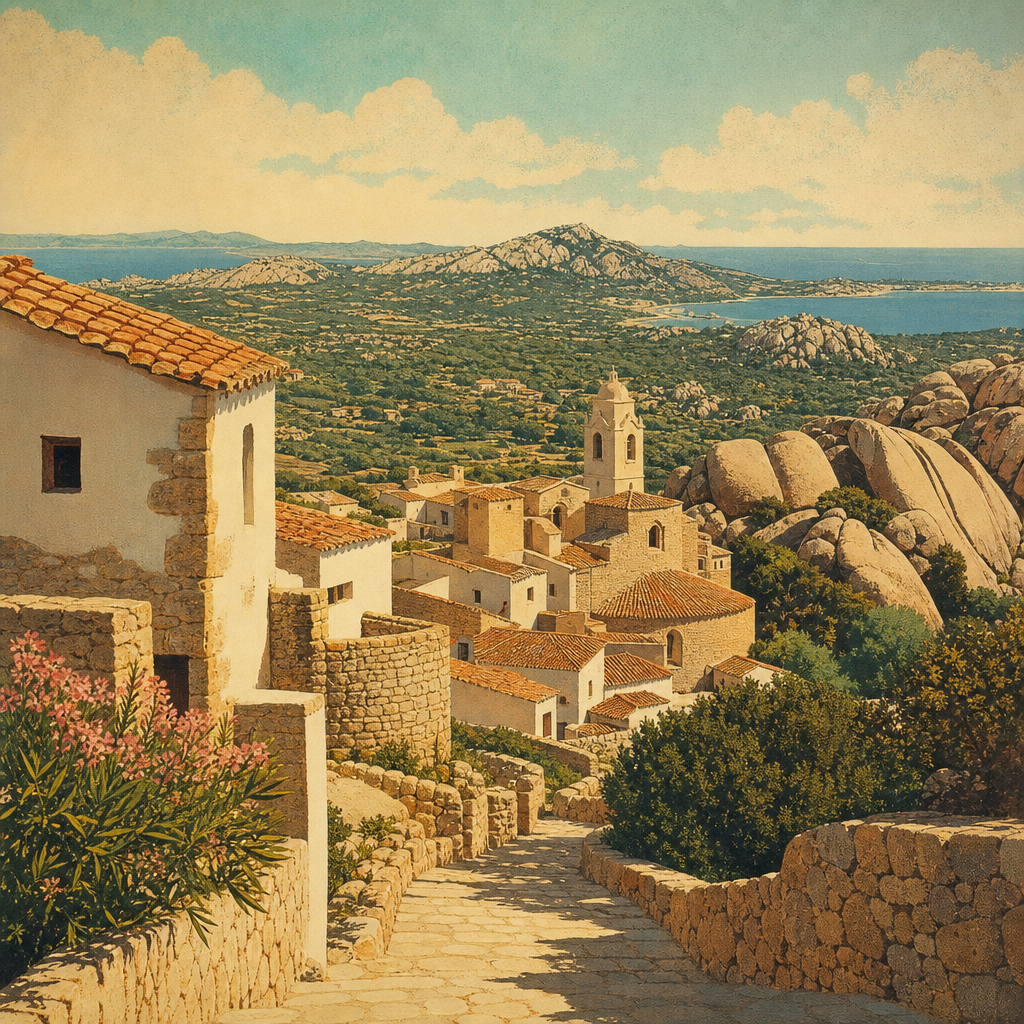
Gallura occupies the far northeastern part of Sardinia. Here, granite rocks, inland valleys, and Mediterranean scrub coexist in a highly distinctive environment. As a result, the relationship between people and the land has taken on unique characteristics over time.
Local history emerges in the rural architecture, the Gallurese language, and agro-pastoral activities. Moreover, many inland settlements preserve a cultural continuity that spans centuries of change.
Arzachena occupies a central position in this context. In fact, its territory includes both inland areas and a long stretch of coastline. For this reason, it offers a privileged vantage point for understanding the villages of Gallura.
For more in-depth information on the historical and institutional context, it is useful to consult the information provided by the Municipality of Arzachena.
What remains of the communities that lived in Gallura before the international fame of the coast?
Often, the answer lies inland. Here, rural routes, archaeological sites, and small settlements tell a long and enduring story.
Villages of Gallura: Arzachena amid archaeology, history, and community
Arzachena is one of Sardinia’s most important archaeological areas. Prehistoric evidence documents a very ancient human presence and a lasting connection with the resources of the land.
Among the best-known sites is the Li Muri complex. In addition, nuraghi and Giants’ Tombs make the area a true open-air historical archive.
Over the centuries, Gallura has undergone numerous changes. However, many traditions have maintained a strong continuity. The stazzi, for example, were not simply farm buildings but centers of family and productive life.
Even today, the connection between the town and the countryside remains an essential component of local identity.
Villages of Gallura: The Villages and Inland Settlements
The villages of Gallura do not form a network of large historic cities. On the contrary, they make up a constellation of small towns, stazzi, and communities spread across the landscape.
Around Arzachena, you come across stone houses, dry-stone walls, and rural paths. These elements tell of a balance built over time between the environment and human activity.
Many places are striking not for their monumentality, but for their authenticity. In addition, local festivals, building techniques, and traditional place names preserve important traces of Gallurese culture.
- Ancient stazzi and rural architecture.
- Historic routes between countryside and coast.
- Rural churches and community spaces.
- Scattered archaeological areas.
- Traditional agro-pastoral practices.
- Linguistic and cultural heritage.
To understand the relationship between the coast and the inland areas, it may also be useful to read Costa Smeralda: Mediterranean lifestyle and identity. In fact, the two dimensions belong to the same territorial system.
Landscape, Environment, and Gallurese Culture
The landscape represents one of the region’s main defining elements. The granite formations shape the horizon and tell a long geological story.
Over time, farming and livestock raising adapted to the environmental characteristics. As a result, many inland areas still preserve a strong landscape coherence today.
Cork oak groves, Mediterranean scrub, and aromatic plants contribute to local biodiversity. In the same way, religious traditions, gastronomy, and craftsmanship keep the bond with the land alive.
For those visiting the villages of Gallura, the landscape is not merely a backdrop. On the contrary, it is a key to understanding local history and identity.
Before and After the Costa Smeralda
The second half of the twentieth century profoundly transformed Arzachena and northeastern Gallura. Before the development of international tourism, the economy was tied above all to rural activities.
The arrival of Prince Karim Aga Khan IV and the creation of the Costa Smeralda marked a decisive turning point. As a result, Porto Cervo gained growing international prominence.
However, the new tourism dimension has not erased the area’s historical roots. On the contrary, it has made understanding the villages of Gallura and the inland area even more important.
To explore this historical turning point in greater depth, it is also useful to consult the article dedicated to Karim Aga Khan IV and the vision of the Costa Smeralda.
Public memory and enhancement of the territory
Collective memory encompasses both the most distant past and recent transformations. For this reason, cultural activities, archives, and interpretive routes play a fundamental role.
Archaeology, rural heritage, and contemporary history are now presented as parts of a unified narrative. Moreover, the enhancement of the landscape helps keep the connection to local roots alive.
In the same area, prehistoric evidence, historic countryside, and more recent architecture coexist. This plurality is one of the most interesting aspects of the villages of Gallura.
Beyond the Most Famous Images
Viewed as a whole, Arzachena reveals a complex and layered reality. The villages of Gallura, the stazzi, and the inland landscapes make it possible to grasp a dimension that is often less well known.
At the same time, the recent history of the Costa Smeralda remains an important part of the territory. However, fully understanding it requires a broader perspective.
For this reason, the villages of Gallura represent an essential key to understanding the area. Through communities, traditions, and landscapes, continuities and changes emerge that define Gallurese identity.
In conclusion, the villages of Gallura reveal the value of the inland area and invite visitors to discover a Sardinia shaped by memory, culture, and slower rhythms. They also help us understand the territory as a whole, far beyond its most famous images.