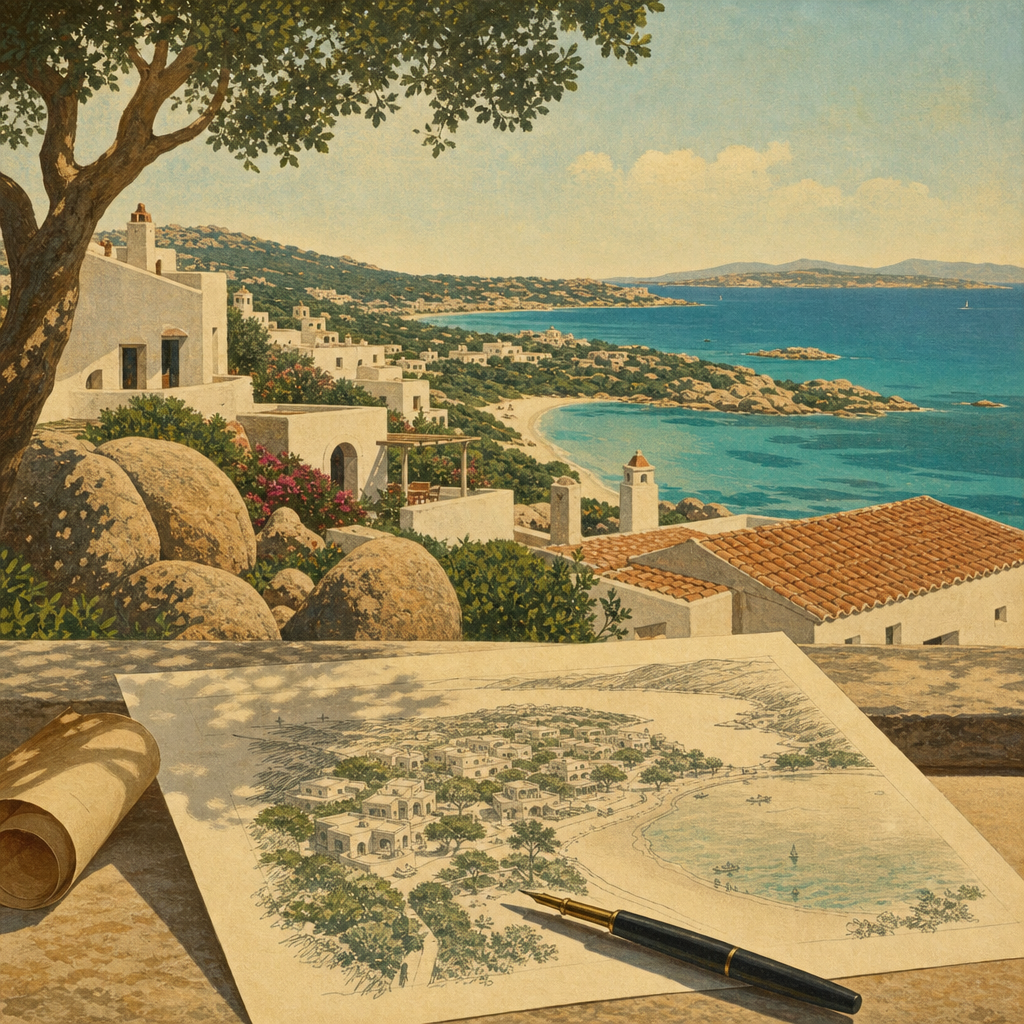
In 1961, when Gallura was still a rugged and little-known territory, a letter of intent marked a decisive turning point. Indeed, that preliminary document foreshadowed the birth of the Costa Smeralda and defined a shared vision. More than a technical act, in fact, it was a cultural commitment that placed landscape, architecture, and community at the center.
It is within this historical context that the initiative promoted by Prince Karim Aga Khan IV, together with international and local interlocutors, took shape. The letter of intent did not simply announce a tourism project. On the contrary, it set out a method and a direction; moreover, it opened up a new reflection on the development of Mediterranean coasts.
- Costa Letter of Intent: The 1961 Context and the Value of the Letter of Intent
- Costa Letter of Intent: Prince Karim Aga Khan IV and the Encounter with Gallura
- Costa Letter of Intent: A Vision Between Landscape and Architecture
- Porto Cervo as a symbolic center
- Local community and shared memory
- A Legacy That Continues
Costa Letter of Intent: The 1961 Context and the Significance of the Letter of Intent
At the beginning of the 1960s, northern Sardinia remained on the margins of major tourist flows. In particular, the coasts between Arzachena and the sea were sparsely inhabited and difficult to reach. However, it was precisely this unspoiled condition that made it possible to imagine a different kind of development.
The 1961 letter of intent was not contractually binding. Rather, it set out shared principles. Among these were the protection of the landscape, architectural quality, and the gradual implementation of interventions. In an era marked by rapid and often invasive transformations, this approach therefore proved innovative.
As a result, 1961 is remembered as a threshold year. It did not mark the immediate start of construction work, but rather the development of an idea of territory destined to mature over time. Moreover, the letter indicated a desire to create a dialogue among investors, designers, and local institutions.
This foundational phase is also documented today through the archives of the Consorzio Costa Smeralda, which preserves the institutional memory of the project and its evolution.
The Costa Letter of Intent: Prince Karim Aga Khan IV and the Encounter with Gallura
Prince Karim Aga Khan IV arrived in Sardinia in the early 1960s. At that time, his international activity was already intertwined with a strong interest in culture and the land. In this sense, Gallura represented a meaningful encounter.
According to historical reconstructions, the first contact with the northeastern coast occurred during a voyage in the Mediterranean. In particular, what struck the prince was the coherence of the landscape. Rocks, Mediterranean scrub, and light formed an intact and fragile whole.
For this reason, the decision to invest was not merely economic. It was above all cultural. Consequently, the goal was to reinterpret the identity of the place without erasing it. The prince’s role thus took shape as that of a promoter of a long-term vision.
Thanks to his network of connections, architects and urban planners attuned to the local context were brought in. Thus, over time, a gradual process took shape, based on dialogue and continuous adaptation.
Costa Letter of Intent: A Vision Between Landscape and Architecture
One of the most significant aspects of the letter of intent concerns the relationship between the built environment and nature. In particular, the vision called for buildings capable of fitting into the landscape without dominating it. As a result, modest proportions and traditional materials were favored.
Architects such as Michele Busiri Vici, Luigi Vietti, and Jacques Couëlle interpreted these guidelines. This gave rise to what is now known as the “Costa Smeralda style.” However, it was not a rigid formula, but rather a set of solutions inspired by Gallurese tradition.
This attention was not an end in itself. On the contrary, it was part of a broader strategy that regarded the landscape as a shared cultural resource. Therefore, every intervention was conceived in relation to the natural and social context.
Is it possible to imagine a tourism development that does not erase what makes a place unique?
For this reason, the Costa Smeralda became a laboratory observed even at the international level. From the very beginning, in fact, an effort was made to strike a balance between the tourism economy and the protection of the territory.
Porto Cervo as a symbolic center
Within this vision, Porto Cervo took on a central role. In particular, it was conceived as an urban heart and a meeting place. Its irregular layout, made up of squares and pedestrian paths, therefore invites a leisurely experience.
La Piazzetta still represents a space for social interaction today. Civic and commercial functions are concentrated here, evoking the squares of small Mediterranean towns. Over time, moreover, public recognition of Prince Aga Khan IV’s role has also been expressed through dedications and commemorative works.
However, Porto Cervo was not conceived as an isolated enclave. In the original intentions, in fact, it was meant to engage with the surrounding area. As a result, connections and services were developed that involved Arzachena and nearby towns.
Local Community and Shared Memory
The relationship with the Arzachena community was complex. In the 1960s, changes came quickly. However, the letter of intent sought to maintain a dialogue with local institutions, recognizing their role in governing the territory.
Many residents found new job opportunities. In addition, local artisans and operators actively participated in the project. In this way, the development did not remain disconnected from the social context.
Over time, the figure of Prince Aga Khan IV has become part of public memory. In particular, cultural initiatives and institutional narratives attest to a process of historical reinterpretation, based on documentation and dialogue.
A legacy that continues
More than sixty years later, the Costa Smeralda remains a case study. Not only for its tourism success, but also for the consistency of its identity maintained over time. This continuity, in fact, reflects the original vision expressed in the letter of intent.
Understanding those initial choices therefore helps us interpret the current landscape with greater awareness. Ultimately, the 1961 letter does not offer definitive answers; however, it raises questions that remain relevant today about the relationship between development and preservation.