The birth of Porto Cervo represents one of the most significant milestones in the history of the Costa Smeralda. In the early 1960s, northeastern Sardinia still retained a predominantly natural character. However, within just a few years, a new urban planning and tourism vision transformed this area into an internationally known destination.
- Birth of Porto Cervo: The Origins of the Territorial Transformation
- Birth of Porto Cervo: A Mediterranean Vision Between Landscape and Design
- The Birth of Porto Cervo
- Architecture, small squares, and visual identity
- Early facilities and the role of the port
- Beaches, nature, and the construction of the territorial image
- The Transformations of the Sixties and Seventies
- A landscape that continues to tell its story
The Birth of Porto Cervo: The Origins of the Area’s Transformation
Until the mid-twentieth century, the territory of Arzachena and coastal Gallura was tied primarily to agro-pastoral activities. In addition, the coasts were sparsely urbanized, and many bays were almost entirely lacking in tourist infrastructure.
Places such as Cala di Volpe, Romazzino, Liscia Ruja, and Capriccioli retained an extraordinary natural appearance. As a result, this setting attracted the attention of Prince Karim Aga Khan IV between the late 1950s and the early 1960s.
The goal was not simply to build hotels. On the contrary, the project aimed to create a destination with its own regional identity. Thus was born an initiative destined to profoundly shape the history of Gallura.
For more information about the area and its historical evolution, it is useful to consult the resources of the Municipality of Arzachena.
Birth of Porto Cervo: A Mediterranean Vision Between Landscape and Design
One of the most innovative aspects of the Costa Smeralda was the attention devoted to integrating new developments into the natural setting. In fact, while many postwar tourist destinations focused on intensive construction, here a constant dialogue with the landscape was sought.
Architects and designers developed a language inspired by the Mediterranean. In particular, the buildings featured gentle forms, light colors, and extensive use of local stone.
At the same time, roads, squares, and pathways adapted to the morphology of the terrain. For this reason, the Costa Smeralda acquired an immediately recognizable visual identity.
The Birth of Porto Cervo
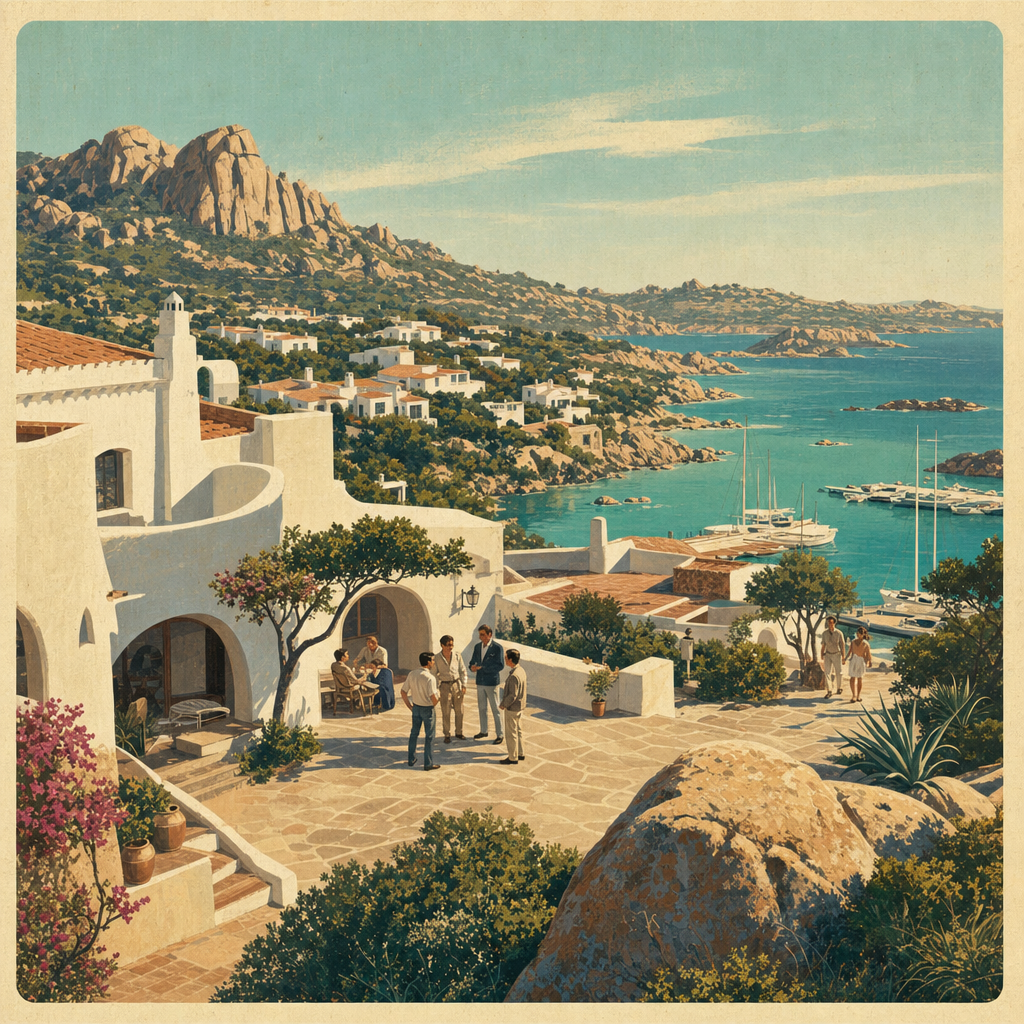
Among the developments carried out in the 1960s, Porto Cervo holds a central role. The chosen area was a deep natural inlet. Moreover, it offered protection from the winds and favorable conditions for navigation.
Thanks to these characteristics, the bay became the heart of the new tourism project. Porto Cervo was not conceived as a traditional town. Rather, it was developed as a harmonious ensemble of small squares, pedestrian paths, buildings, and sea views.
Growth unfolded gradually. At the same time, a strong focus was maintained on the quality of public spaces. As a result, the center quickly acquired symbolic as well as functional value.
Architecture, Piazzettas, and Visual Identity
The architecture of the early years played a decisive role in shaping the destination’s international image. However, the designers avoided a simple imitation of traditional Sardinian architecture.
Porto Cervo’s small piazzas became places for gathering and taking in the landscape. Moreover, their compact size fostered a more direct relationship with the surrounding environment.
Among the elements that defined the visual identity of the Costa Smeralda were:
- Use of local granite.
- Colors in harmony with the landscape.
- Buildings integrated into the slopes of the terrain.
- Mediterranean vegetation incorporated into the projects.
- Limited monumentality of the buildings.
- Great attention to sea views.
Over time, these aspects have helped create a coherent and easily recognizable image.
The First Structures and the Role of the Port
Tourism development required adequate infrastructure. Therefore, the 1960s marked the beginning of a pioneering phase for the entire area.
Among the hotels that contributed to the destination’s fame were the Cala di Volpe, the Romazzino, and the Pitrizza. Moreover, these properties stood out for their strong connection to the coastal landscape.
At the same time, Porto Cervo’s marina was developed. In this way, the destination strengthened its maritime and international character.
- Construction of the first transportation links.
- Opening of the historic hotels.
- Progressive development of the marina.
- Creation of services compatible with the environmental context.
- A focus on architectural quality.
Beaches, Nature, and the Construction of a Territorial Image
The Costa Smeralda’s fame was also due to the exceptional value of its natural heritage. Indeed, the beaches were its main attraction.
Places like Liscia Ruja, Capriccioli, Grande Pevero, Piccolo Pevero, and Romazzino gradually entered the imagination of visitors. At the same time, photographs and reports helped spread the image of a coastline where nature and architecture coexisted harmoniously.
For many European travelers, this part of Sardinia was a discovery. As a result, the destination’s international reputation grew rapidly.
The Transformations of the 1960s and 1970s
Between the 1960s and 1970s, the Costa Smeralda experienced significant growth. In just a few years, it went from a sparsely urbanized area to a benchmark for Mediterranean tourism.
This development generated new economic opportunities. It also fostered improvements in infrastructure and transportation links.
At the same time, reflections emerged on the relationship between growth and landscape protection. However, the Costa Smeralda’s historical role as a laboratory for tourism development in the second half of the twentieth century remains clear.
- Porto Cervo as the main hub.
- The marina as strategic infrastructure.
- The small squares as the heart of social life.
- Historic hotels as architectural landmarks.
- Beaches as identity-defining heritage.
- A strong identity for the area, recognized internationally.
A landscape that continues to tell its story
Today, the Costa Smeralda represents much more than a famous tourist destination. In fact, it tells the story of a transformation that intertwined landscape, architecture, and economic development.
Porto Cervo, the marina, the small squares, and the historic hotels still bear witness to the vision born in the 1960s. Moreover, many of its current features derive directly from those initial choices.
For this reason, the Costa Smeralda continues to be a significant case study in the contemporary history of Sardinia. Its story shows how an area can evolve while maintaining a strong connection with the landscape that inspired its creation.