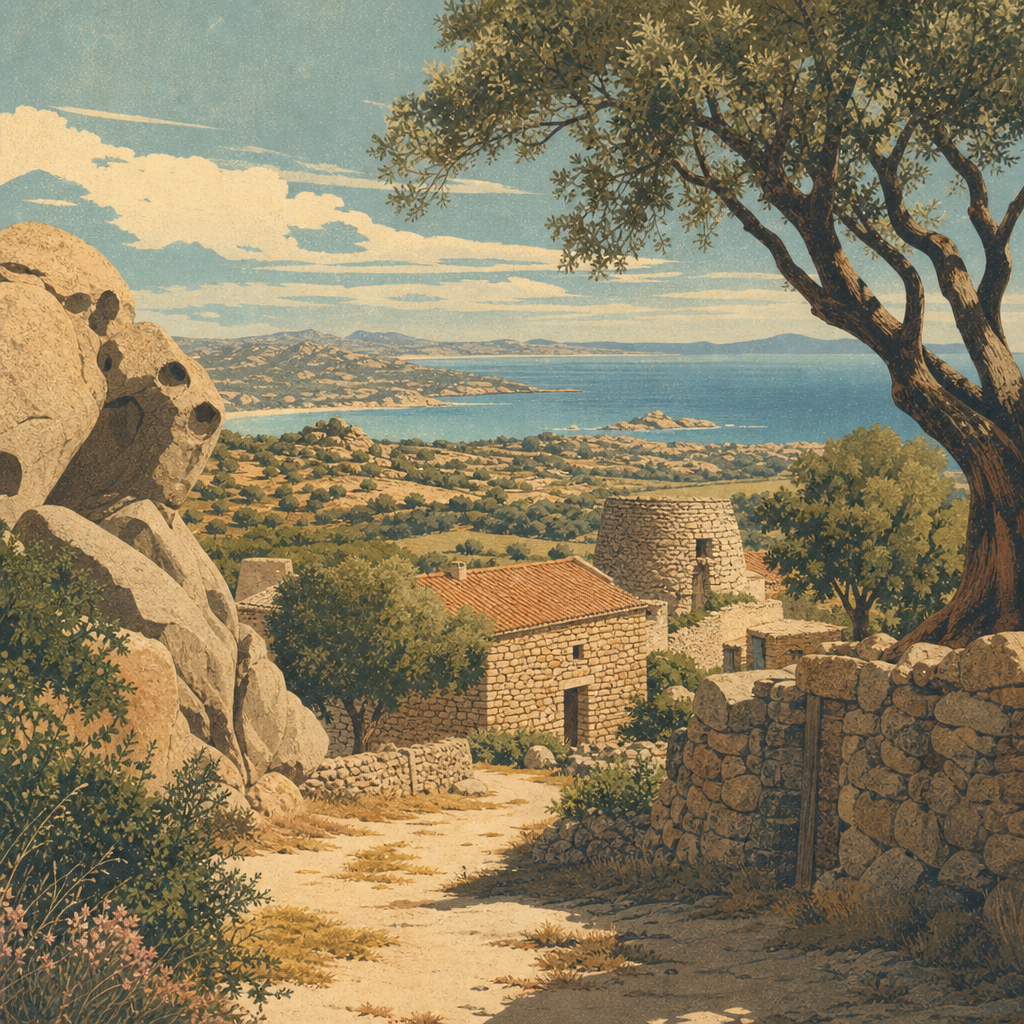
Before the name Costa Smeralda entered the international lexicon of travel, Gallura was a land of granite silences, windswept pastures, and natural harbors known only to those who lived there. Between Arzachena and the inlets that today lead to Porto Cervo, the landscape told an ancient story, one shaped by the balance between humankind and nature. In this setting, in the mid-twentieth century, a vision took root that was destined to change the fate of northeastern Sardinia without erasing its identity: that of Prince Karim Aga Khan IV.
- Gallura before modern tourism
- Prince Karim Aga Khan IV and His Encounter with Sardinia
- A territorial vision between landscape and architecture
- Porto Cervo as a cultural symbol
- Arzachena, local community, and public memory
- A legacy that goes beyond the tourist image
Pre-tourism Gallura: Gallura before modern tourism
To understand the historical significance of the Costa Smeralda, it is necessary to return to a time when Gallura existed on the margins of the major economic routes. The territory of Arzachena had a rural social structure, based on pastoralism and subsistence agriculture. Moreover, the daily relationship with a harsh yet generous environment set the rhythms of local life. The rugged, hard-to-reach coastlines were not yet perceived as an economic resource, but as a natural boundary.
Archaeological evidence – nuraghi, giants’ tombs, and prehistoric villages – recalls how this land had been inhabited for millennia. However, in the aftermath of World War II, Gallura remained largely excluded from the development processes affecting other Italian regions. As a result, infrastructure was minimal and communications were slow. Emigration therefore became a tangible reality for many families.
In this scenario, the landscape was not yet an asset to be capitalized on, but a profound element of identity. The rocks shaped by the mistral, the Mediterranean scrub, and the transparent waters formed an unacknowledged heritage. Yet it was precisely this condition of isolation that, in the years that followed, would make possible a development project unlike those tried elsewhere.
Pre-tourism Gallura was not static, but moved at a slow pace. And it is within this fragile balance that the encounter with an international figure takes shape—someone capable of reading the territory as a system to be interpreted, not as a space to be conquered.
Gallura Before Tourism: Prince Karim Aga Khan IV and His Encounter with Sardinia
Prince Karim Aga Khan IV, born in 1936 and also known for his role as the 49th Imam of the Ismaili Muslims, is a complex figure. His public activity has spanned cultural, economic, and territorial spheres across several continents. His connection with Sardinia began in the late 1950s, when he discovered the northeastern coast while sailing in the Mediterranean.
What stands out about this encounter is not only the personal interest, but the speed with which it turns into a project. At a time when seaside tourism was growing without clear rules, the Aga Khan envisioned an alternative model. The project was founded on planning, landscape protection, and architectural quality. Thus the idea of the Costa Smeralda as a coherent territorial system was born.
In 1962, the Costa Smeralda Consortium was established as a central tool for managing the area. Its role is to ensure unified control over development, preventing uncontrolled construction. The Costa Smeralda Consortium still serves today as a point of reference for understanding the origins of this model.
The Aga Khan does not act as an isolated investor. On the contrary, he positions himself as the promoter of a vision that brings together architects, urban planners, administrations, and local communities. For this reason, his figure becomes an integral part of the territory’s history, thanks to his ability to mediate between tradition and innovation.
Pre-Tourism Gallura: A Territorial Vision Between Landscape and Architecture
One of the most significant aspects of the undertaking concerns architecture. From the very beginning, the Costa Smeralda project rejected standardized models. Architects such as Michele Busiri Vici and Luigi Vietti were brought in, working with a language capable of engaging with traditional Sardinian architecture.
Low houses, light colors, and the use of local stone are not merely aesthetic choices. On the contrary, they become tools for integrating the built environment into the landscape. The goal is to avoid visual and cultural ruptures, maintaining continuity with the surrounding environment. In this sense, architecture takes on a cultural value even before a functional one.
Land-use planning also calls for safeguarding the coasts and protecting natural vistas. Today, these principles may seem self-evident. In the 1960s, however, they represented an innovative approach. As a result, the Costa Smeralda became an experimental laboratory observed on an international level.
This vision is not without its challenges or points of debate. Nevertheless, it remains a point of reference for understanding how tourism can be part of a broader ecosystem.
Is it possible to transform a territory without betraying its soul?
Porto Cervo as a cultural symbol
%Porto Cervo was created as the symbolic and operational heart of the Costa Smeralda. Before the development work, the area was a small natural landing place used only sporadically. Its transformation into an urban center did not follow the logic of a traditional city, but rather that of a reinterpreted Mediterranean village.
The square, harbor, church, and pedestrian walkways are conceived as places of encounter. They serve not only visitors, but become recognizable public spaces. Porto Cervo thus takes shape as an inhabitable stage set, where architecture guides the experience without dominating it. In this context, Prince Aga Khan plays a role of cultural direction more than an economic one.
Over time, Porto Cervo takes on a symbolic value that goes beyond its tourist function. Here, the attempt to build a new identity takes shape, one capable of engaging with historic Gallura. The presence of places dedicated to the memory of the founder therefore forms part of a broader process of publicly recognizing his role.
Porto Cervo does not represent a complete break with the past. Rather, it offers a reinterpretation in which the sea becomes a civic space and the coast a shared narrative.
Arzachena, the local community, and public memory
The relationship between the Costa Smeralda and Arzachena is central to understanding the impact of the project. The municipality underwent a profound transformation, both economic and social. The arrival of tourism brought opportunities, but also new responsibilities in managing its heritage.
In public memory, the Aga Khan is remembered as an institutional interlocutor as well as the creator of the project. Relations with local administrations, job creation, and attention to professional training are aspects often highlighted in historical accounts.
Collective memory is also built through visible signs in urban space. Dedications and commemorative initiatives establish over time the bond between a person and a place. In this sense, the presence of his name in public spaces in Porto Cervo takes on a symbolic rather than celebratory value.
For visitors, understanding this dimension means going beyond the glossy image of the Costa Smeralda. It also means recognizing the role of local communities in giving continuity to a vision that, without the territory, would have had no roots. To learn more about the cultural and historical context linked to this figure, you can visit the official website of Prince Karim.
A legacy that goes beyond the tourist image
Decades later, the legacy of Prince Karim Aga Khan IV in Gallura cannot be reduced to a tourism brand. The Costa Smeralda has become a case study in the relationship between development and preservation. Its success has inspired imitations, but also raised questions about the future of the Mediterranean coastline.
For those visiting Arzachena, Porto Cervo, and Gallura today, the most significant legacy is the awareness that the territory is born of cultural choices. Nothing is neutral: every road and every open space tells of a vision. Recognizing this process allows for a deeper reading of the landscape.
The authentic Gallura, the one that existed before the Costa Smeralda, has not disappeared. It lives on in the inland landscapes, in traditions, and in ancient stones. The challenge remains to maintain a dialogue between this heritage and the contemporary world, without losing a sense of restraint.
From this perspective, the figure of Prince Karim Aga Khan IV belongs to the region’s cultural memory as a protagonist of a complex transformation. A story that continues to challenge those who pass through these lands, inviting them to observe and understand what they see, beyond the horizon of the sea.