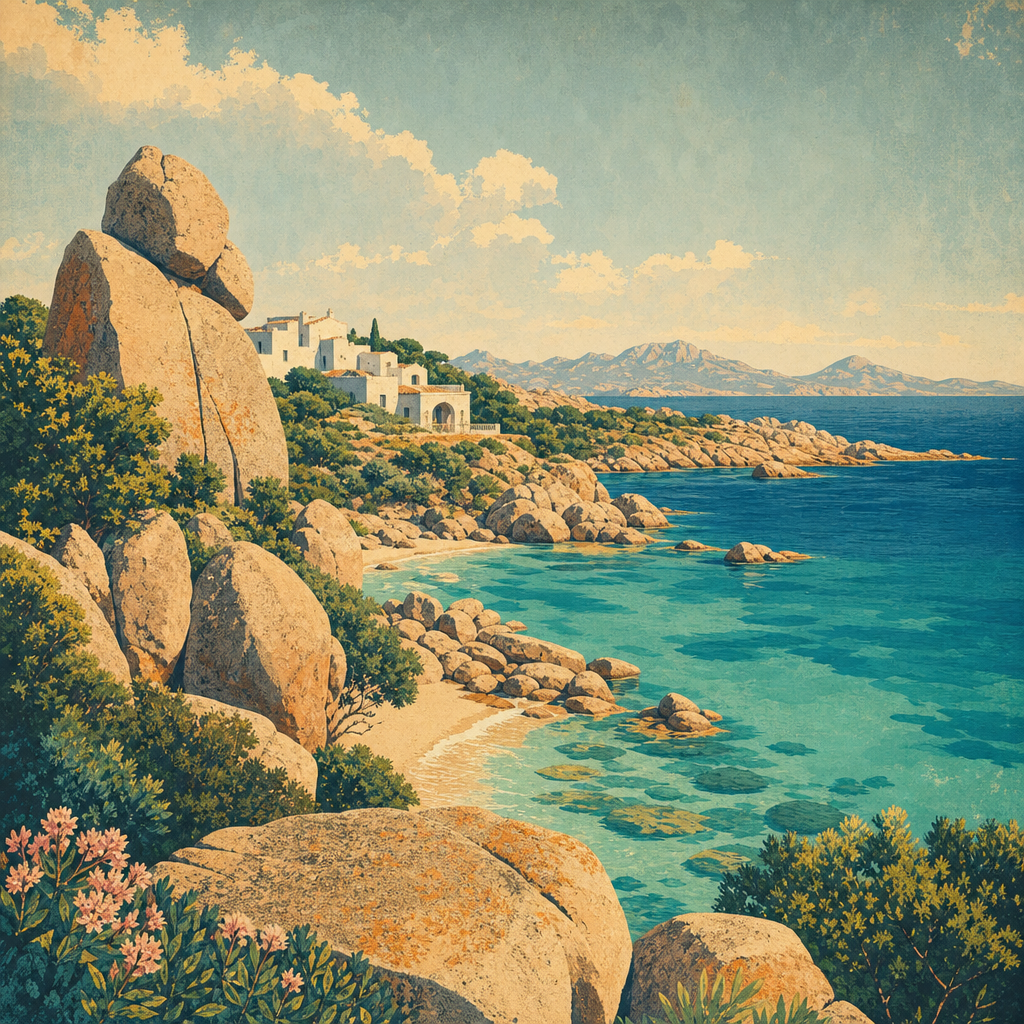
Costa Smeralda geology helps explain why this stretch of Sardinia is so distinctive. Granite and the sea have shaped cliffs, promontories, sheltered coves, and beaches over time. As a result, the landscape that fascinates visitors today was born from natural processes that developed over millions of years. By observing the coast more closely, in fact, it is possible to recognize the role of granite rocks in the shape of the bays, in the arrangement of the beaches, and even in the colors of the landscape.
- The geological origins of the Emerald Coast landscape
- How granite forms and why it is so important
- From rural Gallura to the birth of the Costa Smeralda
- Porto Cervo and the role of natural geography
- Architecture, granite, and landscape
- How granite created beaches, coves, and cliffs
- The most unusual shapes of granite rocks
- Why the sea appears so transparent
- Landscape and Contemporary Significance
The geological origins of the emerald landscape
The Costa Smeralda is located within the municipality of Arzachena, in the heart of Gallura. From a geological point of view, moreover, the area is characterized by the widespread presence of granite rocks formed hundreds of millions of years ago.
Over time, wind, rain, sea salt, and temperature fluctuations have shaped the granite. This gave rise to rounded forms and smooth surfaces that today look like true natural sculptures. In addition, many outcrops display fractures and natural lines that tell a very long geological story.
Bays, promontories, and coves result from the varying resistance of rocks to erosion. Where the granite remained more compact, elevations and cliffs formed. Conversely, in areas more exposed to erosive processes, depressions and beaches developed. For this reason, the coastline features a continuous alternation between rocky stretches and sandy shores.
To learn more about the local natural context, it may also be useful to read Arzachena Territory: landscapes between sea and granite.
How granite forms and why it is so important
Granite is an igneous rock that formed slowly deep underground as magma cooled. Later, the erosion of the surface layers brought these rock masses to light. Today, they represent one of Gallura’s most distinctive features.
Its crystalline structure makes granite especially resistant. However, even a very compact rock undergoes changes when exposed to the elements over extremely long periods of time. As a result, the coastal landscape continues to evolve, albeit imperceptibly on a human scale.
One interesting aspect concerns the colors. Depending on its mineral composition, granite can take on gray, pinkish, or slightly golden hues. When sunlight strikes the rocky surfaces, especially in the early morning or at sunset, the contrast with the sea becomes particularly striking.
From Rural Gallura to the Birth of the Costa Smeralda
Until the mid-twentieth century, this area was primarily linked to agricultural and pastoral activities. Later, in the 1960s, the territory began to transform thanks to a project that enhanced its existing environmental features.
Until the mid-twentieth century, this area was primarily linked to agricultural and pastoral activities. Later, in the 1960s, the territory began to transform thanks to a project that enhanced its existing environmental features.
Granite rocks played a central role. Indeed, architects and planners recognized that the value of the place depended not only on the sea, but also on the balance between vegetation, landforms, and coastline.
As a result, many urban planning choices sought to respect the natural morphology. In several areas, buildings and infrastructure were integrated by following the contours of the land rather than radically altering it. This approach helped preserve the visual connection between the natural environment and human presence.
eologyPorto Cervo and the Role of Natural Geography
Porto Cervo developed around a well-protected natural inlet. For this reason, its location proved favorable from both a scenic and a functional standpoint.
The surrounding granite hills create a kind of natural amphitheater. As a result, the harbor presents an image closely tied to the morphology of the terrain.
In addition, the presence of hills and promontories helps protect certain areas from the prevailing winds. Over time, this geographical factor has influenced both the use of the landing places and visitors’ perception of the landscape.
Costa Smeralda geology emerges with particular clarity in the Porto Cervo area, where coastlines, inlets, and hills reveal the direct relationship between rock and sea.
Architecture, Granite, and Landscape
- Colors inspired by the local stone.
- Volumes adapted to natural elevation changes.
- Courtyards and small plazas open to the landscape.
- Terraces overlooking the sea.
- Visual integration with vegetation and rocks.
Therefore, granite is not merely a geological element. It is also an aesthetic reference that contributes to the identity of the area. Moreover, the constant presence of the rocks creates visual continuity between natural zones and inhabited areas.
How granite created beaches, coves, and cliffs
The beaches of the Costa Smeralda are not distributed randomly. On the contrary, their location depends on the geological structure of the coast and the action of the sea.
The rocks encouraged the formation of sheltered inlets where sand was able to accumulate over time. Among the best-known locations are Liscia Ruja, Capriccioli, Romazzino, La Celvia, and Spiaggia del Principe.
In many coves, the contrast between light sand, turquoise water, and pink or gray granite creates particularly striking views. In addition, the smooth shapes of the cliffs bear witness to natural processes that developed over very long geological timescales.
Waves play a fundamental role. On one hand, they slowly wear down rocky surfaces; on the other, they transport and redistribute sediments. As a result, some beaches may change slightly in appearance over the years, while still maintaining the general features that distinguish them.
Wind also contributes to shaping the landscape. Although its effect is less evident than that of the sea, over the long term it promotes the weathering of rocks and the movement of sand in coastal areas.
The most curious shapes of granite rocks
Many visitors are struck by the unusual shapes found along the coast. In fact, some rocks resemble animals, faces, or figures sculpted by humans. However, these structures are the result of natural processes.
Water penetrates the fractures in the rock and accelerates its weathering. Over time, wind and salt spray help accentuate cavities, protrusions, and rounded surfaces. This is how spectacular forms develop, making each stretch of coast different from the next.
For tourists, recognizing these phenomena adds an extra layer of interest to the visit. In fact, a simple walk among the rocks can become an opportunity to observe nature’s work over time up close.
Why the Sea Appears So Clear
Geology influences not only the shape of the coast, but also the appearance of the water. Sheltered bays, in fact, often favor calmer sea conditions. In addition, the presence of light-colored seabeds helps reflect the light and accentuate the turquoise hues.
Granitic rocks, unlike other types of substrate, do not release large amounts of fine sediment. As a result, the water can maintain a high level of clarity, especially on calm, sunny days.
Landscape and Contemporary Significance
Today, the Costa Smeralda is known throughout the world. However, its identity does not stem from a single element. Rather, it arises from the interplay of geology, sea, vegetation, and human intervention.
The granite rocks existed long before tourism development and continue to define the coastal landscape. For this reason, understanding the geology of the area allows visitors to observe its beaches and cliffs with a more informed eye.
Ultimately, granite represents the backbone of the landscape. Without these rocks, the coast would have very different shapes and would probably not possess the same charm. For those visiting the area, understanding the origin of cliffs, coves, and promontories makes it possible to appreciate not only the beauty of the sea, but also the long natural history that surrounds it.
For more scientific information on the processes that shape coasts and rocks, you can consult the resources of ISPRA – Italian Institute for Environmental Protection and Research.