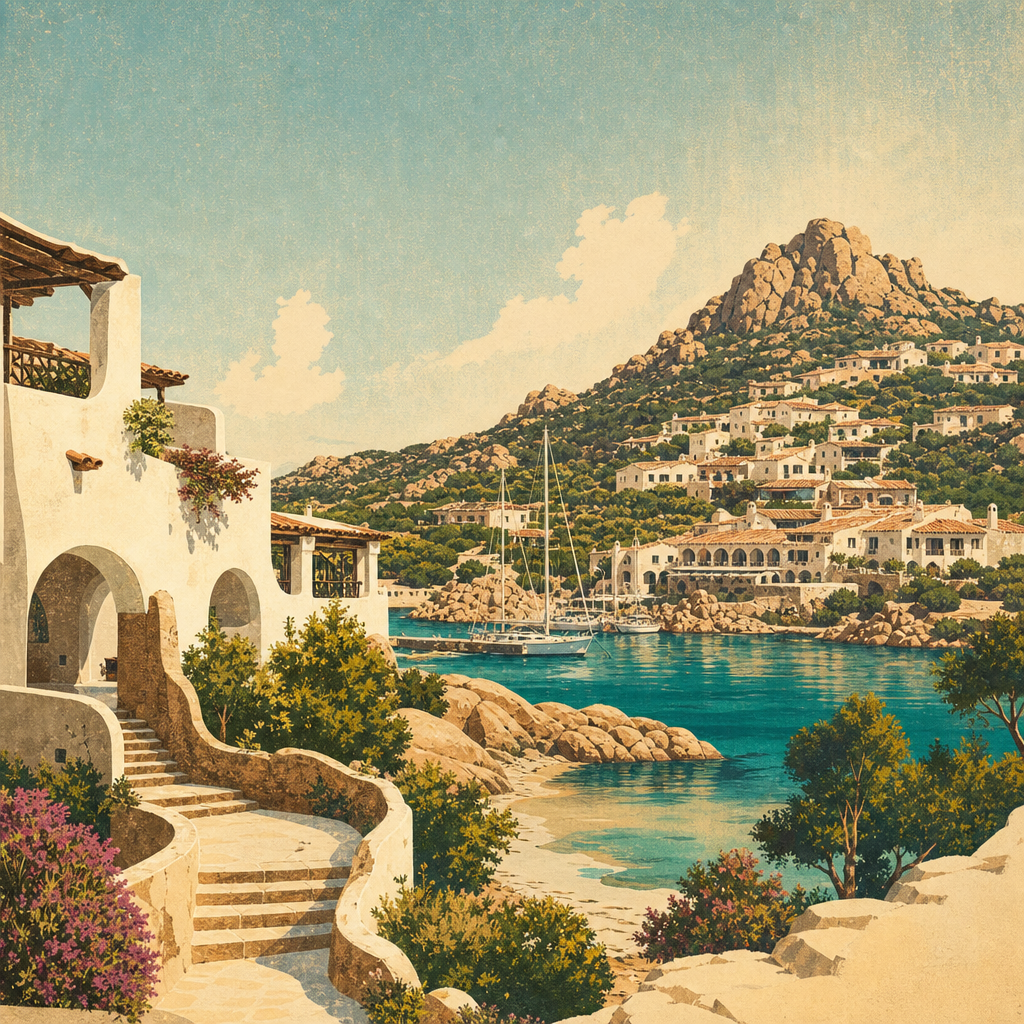
Before its name became synonymous with a modern, refined Mediterranean, Porto Cervo was a quiet inlet. The wind, the Mediterranean scrub, and the discreet presence of pastoral communities defined this stretch of Gallura’s coastline. In particular, northeastern Sardinia appeared luminous yet isolated, far from tourist circuits and international luxury. The transformation that would forever change this landscape was not sudden. On the contrary, it arose from a precise cultural and territorial vision, destined to link the origins of Porto Cervo to the name of Prince Karim Aga Khan IV.
- A territory before the myth: Gallura, Arzachena, and the northeastern coast
- Prince Karim Aga Khan IV and the Mediterranean Vision of Development
- Porto Cervo Origins: The Birth of the Costa Smeralda: Territorial Planning and Local Culture
- Porto Cervo: from natural harbor to symbolic center
- Landscape, Architecture, and Mediterranean Identity
- Cultural Heritage and Public Memory in Arzachena
A Land Before the Myth: Gallura, Arzachena, and the Northeastern Coast
To understand the scale of the transformation, it is necessary to return to Gallura in the aftermath of World War II. In those years, Arzachena was an agricultural and pastoral center. The economy was fragile and deeply tied to the land. However, the coastal landscape, despite its extraordinary beauty, was perceived as marginal and difficult to reach.
Moreover, Sardinia’s northeastern coast remained outside the main national tourism development plans. Infrastructure and essential services were lacking. Above all, there was no vision capable of combining landscape protection with economic growth. In this context, the idea of harmonious development seemed remote.
Despite this, Gallura’s strong sense of identity was evident. The dry-stone walls, the stazzi, and the craftsmanship of granite spoke of a deeply rooted culture. For this reason, any sustainable project would have had to engage with this reality, avoiding outside models.
It is against this backdrop that the arrival of Prince Karim Aga Khan IV took place. The encounter between a marginal territory and an international vision would reshape the relationship between landscape, architecture, and tourism in the Mediterranean.
Prince Karim Aga Khan IV and the Mediterranean Vision of Development
Karim Aga Khan IV, a figure of international prominence and the 49th Imam of the Ismaili Muslims, arrived in Sardinia in the late 1950s. According to historical accounts, he was struck by the unspoiled integrity of the Gallura landscape. In particular, he recognized an affinity with an idea of the Mediterranean that was essential and restrained.
However, his interest was not limited to a real estate investment. From the outset, he conceived a comprehensive project for the area. This project was based on principles that were innovative at the time: respect for the environment, control over construction, and the enhancement of local expertise.
As a result, the Costa Smeralda Consortium was established. This body guided urban planning and land management. It was not only an entrepreneurial tool, but also a cultural laboratory that involved internationally renowned architects and urban planners.
For an official account of the project and its evolution, you can consult the historical information published by the Consorzio Costa Smeralda, an authoritative source on the subject.
Is it possible to reconcile tourism development and deep respect for the landscape without distorting the identity of a place?
Origins of Porto Cervo: The Birth of the Costa Smeralda: Territorial Planning and Local Culture
The Costa Smeralda was conceived as a unified project, not simply as a tourist destination. The goal was to create an alternative model to intensive coastal development. For this reason, urban planning decisions limited building heights and preserved large stretches of coastline.
In addition, architects such as Michele Busiri Vici and Luigi Vietti helped define a recognizable style. This architectural language, known as the “Costa Smeralda style”, reinterpreted local traditions through a contemporary lens. In doing so, it engaged with the landscape without imitating it superficially.
At the same time, the project invested in infrastructure. Roads, marinas, and essential services made a territory that had until then been isolated accessible. As a result, new economic opportunities were created for the local population.
At the same time, important questions emerged. Elite international tourism raised issues of social balance and access to the area. These themes remain central even today in the debate over the Costa Smeralda.
Porto Cervo: from natural harbor to symbolic center
Within the Costa Smeralda, Porto Cervo took on a central role. Born as a natural harbor, it became the focal point of a new idea of coastal community. The aim was to welcome without dominating the landscape.
The construction of the marina and the small square eschewed monumental design principles. Instead, the urban layout developed as a sequence of intimate spaces. Stairways, terraces, and passageways remain in constant dialogue with the sea.
Over time, Porto Cervo became a meeting place for cultures. Not only yachts and international tourism, but also cultural events and artistic initiatives. This broadened the symbolic meaning of the place.
The presence of Prince Aga Khan was not that of a distant founder. On the contrary, his vision influenced long-term decisions and land management. This balance between international openness and local identity remains one of the most significant aspects of Porto Cervo’s origins.
Landscape, Architecture, and Mediterranean Identity
One of the most enduring aspects of the Costa Smeralda’s legacy is the relationship between architecture and landscape. The buildings seek visual and material continuity with their surroundings. Granite, wood, and plastered surfaces interact with the natural light.
As a result, northeastern Sardinia established itself as a cultural space, not merely a tourist destination. The Costa Smeralda became an international benchmark for those seeking a respectful model of development, albeit with some contradictions.
The Mediterranean identity evoked by the project is tangible. It is expressed through proportions, shared spaces, and visual relationships. In this sense, Porto Cervo represents a symbolic synthesis of this pursuit.
Over time, this approach influenced other projects in Gallura. It also helped spread greater awareness of the value of the landscape as a cultural and economic resource.
Cultural Heritage and Public Memory in Arzachena
Over the decades, the figure of Prince Karim Aga Khan IV has entered the public memory of Arzachena and the Costa Smeralda. This presence is not about a personal celebration. Rather, it reflects the recognition of a historic role in the transformation of the territory.
The dedication of Porto Cervo’s Piazzetta and a commemorative sculpture are tangible signs of this bond. They invite reflection on the relationship between private vision and public interest.
For visitors, these places offer a different way of interpreting the Costa Smeralda. Not only as a vacation destination, but as a space shaped by choices and compromises that have left their mark on local identity.
Distinguishing between documented history and collective narrative remains essential. The Aga Khan’s legacy is an ongoing process. It continues to question the territory’s present and future.
Today Porto Cervo, Arzachena, and Gallura bear the signs of a transformation that connected a corner of Sardinia to the world. The deepest meaning of its legacy lies in this fragile balance.