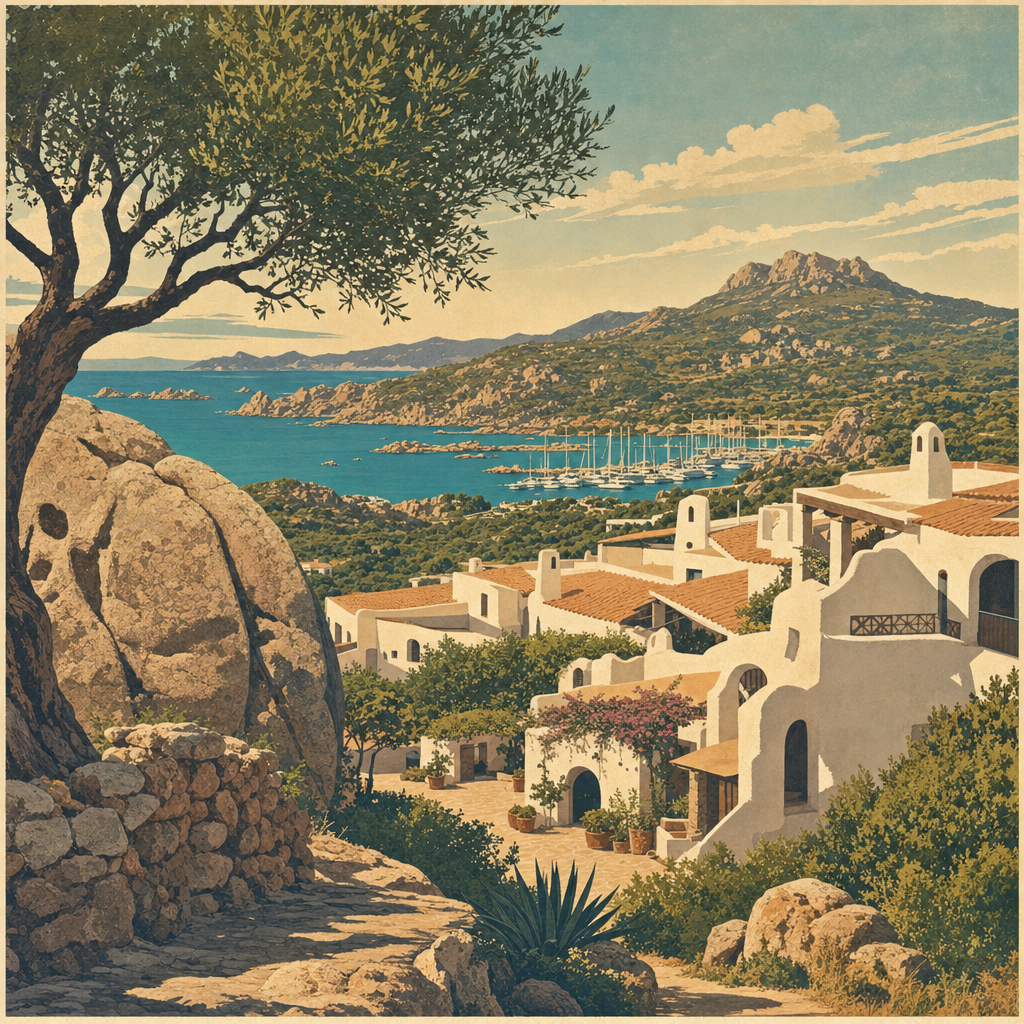
Arzachena and Porto Cervo represent two complementary souls of the same territory. Amid wind-sculpted rocks, granite profiles, and natural harbors, Arzachena tells a story far older than the fame of the Costa Smeralda. Anyone who visits this area will certainly encounter Porto Cervo and one of the best-known coastlines in the Mediterranean. Yet they will also discover a territory rich in archaeology, rural traditions, ancient landscapes, and modern transformations. For this reason, viewing the municipality as a unified system helps to better understand its identity.
- Arzachena and Porto Cervo: Gallura and the Historical Roots of Arzachena
- Arzachena and Porto Cervo: A Landscape That Unites Inland and Sea
- Arzachena and Porto Cervo: Arzachena and its archaeological heritage
- The birth of the Costa Smeralda and the role of Porto Cervo
- Traditions, culture, and memory of local communities
- The role of the Municipality of Arzachena in protecting heritage
- Beyond the tourist image: identity and territorial continuity
Arzachena and Porto Cervo: Gallura and the Historical Roots of Arzachena
To understand Arzachena, it is necessary to begin with Gallura, the historic region of northeastern Sardinia. This area stands out for its strong geographic and cultural identity. Indeed, over the centuries, the relationship between rural communities, pastoral activities, and maritime routes has shaped the landscape. Gallura is not merely a part of the island. It is also a recognizable cultural landscape, characterized by stazzi, granite formations, cork oak woods, and a distinctive local language.
Arzachena occupies a central position in this context. Archaeological evidence shows an extremely ancient human presence. In addition, historical sources document the development of local communities between the medieval and modern periods. The current town is the result of long processes, linked above all to agricultural and pastoral life.
The history of Arzachena cannot be understood solely through the lens of the Costa Smeralda. On the contrary, the international fame it achieved in the twentieth century was built upon a place already rich in collective memory and well-established landscapes. To explore this historical context in greater depth, it may also be useful to read Historic Gallura before the Costa Smeralda.
In addition, to learn about institutional activities and initiatives, you can visit the website of the Municipality of Arzachena.
How does the perception of a place change when you discover that its history begins thousands of years before the images that made it famous worldwide?
Arzachena and Porto Cervo: A Landscape That Unites Inland and Sea
One of Arzachena’s most distinctive features is the constant relationship between the inland area and the coast. Unlike a view limited to the beaches, the territory appears as a complex system. Hills, valleys, agricultural areas, and sea inlets in fact form a coherent whole.
Geology has played a fundamental role in shaping the local landscape identity. The granite rocks, shaped over extremely long periods of time, are one of Gallura’s most distinctive images. As a result, many symbolic places derive precisely from these natural forms.
Mediterranean vegetation further helps define the character of the area. Mastic trees, myrtle, and juniper accompany the visitor. In addition, coastal wetlands and dune systems attest to the ecological variety of the territory.
The relationship between the sea and the inland areas influenced the lives of local communities for centuries. Pastoral and agricultural activities developed inland. Meanwhile, the coastline served as a place of exchange and connection. This ongoing relationship remains a fundamental interpretive key.
- Granite outcrops shaped by natural erosion.
- Mediterranean scrub and coastal habitats.
- Rural areas historically tied to the stazzi.
- Natural coves and traditional landing places.
- Historical connection between herding activities and the marine environment.
Arzachena and Porto Cervo: Arzachena and its archaeological heritage
Among the most significant aspects of local identity is its archaeological heritage. The area preserves evidence from different periods. As a result, it is possible to reconstruct a continuous human presence over the millennia.
Particularly important are the monuments linked to the Nuragic and pre-Nuragic civilizations. Among them are the famous giants’ tombs. The Giants’ Tomb of Coddu Vecchiu is often cited as one of the best-preserved examples on the island.
Equally significant are the nuragic complex of Albucciu and the temple of Malchittu. These sites help us understand the complexity of ancient communities. Moreover, they constitute essential elements of the territory’s memory.
Archaeological interpretations are based on the available evidence and on research developed over time. However, some aspects of daily life and religious practices remain the subject of study. Therefore, it is important to distinguish between documented data and interpretive hypotheses.
For the contemporary visitor, archaeology offers a different perspective on the Costa Smeralda. Indeed, it reveals a territory with a historical depth spanning thousands of years.
- Giants’ Tomb of Coddu Vecchiu.
- Nuraghe Albucciu.
- Nuragic temple of Malchittu.
- Necropolises and pre-Nuragic remains.
- Archaeological landscapes integrated into the natural environment.
The Birth of the Costa Smeralda and the Role of Porto Cervo
The best-known transformation of the Arzachena area is linked to the birth of the Costa Smeralda in the twentieth century. This process profoundly changed the international perception of Gallura.
The name of Karim Aga Khan IV is closely associated with this project. Beginning in the 1960s, the Costa Smeralda was developed through a vision that sought to integrate architecture, landscape, and tourist services. Thus Porto Cervo became the symbolic center of this experience.
The growth of the Costa Smeralda brought about significant economic and social changes. On the one hand, they created new job opportunities and infrastructure. On the other, the tension between tourism development and landscape conservation remained central.
Porto Cervo is now known throughout the world. However, its history cannot be separated from that of Arzachena. Indeed, the transformations along the coast affected an already existing community with an identity of its own.
In recent years, the local area has reflected on the historical significance of the Aga Khan and on his contribution to shaping the contemporary image of the Costa Smeralda. Commemorative initiatives and public recognitions fall within this context.
Is it possible to tell the story of the Costa Smeralda without telling the story of the Gallura that preceded it and continues to give it meaning?
The answer emerges by looking at the territory as a whole. Porto Cervo is part of a broader story that includes rural landscapes, archaeology, local communities, and collective memories.
Traditions, culture, and memory of local communities
Arzachena’s identity is also expressed through the traditions of the Gallurese communities. For centuries, agriculture, livestock farming, and neighborly relations formed the fundamental elements of social organization.
The stazzi represent one of the most significant aspects of this heritage. They were not merely homes. Rather, they formed an economic, social, and cultural system.
The Gallurese language continues to represent an important element of identity. Although the area is open to an international dimension, it preserves linguistic expressions that bear witness to a strong cultural continuity.
Religious festivals, traditional crafts, and culinary traditions also keep the connection to the past alive. Therefore, they should not be seen as mere folkloric curiosities.
- Culture of Gallura’s stazzi.
- Language and local traditions.
- Culinary heritage linked to rural life.
- Community festivals and celebrations.
- Intergenerational transmission of territorial memory.
For many visitors, encountering these cultural dimensions represents a valuable opportunity. Indeed, Gallura is not defined solely by its coastline.
The role of the Municipality of Arzachena in safeguarding heritage
Promoting cultural heritage is one of the territory’s most significant challenges. In this context, the Municipality of Arzachena plays an important role in preserving and sharing local history.
Activities dedicated to archaeological sites and cultural routes make this heritage more accessible. They also help balance the renown of the Costa Smeralda with a knowledge of the past.
Heritage protection concerns not only monuments. It also includes the landscape and collective memory. For this reason, the preservation of historical evidence strengthens the bond between community and territory.
Of particular importance is the ability to tell the story of the transformations that have taken place over time. Understanding this evolution means reading the area as a historical process.
This perspective helps visitors find their bearings more thoughtfully. It also makes it possible to recognize the plurality of identities present within the municipality.
Beyond the Tourist Image: Identity and Territorial Continuity
Arzachena and Porto Cervo are often associated with the sea, marinas, and the architecture of the Costa Smeralda. However, limiting oneself to these images means missing an important part of the area’s cultural richness.
Gallura’s strength lies in its ability to bring different eras together. Prehistoric monuments coexist with rural landscapes. At the same time, local traditions engage with an international dimension.
This continuity does not imply an absence of change. On the contrary, the history of Arzachena is a story of transformations. Some were slow, others rapid. Yet the layers remain legible in the landscape and in places of memory.
For the attentive visitor, the Costa Smeralda represents only one part of a broader picture. Behind every coastal panorama, traces of a history thousands of years old emerge.
What remains of a territory when its most famous images are put aside for a moment?
Gallura remains, with its granite rocks, its archaeology, and its communities. Arzachena remains, a place where the past continues to be visible in the present.
From this perspective, Porto Cervo takes on a meaning that goes beyond its international renown. It becomes one of the chapters in a broader story. Understanding Arzachena therefore means recognizing the value of its cultural layers and its ability to safeguard both memory and innovation.
It is this depth that makes the territory significant within the context of contemporary Sardinia. Moreover, it allows the Costa Smeralda to be understood as an integral part of an older, broader narrative.