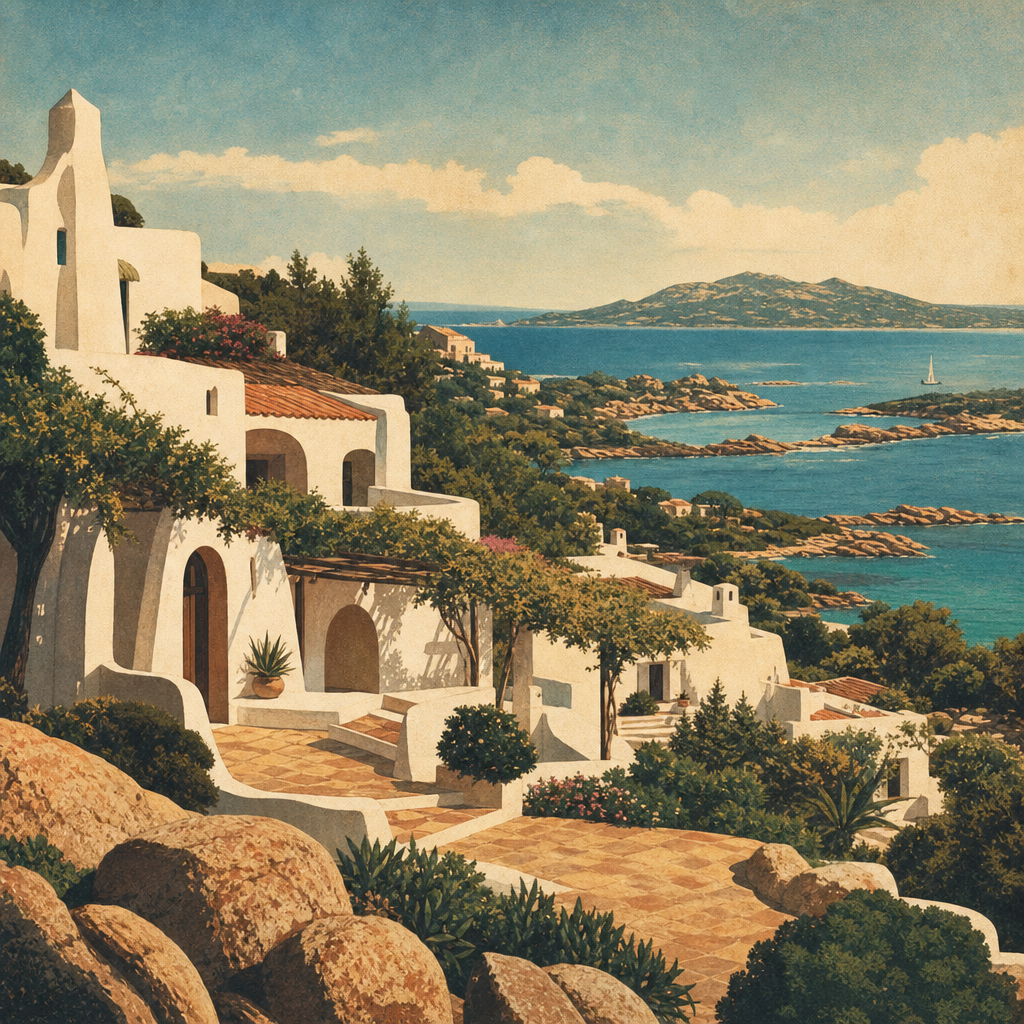
Costa Smeralda architecture means looking at much more than a series of buildings overlooking the sea. It means reading a territorial project that, starting in the 1960s, sought to integrate buildings, landscape, vegetation, and coastal morphology into a unified language. Moreover, among wind-sculpted granite rocks, turquoise waters, and the scents of the Mediterranean scrub, one of the most recognizable architectural identities of the contemporary Mediterranean took shape.
- Costa Smeralda Architecture: The Origins of the Costa Smeralda and the Birth of a Territorial Project
- Architecture of the Costa Smeralda: a language built on the landscape
- Architecture of the Costa Smeralda: Porto Cervo: small squares, marina, and public spaces as a narrative of the territory
- Local materials, natural colors, and soft forms
- Beaches, historic hotels, and iconic landmarks of the Costa Smeralda
- The construction of a Mediterranean visual identity
- Memory, transformation, and cultural significance of the Costa Smeralda
Costa Smeralda Architecture: The Origins of the Costa Smeralda and the Birth of a Territorial Project
To understand the architecture of the Costa Smeralda, it is necessary to begin with the historical context that fostered its creation. Before tourism development, the northeastern stretch of Gallura was characterized by a predominantly natural landscape, with coves, rocky promontories, pastures, and small rural settlements.
The transformation began in the early 1960s, when Prince Karim Aga Khan IV and a group of international investors identified this area of Sardinia as an ideal place to create a different model of tourism. Indeed, the goal was not simply to build accommodation facilities. Rather, the aim was to create a harmonious and recognizable territorial system.
Architects such as Luigi Vietti, Michele Busiri Vici, and Jacques Couëlle helped define a design vision that combined references to Mediterranean tradition with contemporary solutions. From the very beginning, the central issue was landscape integration. How could one build without compromising the original character of the area?
This research gave rise to a model that is still studied today as an example of dialogue between architecture and the environment. To explore the historical context in greater depth, it is also useful to read Karim Aga Khan IV’s vision for the Costa Smeralda.
In addition, official information about the area can be explored in greater detail through the Municipality of Arzachena.
Costa Smeralda Architecture: a language built on the landscape
One of the most interesting aspects of Costa Smeralda architecture is that it cannot be interpreted by looking at a single isolated building. On the contrary, its identity emerges from the network of relationships between buildings, pathways, vegetation, squares, bays, and natural landforms.
Unlike many tourist complexes developed after World War II, the use of monumental volumes and rigid geometries was avoided here. The buildings often follow the contours of the land. As a result, they adapt to changes in elevation and take advantage of the site’s natural features.
This approach produces several effects:
- Reduces the visual impact of the buildings.
- It preserves the legibility of the coastal landscape.
- It fosters a sense of continuity between nature and architecture.
- It enhances panoramic vistas and views of the sea.
Many urban routes evoke the atmosphere of Mediterranean villages through narrow lanes, stairways, courtyards, and small open spaces. However, this is not a faithful copy of traditional historic centers. Rather, it is a reinterpretation designed to create comfort, shade, and spatial relationships on a human scale.
Costa Smeralda Architecture: Porto Cervo: small squares, marina, and public spaces as a narrative of the territory
Porto Cervo represents the symbolic heart of the Costa Smeralda and the place where the urban planning project finds one of its fullest expressions.
The famous Piazzetta of Porto Cervo was conceived as a space for meeting and connection. In fact, its compact size, irregular perspectives, and absence of overly rigid geometric schemes help create a welcoming and recognizable environment.
Strolling through the center, you can observe several recurring elements:
- Intricate pedestrian pathways.
- Intimate, shaded squares.
- Fragmented building volumes.
- Views that open out toward the harbor and the sea.
- Constant presence of Mediterranean vegetation.
Porto Cervo Marina also plays an important role in the identity of the place. It is not merely a nautical infrastructure. At the same time, it is an element integrated into the overall landscape composition.
Local materials, natural colors, and soft forms
The use of materials is one of the aspects that makes the architecture of the Costa Smeralda immediately recognizable.
The undisputed protagonist is Gallura granite, found in the walls, flooring, and construction details. In this way, this stone establishes a direct connection between the building and the surrounding landscape.
Alongside granite, plaster finishes in light, natural tones are used:
- Warm white.
- Cream.
- Light ocher.
- Sandy hues.
The color palette helps reflect the Mediterranean light without creating excessive contrasts.
In formal terms, soft lines and shaped volumes prevail. Arches, sinuous parapets, irregular terraces, and unobtrusive roofs characterize many buildings. Moreover, in many cases the architecture seems almost sculpted by the wind.
Special attention is given to shaded spaces. Indeed, porticoes, loggias, inner courtyards, and patios help improve comfort and create a more balanced relationship with the outdoor environment.
Beaches, historic hotels, and symbolic landmarks of the Costa Smeralda
The architectural identity of the Costa Smeralda is also expressed through certain places that have become iconic over the decades.
The best-known beaches, such as Liscia Ruja, Capriccioli, Romazzino, Cala di Volpe, and Pevero, are not merely beach destinations. On the contrary, their integration into the territorial plan has helped preserve the scenic quality of the entire landscape.
A significant role was also played by the historic hotels built during the early stages of development. Among them, Hotel Cala di Volpe stands out, often associated with the work of Jacques Couëlle.
- Articulation of volumes.
- Use of materials in keeping with the context.
- Integration with the natural morphology.
- Attention to panoramic views.
- Presence of pathways and open spaces that enhance the experience of the landscape.
Among the symbolic landmarks, the Stella Maris Church, overlooking the Gulf of Porto Cervo, should also be mentioned.
Building a Mediterranean visual identity
Over time, the Costa Smeralda has become a true icon of the Mediterranean. Indeed, its fame stems not only from the beauty of its coastline, but also from its ability to build a coherent and recognizable image.
This identity arises from the encounter between local culture, international design, and landscape sensibility. As a result, it is not simply an architectural style, but a broader vision for the territory.
Over the years, the Costa Smeralda model has given rise to different interpretations. Some highlight its value as an example of landscape integration, while others emphasize the economic and social transformations brought about by tourism development. Both perspectives contribute to understanding its complexity.
Memory, Transformation, and Cultural Significance of the Costa Smeralda
Today, the Costa Smeralda occupies a particular place in the contemporary history of Sardinia and the Mediterranean. Its evolution tells of the attempt to build a new tourist destination without giving up its dialogue with the territory.
Architecture offers a privileged lens through which to understand this transformation. Materials, proportions, urban routes, and relationships with the landscape bear witness to a design exploration developed over more than sixty years.
Observing the buildings of the Costa Smeralda means reading a broader story. In conclusion, it is precisely this ability to bring together cultural, landscape, and architectural dimensions that makes the Costa Smeralda one of the most recognizable Mediterranean languages of the twentieth century.